





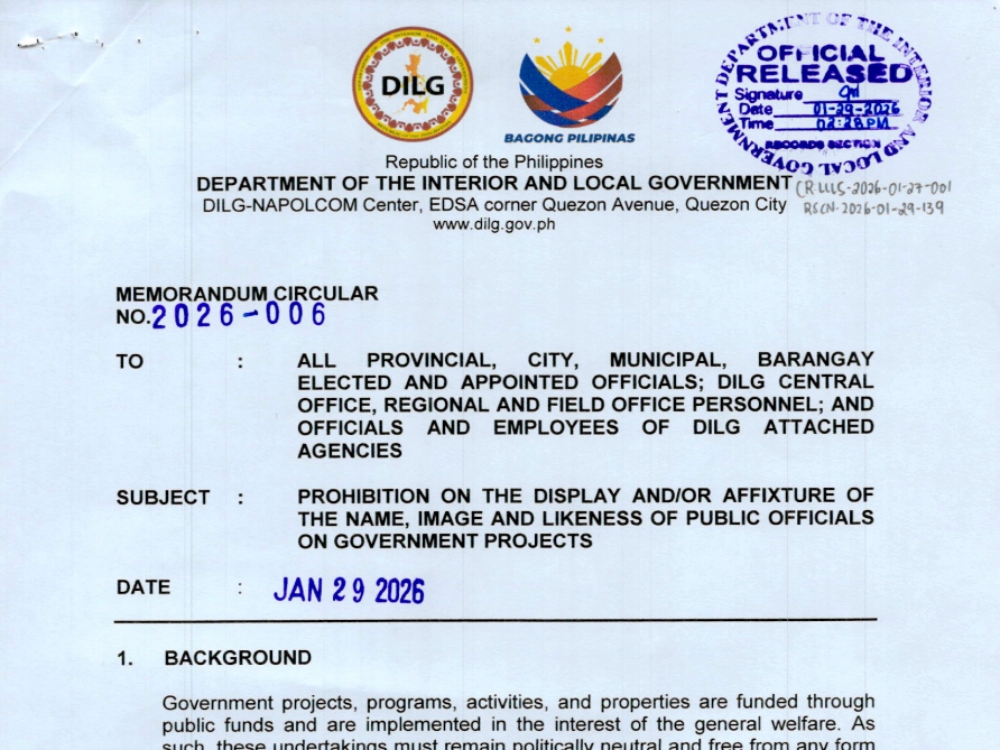
The Department of Interior and Local Government released and implemented Memorandum Circular No. 2026-006 aka Anti-Epal on January 29, directing all local government offices from the provincial level all the way down to the barangay level, to remove politicians’ names and other forms of branding from government projects.
So what does the policy say, and what does it cover?
In essence, the ‘anti-epal’ drive reminds, and enforces, what has time and again been pointed out by the common folk– that projects of the government are funded by the general public, and as such should NOT be perceived as, in DILG’s words, “personal initiatives of individual officials.”
The misguided perception, DILG believes, “may undermine public trust in the impartiality and professionalism of civil service.”
The memorandum argues that state-sanctioned programs are “funded through public funds, and are implemented in the interest of the general welfare,” and must “remain politically neutral and free from any form of self-promotion…”
COVERAGE
According to the memorandum, ALL provincial, city, municipal, and barangay elected and appointed officials are covered.
Also included are officials and employees of the following DILG-attached agencies:
Philippine National Police (PNP)
Bureau of Fire Protection (BFP)
Bureau of Jail and Management Penology (BJMP)
National Youth Commission (NYC)
Philippine Commission on Women
National Commission on Muslim Filipinos
Philippine Public Safety College
Local Government Academy
Early Childhood Care and Development Council
National Police Commission (NAPOLCOM)
DIRECTIVES
The memo orders public officials, in and all aforementioned entities, to remove existing signages and markers; and to “cause the widest dissemination” of the policy’s tenets in order to reach more people and ensure prolonged observance.
This means existing faces, names, and tag lines of politicians must be taken down or erased, while future projects must be spared from such ‘epal’ moves.
Any graphic representation that associates (and will associate) public officials to public initiatives are banned, and was ordered for full implementation immediately.
PENALTY?
As with any other policy, penalties and their strict, unbiased, and consistent implementation are pivotal.
DILG’s ‘anti-epal’ memo features a one-sentence statement as regards penalty, under Section 6. Penal Provisions.
It reads “Any person found violating this Memorandum Circular shall be held administratively and/or criminally liable in accordance with pertinent laws, rules, and regulations.”
While there was no direct mention of what sanctions and/or penalties await violators, it clearly stated that offenders shall be charged administratively and/or criminally, implying the existence of ramifications.
The memo made mention of five references under Section 2. Legal Bases. It referenced the 1987 Constitution Article XI Sec. 1; RA 6713 Sec. 2; RA 6713 Sec. 4(c); COA Circular No. 2014-004 (January 30, 2013) Sec. 2.2.6; and RA 12314 (2026 General Appropriations Act) Sec. 20.
Full details on DILG's anti-epal rule here.
NAGA AND PASIG
Even before DILG’s encompassing anti-epal campaign in early 2026, a few LGUs had already enacted their own anti-credit grabbing ordinances.
Naga City in Bicol— led by local chief and former VP of the Philippines Leni Robredo— signed into ordinance on November 18, 2025 the prohibition of affixing and installing politician’s names on public projects (Ordinance No. 2025-096).
Authored by City Councilor Hon. Allan Reiz C. Macariilg and City Youth Councilor Yuan Angelo P. Pacao, the policy aimed to “reinforce the principle that public office is a public trust” and to “prevent patronage politics.”
It states a P5,000-fine and/or a 30 to 180-day imprisonment, on top of having to shoulder all the costs of removing prohibited materials. s
Full details on Naga City’s anti-epal rule here.
Pasig City in the National Capital Region— led by mayor Vic Sotto— has been implementing an anti-epal mechanism for more than three years now through its Ordinance 20 S. of 2022, signed on August 18.
It directly described the traditional politics practice of putting names and branding on government projects as purposefully “claiming personal credit, misleading the public to believe that projects may have come from their own personal capacities, clearly contrary to law.”
Pasig’s ‘Anti-Epal Ordinance of 2022’ also has a P5,000-fine, along with imprisonment of no less than six (6) months.
Full details on Pasig City's anti-epal rule here.