






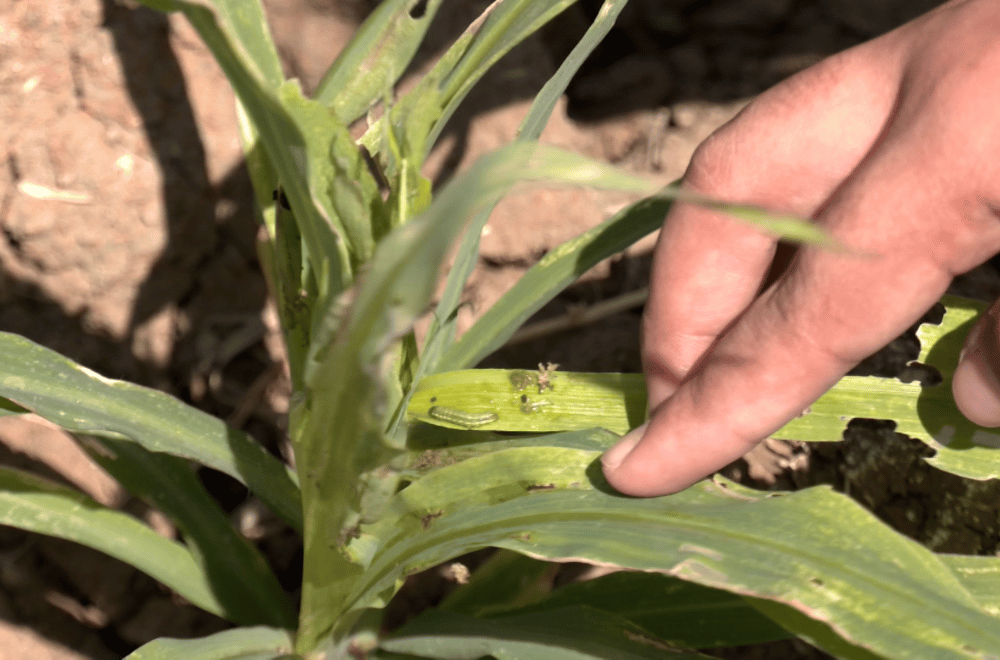
Corn farmers in Mangaldan, Pangasinan are battling an infestation of fall army worms that threatens crops at a critical stage of growth, causing the Department of Agriculture to introduce non-chemical pest control methods to limit damage.
Farmers began planting corn in January 2026 and by February, the crops had reached what agricultural experts describe as their most vulnerable growth stage. Inspections of several farms showed corn leaves being eaten by fall army worms, locally known as harabas, a pest that can cause severe losses if left unmanaged.
Aries Magat, station chief of the Pangasinan Research and Experiment Center, warned that the infestation poses a serious risk, especially to white corn.
“Problema ito pag hindi siya napuksa lalo na sa puting mais. Kaya niyang puksa-in yung around 70 percent. Ganun kataas kapag hindi siya ma-manage,” Magat said.
At one farm site, nearly all corn plants showed signs of infestation. In response, the Department of Agriculture Region 1, together with the Mangaldan local government, conducted a field day and technology transfer activity to train farmers on non-chemical approaches to pest control.
The program promotes the use of biochemical and natural methods instead of insecticides, which experts say can worsen resistance over time.
“Kapag nag-dwell ka sa mga paggamit ng chemical pesticides, mas lalong mahirap siyang puksa-in. Eh sa natural na environment niya, may mga natural enemies kasi o mga kaibigan talaga na puwedeng pumatay sa kanila,” Magat said.
Farmers who joined the demonstration like Jing de Guzman said the training gave them practical tools to protect their crops while reducing dependence on chemicals.
“Masaya rin ako na nandito kami sa demo para mapag-aralan at makita namin kung paano masubaybayan yung pagpapahalaga ng mais,” de Guzman said.
Agriculture officials said the same non-chemical methods have also proven effective in rice fields and vegetable farms. Farmers in Mangaldan expressed hope that the program will help reduce crop losses and improve yields as the growing season continues.