






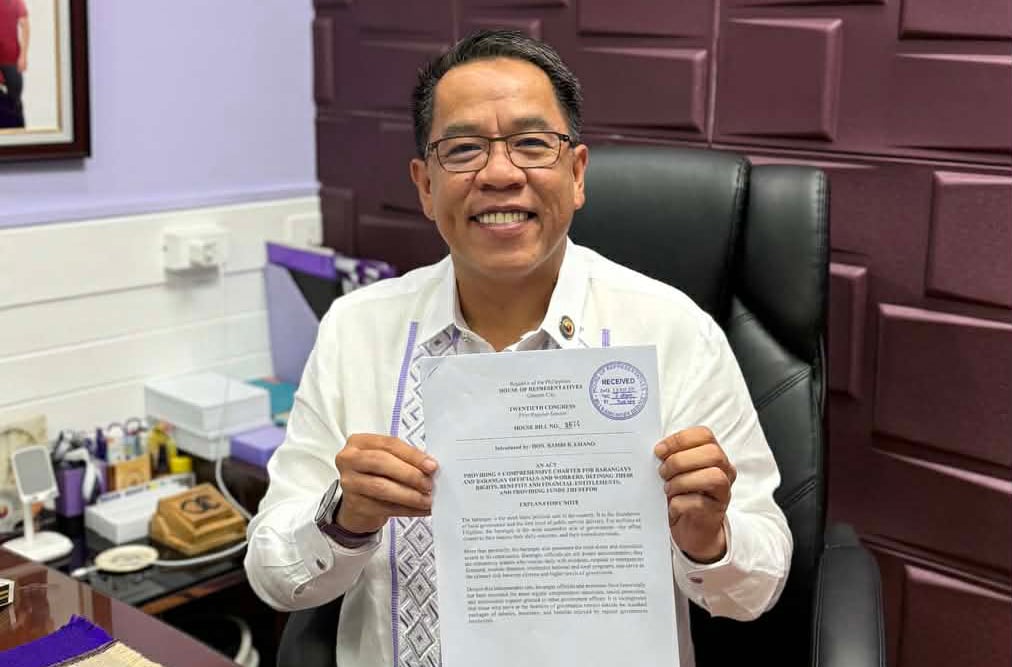
Misamis Oriental Second District Rep. Yevgeny Vincente Emano wants barangay officials and employees to get standard salaries and other benefits like other government workers.
Emano filed House Bill No. 8674 or the “Magna Carta for Barangays,” which aims to establish a comprehensive charter for barangays and barangay officials and workers, defining their rights, benefits, and financial entitlements.
Under the bill, barangay officials – chairperson, kagawad, Sangguniang Kabataan (SK) chairperson, secretary, treasurer, health workers, daycare workers, and tanods – will be recognized as term-based government personnel entitled to standardized compensation, allowances, insurance coverage, medical benefits, and retirement privileges in accordance with guidelines from the Civil Service Commission (CSC) and the Department of Budget and Management (DBM).
The bill outlines a four-tier salary grade system, wherein barangay health workers, daycare workers, and tanods may receive Salary Grade I (P135,30-P14,331 per month) while appointive officials such as secretaries, treasurers and nutritionists may receive Salary Grade II (P14,300 to P15,200 per month).
On the other hand, elective officials like kagawads and SK chairpersons may be assigned Salary Grade III (P15,200 to P16,000 per month) while barangay captains may receive Salary Grade IV (P16,000 to P16,900 per month).
The measure also proposes that barangay officials and workers be covered by the Government Service Insurance System (GSIS).
The bill also grants representation and transportation allowances for barangay chairpersons, hazard pay for those serving in calamity areas, and death and burial assistance for barangay personnel.
Emano said he was prompted to pass the bill as barangay officials and workers have not been accorded the same regular compensation structures, social protection, and institutional support granted to other government offices despite their indispensable roles.
“The barangay possesses the most direct and immediate access to its constituents. They are community leaders who interact daily with residents, respond to emergencies and serve as the primary link between citizens and higher levels of government,” Emano said.
“It is incongruous that those who serve at the frontline of governance remain outside the standard packages of salaries, insurance, and benefits enjoyed by regular government employees,” he added.