






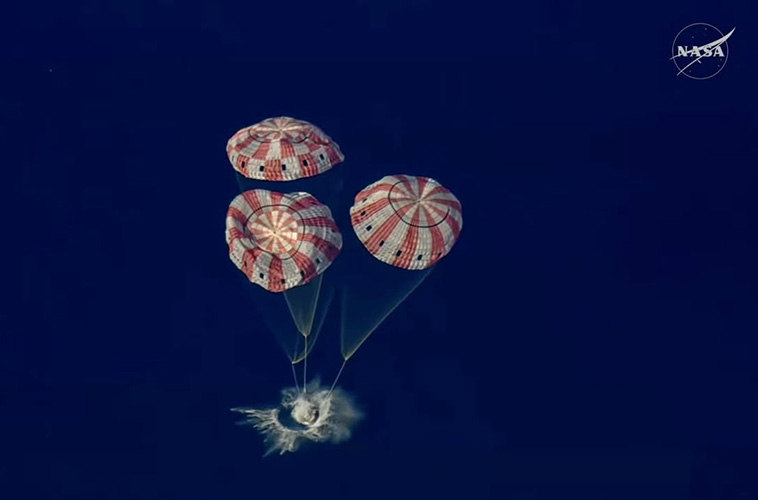
The crew of Artemis II crew returned to Earth on Saturday, April 11, 2026 after a record-breaking 10-day journey around the Moon.
The Artemis II crew capsule splashed down in the Pacific Ocean at around 8:07 a.m. (PH time), concluding the space mission.
“Welcome home Reid, Victor, Christina, and Jeremy! The NASA Artemis II astronauts have splashed down at 8:07 p.m. EDT (0007 UTC), bringing their historic 10-day mission around the Moon to an end,” reads a post of the National Aeronautics and Space Administration (NASA) on its Facebook page.
Hours before the return, NASA also paid homage to the men and women at its Mission Control “responsible for getting the astronauts around the Moon and safely home.”
“Behind the four astronauts of Artemis II are hundreds of people tracking their every move: monitoring spacecraft systems, evaluating crew safety, and staying in constant communication. The job requires sleepless nights and a level of teamwork that verges on a mind meld,” NASA’s Facebook post reads.
HISTORIC
The crew, composed of four astronauts, flew deeper into space than any human before them as they cruised through a rare flyby of the shadowed far side of the moon that revealed a lunar surface under cosmic bombardment, read an earlier report by Reuters.
The six-hour survey of the normally hidden hemisphere of Earth's only natural satellite was highlighted by the astronauts' direct visual observations of "impact flashes" from meteors pelting the darkened and heavily cratered lunar surface, the report read further.
The six-hour flyby, which swooped to within 4,070 miles of the lunar surface, came six days into a spaceflight, marking the world's first voyage of astronauts to the vicinity of the moon since NASA's Cold War-era Apollo missions more than half a century ago, the report said.
Six of those missions landed two-man teams on the moon between 1969 and 1972 - the only 12 humans ever to walk on its surface.
Artemis, a successor to the Apollo program, aims to repeat that achievement by 2028, ahead of China's first landing, and to establish a long-term US lunar presence over the next decade, including a moon base to serve as a proving ground for potential future missions to Mars, Reuters said.