






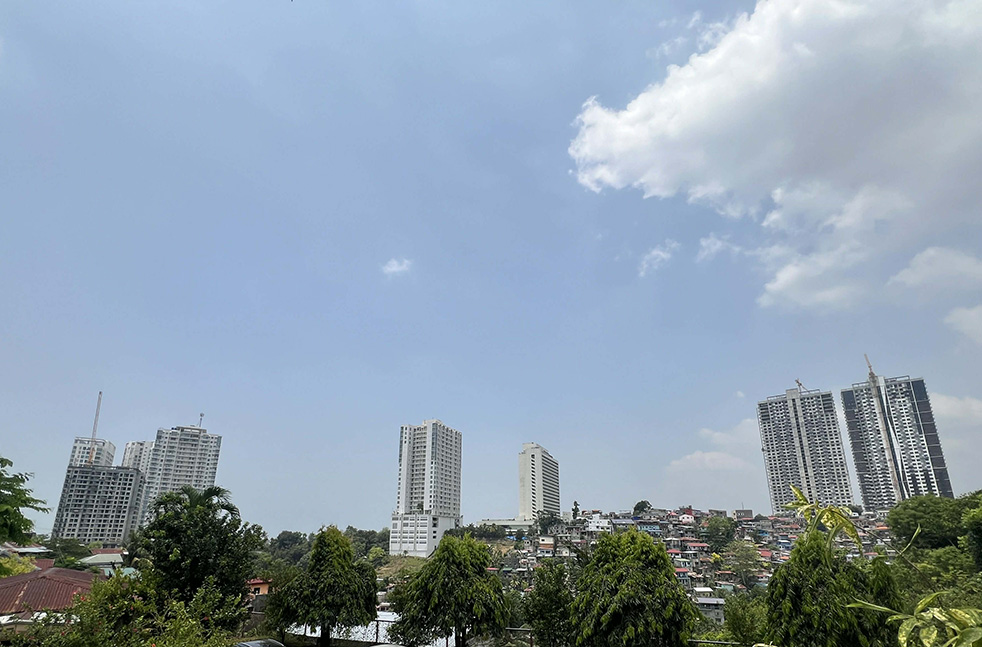
Authorities have advised residents of Metro Cebu to wear protection and to not engage in activities that may put their respiratory system at risk.
The Environmental Management Bureau (EMB) of the Department of Environment and Natural Resources (DENR) made the advisory after noting that the Air Quality Index (AQI) has climbed from to 199 on April 19, 2026 from 112 the day before.
Since April 17, a persistent haze has settled over Metro Cebu and data from its Talisay City Station confirmed a significant and concerning rise in fine particulate matter (PM2.5), the agency said.
“This sharp increase officially moves our air quality into the "VERY UNHEALTHY" category,” EMB said.
The agency said this has become a concern for everyone, and not just those with preexisting conditions.
Under these conditions, the general public may throat irritation, coughing, or shortness of breath.
EMB said those in the high-risk groups are at risk of respiratory distress, including children, pregnant women, older adults, and those with asthma or heart/lung conditions.
PROTECTION
The public can do the following to protect themselves from these conditions:
- Stay indoors: Keep all windows and doors closed. Use air conditioning on "recirculate" mode if possible to prevent outside air from entering.
- Cancel outdoor activities: Avoid jogging, outdoor sports, or strenuous physical labor. The more deeply you breathe, the more harmful particles enter your lungs.
- Wear protection: If you must go outside, a standard cloth or surgical mask is not enough for PM2.5. Please use a well-fitted N95 or KN95 mask.
- Monitor health: Seek medical attention immediately if you experience chest pain, difficulty breathing, or severe wheezing.
FACTORS
EMB said the present conditions can be attributed to the following factors:
- In very hot weather, high-pressure systems often lead to stagnant air. Without strong winds or rain to "wash" the atmosphere, pollutants from vehicles and industry don't disperse and hover over the city, creating the hazy conditions obseved in Talisay City and Cebu City.
- Zero Dispersion: A total lack of wind means that smoke, vehicle emissions, and dust are not being blown away; instead, they are accumulating directly in the air people breathe.
- Localized Emissions from vehicles and road dust
- Other area sources, such as grass fires (SRP Area) and residential/commercial fires(Pahina Central)