






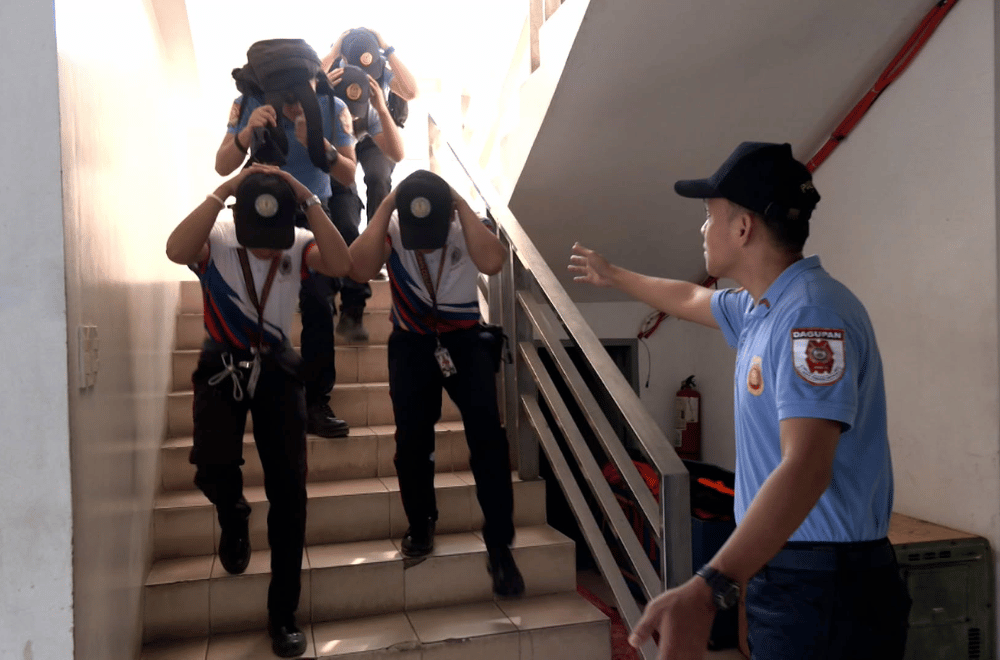
Communities across northern Luzon joined coordinated earthquake and tsunami drills on Thursday as authorities renewed calls for preparedness.
Survivors of the deadly 1990 quake reflected on the disaster that killed over a thousand people.
The drills in Dagupan City, Pangasinan, and provinces nearby included rapid emergency response simulations, evacuation exercises, and rescue operations meant to test readiness in case of a major earthquake.
The exercise also brought back memories of the July 16, 1990 “killer quake” that struck Luzon, causing widespread destruction and collapsing buildings.
Then a student during the 1990 disaster, Police Lt. Gerard Manaois recalled the panic and confusion he witnessed.
“Bale nasa bahay ako noong nagkalindol, may dalawang mag-nanay na nag-iiyakan kaya dali-dali akong naglakad papunta sa kanila, unaware na sa ganoong sitwasyon at mahirap palang maglakad,” he said.
Manaois said the experience taught him the importance of preparation and participation in disaster drills.
During the nationwide simultaneous earthquake drill in Dagupan City, police demonstrated rapid deployment and coordinated response procedures.
TEAMWORK CRITICAL
Dagupan City Police Director, Col. Arnold Solomon, said teamwork is critical during emergencies.
“Magiging practice na pag may earthquake, alam natin ang gagawin natin kumbaga we will work as a team,” he said.
In Pangasinan, the Provincial Disaster Risk Reduction and Management Office also led a tsunami drill in Santiago Island, Bolinao where residents practiced evacuation procedures for possible offshore earthquakes. The activity followed recent tremors recorded in the area.
Meanwhile, in Sta. Maria, Ilocos Sur, the Office of Civil Defense Region 1 conducted earthquake scenarios simulating building collapse, trapped victims, and emergency rescue operations.
Officials said the drills aim to improve coordination among responders and ensure communities are ready for possible large-scale disasters in the future.