






A word of the year surely must imply impact.
Presumably, the ‘chosen one’ represents a shared experience, like a semantic microcosm. It is meant to tell how narratives during a particular milieu entered the mainstream, and the conversation drivers that contributed to the word's usage.
In separate conversations with young adults about 'brain rot' and 'polarization'– Oxford and Merriam-Webster's 2024 picks– they share their personal encounters with these words, how they used them in daily conversations, and why they think the two are culturally relevant signs of the times.
ON BRAIN ROT; POLARIZATION
Oxford’s brain rot and Merriam-Webster’s polarization appear to have taken the internet world by storm in 2024.
As per Oxford, brain rot is the “supposed deterioration of a person’s mental or intellectual state,” with particular mentions of “overconsumption” and “material (now particularly online content) considered to be trivial or unchallenging.”
Bacoor, Cavite-born John Benedict Silla, an incoming senior at the University of the Philippines Diliman, feels a similar sentiment about the term, suggesting that it emits a “feeling of tiredness after thinking for too much.”
According to the 23-year-old Community Development student, he is a frequent customer of brain rot, using it often “during the writing of my thesis whenever I feel like I no longer have progress to whatever I am writing.”
Lagunense and UP Los Baños senior Kristine San Agustin, 24, associates brain rot to a feeling of “mental exhaustion.” She also mentioned its negative impacts on thinking activities, like “running out of creative juices, or a brain fog, and struggling to think clearly or critically.”
Like John, Kristine saw fit to use the term in day-to-day contexts more frequently, “especially in school when I felt burnt out or uninspired while working… it’s a term I relate to moments of creative lag.”
Basilan native Riri Khalid, a 22-year-old Philippine Studies student further described it as an “acquired behaviour” where his “thinking capacities are influenced by overconsuming online content.”
Experiential testimonies like theirs agree with Oxford’s evaluation of brain rot.
They carry elements of the word’s distinct but undesirable rise to mainstream, reinforced by the fact that its relatability is somehow proportional to the digitalization of the world.
This means that as life online became more frequent and immersive, users’ overconsumption of whatever was available via these platforms also ramped up.
This occurrence, Oxford suggests, has often led to subsequent negative impacts, which are anything but surprising for a word that has the term ‘rot’ in it.
Twenty-one year-old Jay Postrado, a Bicolano sports journalist based in the Metro, had a different suggestion. He claimed to have felt more positive vibrations from brain rot.
“I [actually] see myself in the word ‘brain rot.’ As a way of coping, there are just rest days where doing nothing and just scrolling on the Internet feels comforting,” Jay noted. “It is considered as a state of escaping from the harsh pills that people need to swallow.”
Amidst all these encounters, it remains true that it is a reference both to the activity of being too online, and to the repercussions of people's involvement in nonsensical content– mostly online.
On the other hand, Merriam-Webster’s polarization can be said to be more general than it is specific, as it exists beyond the confines of social media.
It manifests in many different forms because it can be anything, according to the US-based dictionary, that is "divided into two sharply distinct opposites,” characterized by “opinions, or interests” that are too extreme for a common ground.
Jay believes that this word “is a good mirror of our present reality, as many people have varying principles that are often irreconcilable,' from "food preferences" all the way to "political stances."
Notably, he also sees a connection between ‘polarisation’ and social media use, which we’ve earlier established to be a central concept in brain rot. “This is a very apt word of the year,” shared Jay, “because the world tends to become more standoffish in the realm of social media.”
Merriam-Webster found that ‘polarisation’ was a hit on its online dictionary, and was often used “across the media landscape.”
They cited notable media organizations in the US who published individual reports on the “cultural polarization” in the workplace, a presidential poll-triggered country "more polarized than ever," and “voter polarization.”
Joshua Dita, a 25-year-old UP Law student from Biñan, Laguna, said that his primary exposure to the word was in the exchanges of ideas that “frequently came up during class discussions regarding the political state of the country.”
The same can be said for Kristine, a Communications major, who “mostly encountered ‘polarization’ in academic settings or discussions about social issues.”
These comments align with Merriam-Webster’s contextual assessment of the word: that its vast usage “reflected the desire (of Americans) to better understand the complex state of affairs in our country and around the world.”
Its popularity in conversations, both in physical and digital spaces, speaks volumes about the reality that people need to face, Jay warns, "that people will have strong opinions about different things in the world."
What’s common between 'brain rot' and 'polarisation' is that they are signs of the times. They summarize some of the most remarkable segments of 2024.
For one, these words depict the “divide happening all around the world,” said John Benedict, “like the ongoing wars, the presidential elections…” which are all “highly documented on social media that are being consumed by people.”
They are a “snapshot of what 2024 has been” Joshua believes, where half reeks of political divide, and the other half saturated with nonsensical content.
Indeed, words of the year are different things to different people. But they represent a “collective consciousness,” shared Kristine, “and capture the essence of what many people are thinking [of], feeling, or facing at a particular time.”
“Even though we may not know each other personally, these words connect us— bringing a sense of mutual understanding despite our differences,” she added.
The aspirational nature of these takes are a welcome indication that despite gloomy definitions surrounding these words, the concept of hope is not too far lurking.
ON ‘WORDS OF THE YEAR’
Dictionaries obviously have their unique takes, but seem to share a similar process of shortlisting their words.
The criteria revolve around visibility, volume, and impact all throughout the year.
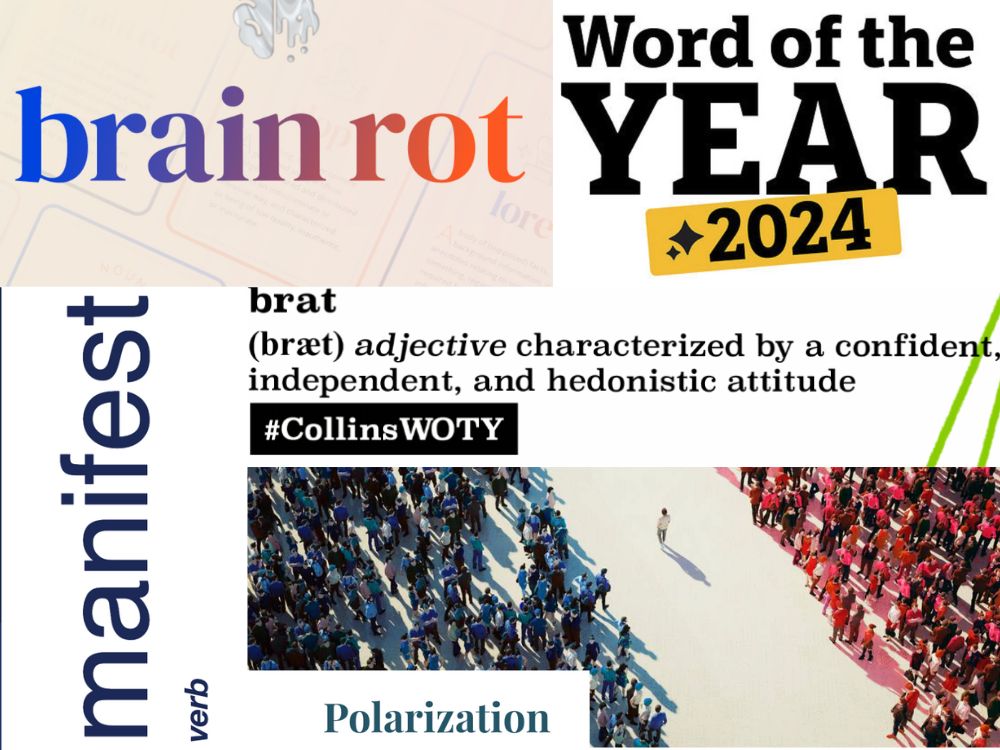
The following are the picks of the four major English dictionaries (visit links to read more about the publishers' explanation of the word):
Brain rot - Oxford
Polarization - Merriam-Webster's
Manifest - Cambridge
Brat - Collins
Summarily, words of the year are what they are in their purest form: word— connectors that enable communities to understand a larger context, and, hopefully, work toward a common goal.
They are mere representations of impact and cultural traction.
At least during the period when their impact was notable, these words helped describe a phenomenon by being described by the phenomenon.
[Note: Words of the year are picked by major English dictionaries in the world, selected autonomously through their own pool of experts and decision-makers. The four publishers mentioned in this article who named their own words of the year are all headquartered in the West: Collins in Scotland, Merriam-Webster in the US, and Oxford and Cambrdige in the UK.]