






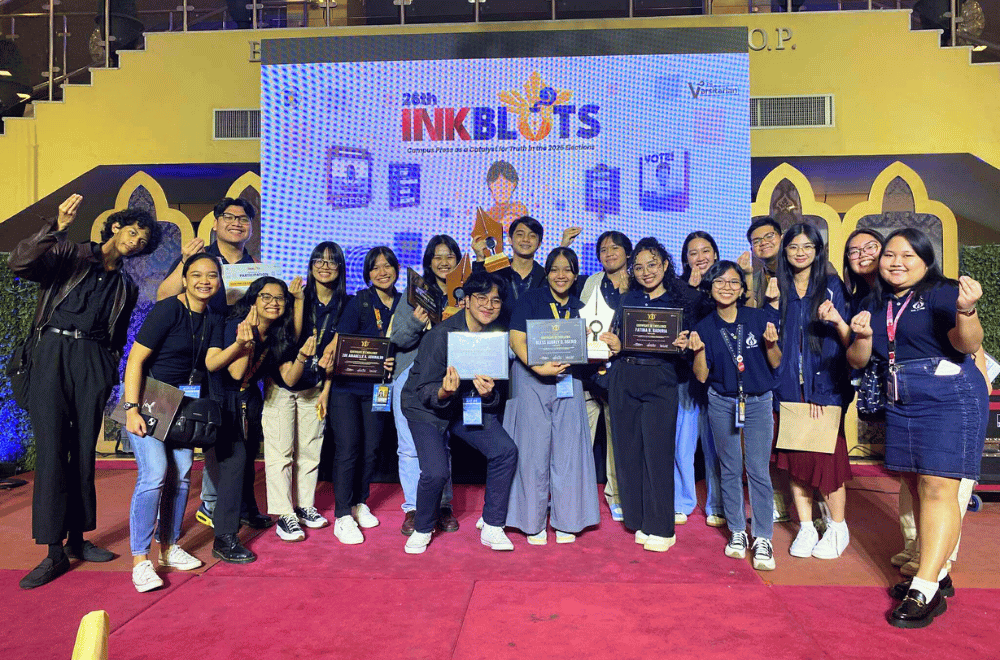
A student publication from the University of Santo Tomas (UST) has made history as the first campus paper in Asia to be recognized by the Society of Professional Journalists (SPJ) in the 2024 Mark of Excellence (MOE) Awards.
The Flame, the official publication of UST’s Faculty of Arts and Letters, clinched first place in the In-Depth Reporting category for large universities at the Region 11 2024 MOE Awards.
The award-winning story, “From streets to sheets: Motorcycle drivers ride on sex work as they traverse hard times,” explores how some motorcycle taxi drivers in the Philippines turn to sex work to survive financial struggles. The piece was written by The Flame’s editor-in-chief Zoe Airabelle Aguinaldo, associate editor Joss Gabriel Oliveros, Jianzen Deananeas, and Ma. Alyanna Selda.
All four authors brought with them a diversity of perspectives shaped by life outside of Metro Manila — Aguinaldo is from Cavite, Oliveros is from Albay, Deananeas is from Northern Samar, and Selda is from Rizal.
SPJ’s Region 11 is comprised of Arizona, California, Guam, Hawaii, Nevada, and the Mariana Islands. First-place winners from each category in each region advanced to compete at the national level, facing other top student works from SPJ’s 12 regions.
This marks the first time a student publication from Asia has won in this category since the SPJ launched the MOE Awards in 2000.
At the national level, the winning piece in the In-Depth Reporting category was “Where’s my mom: The case of Cecilia Perez” by Jordyn Graff and Ruth Bailey of the Nebraska News Service, University of Nebraska.
CHASING WHISPERS
For Oliveros, the journey started with a rumor suggesting that some motorcycle taxi riders in the Philippines were offering sexual services on the side to make ends meet.
"It all started as a rumor that motorcycle taxi riders were engaging in sex [work], and it was allegedly posted in social media groups, like in Facebook," he said.
"I personally went into a rabbit hole at first ng mga Facebook groups involving these kinds of incidents... It was only in Facebook... It was to confirm a rumor to see if it is really true that the riders were engaging in commercial sex because kapos sila sa kita," he added.
Aguinaldo said the team pursued the story cautiously, following a trail that began with whispers and ended with first-hand testimonies.
"We went through verifying these facts until we got the stories from those who were engaging in this service," she said.
For Selda, what struck her was the proximity of the issue to everyday life.
"We use these ride-hailing apps all the time but we were oblivious to what some of these drivers actually go through," she said.
Oliveros was the one who pitched the story initially, and the team knew early on that reporting on sex work would come with unique challenges. Still, they forged ahead — with empathy, respect, and careful consent at the heart of their approach.
"We were all very hesitant to start on this article knowing the nature of the story," Aguinaldo said.
"But Gab, again, being the one who was very determined to know about this story, approached... I think [someone] we assumed that had information about this topic," she added.
BEHIND CLOSED CONVERSATIONS
Aguinaldo said some were in denial at first, but others began to share more. Eventually, they found some who were offering the services actively.
Building trust was key, Oliveros emphasized.
"The most important thing about approaching them was rapport... It was a kind of journalism that you would often see in movies na parang old-school na hindi kailangan ng phone and everything," he said.
Aguinaldo echoed that sentiment and said they didn't want the interviewees to feel like they were being cornered.
"We wanted them to know that they could back out anytime... so, the ball is in their court kumbaga — 'yung pag-atake sa story na ito."
Selda described it as a complete shift from the typical aggressive interview style taught in journalism classes.
"It was about being sensitive to boundaries and knowing when to step back. We were lucky to have mentors and professors in the journalism department who were willing to guide us through that process," she said.
Their investigative process blended online sleuthing and fieldwork.
"We did it both ways... we talked with the riders on the ground, the riders name-meet, and the riders that we see online that offer such sexual services talaga," Oliveros said.
Leads were everything. Aguinaldo said what solidified their pursuit was discovering how organized and active the online marketplace was.
"We witnessed the burner accounts posting about their offers, their height, and the basic physical attributes as if they were selling themselves to these people. And yet, the market was very vibrant and active because even though they were just posting their offers, a lot of people were already expressing their interest," she said.
BURDEN OF TRUTH
Tackling the story was not just a journalistic challenge but an emotional and ethical one as well, the team shared.
From the very beginning, they wrestled with how to tell the story without exploiting the struggles of their subjects.
"We didn't want to exploit the struggles that they were facing for our story," Aguinaldo said.
She added given the topic’s taboo nature in a conservative community that "often turns a blind eye," they made it a priority to consult media practitioners who were experts on sexual and child abuse.
They were transparent with their sources, refusing to pretend or deceive to gain information, and understanding that trust was vital.
"We couldn't pretend that we were clients or interested in it because that would violate their trust," Aguinaldo said.
Emotionally, the team shared a heavy burden. Many of the individuals they interviewed were driven by financial hardship, and the lengths they went to just to survive left a lasting impact on the young journalists.
"We were dealing with others' personal traumas. To take on such a sensitive topic... I guess it broadened my empathy and my perspective when it comes to that. But in order to give justice to these people... we really had to persevere in this story," Deananeas said.
There was constant tension between pushing for more detailed accounts to shed light on the issue and respecting the boundaries of what the sources were ready to share. The team had to remind themselves that behind every story were real people affected deeply by their circumstances.
At times, doubts crept in. Oliveros questioned whether they should even publish the story, concerned about the ethical implications of their work.
"There was this time na iniisip ko 'yung article na, ipu-publish pa ba natin 'to, ipapatuloy pa ba natin 'to? Because I think this will bring a lot of attention not only to us," he said.
The fear of missteps lingered, especially since such stories come with great responsibility. But Oliveros believed "the hardest stories are the stories that are really worth telling."
Handling personal trauma in interviews was emotionally taxing, but for Deananeas, it expanded his empathy and broadened his perspectives.
He recognized, despite the stigma and discomfort surrounding the topic, it was crucial to give these voices a platform.
"In order to give justice to these people who went through these experiences, we really had to push through with everything," Deananeas said.
EYES OPENED, STORIES FOUND
As they reflected on their experience, Deananeas said he realized there are a vast number of untold stories waiting to be uncovered—stories that often exist right before their eyes but go unnoticed.
"I guess what we did was just scratching the surface of the many stories that people can provide in general," he said.
The work deepened his passion for journalism and motivated him to continue seeking meaningful narratives.
One striking realization came from Aguianaldo, who warned of the danger of becoming "desensitized in a fast-paced newsroom."
"Once you finish writing this story, you move on to the next. Sometimes you don't get to fully process the weight of the subjects of your story," she added.
She emphasized that behind every published article are real people whose struggles do not simply disappear with print.
"We’re just giving a voice to these people, but we can’t fully resolve them," she added.
Oliveros noted how the piece not only shed light on sex work but also opened up dialogue about the motor taxi driver industry, a sector, he believes, fraught with unfair labor practices.
These discussions, he said, “are very important because they don’t just aim to tell stories for the sake of telling stories but aim to create meaningful change.”
For Selda, the process revealed the value of silence and vulnerability in journalism. To her, it was more of slowing down—sometimes going against the fast-paced nature of newsroom.
"It was a process that required us to empathize with the experiences and sentiments of our interviewees," she said.
REPORTING WITHOUT APPLAUSE
They were not waiting for a trophy. In fact, they had almost forgotten they entered the contest.
For the team, the international recognition they received was a surprising epilogue to a story they thought had already ended.
"Pinasa na namin siya nung February and nakalimutan namin siya for a few months," Oliveros said.
“A few days after it was submitted, naging busy na rin kami with other responsibilities in the publication and in the university, so we forgot about it,” Selda added.
"And when we checked, 'la, nanalo pala kami," Oliveros added.
Deananeas, who had already let the piece slip from his mind, was caught completely off guard.
"It was just a random Thursday... kasi nawala na talaga sa isip ko yung article," he said.
Their story, had already achieved what mattered to them: it told a difficult truth, gave space to unheard voices, and, in Oliveros's words, "sparked a conversation."
The award, from an international body no less, was not part of the plan — it was simply a bonus.
The news came at a hectic time. Aguinaldo said they learned about the award just before finals week.
"So, parang may moment of celebration, tapos ito na naman, ang dami [na] naman ng requirements," she said.
Still, she couldn’t help but feel a spark of curiosity — wondering how their story compared to others on the list.
Aguinaldo said it was motivating, not for recognition's sake but for "the impact and change na pwede namin magawa no matter how little."
Perhaps the most striking realization came from seeing their work recognized alongside entries from institutions like Stanford and Berkeley.
"Who would expect that students from the Philippines will win an award against these well-established institutions?" Oliveros said.
Their humility wasn’t self-deprecating, it was grounded in awe for what grassroots, student-driven journalism could achieve.
In their reflections, the group shared more than just pride. They spoke of purpose.
DON’T WAIT TO BE CALLED ‘REAL’
Aguinaldo urged fellow student journalists to shake off the label of being “just” students.
"The power that we have as student journalists parang it's just parang equal lang din sa kahit anong pwede pang magawa ng iba," she said.
"I remember a professor din from journalism who said na 'yung purest form of journalism talaga is campus journalism because parang it is led by students, and walang any possible restrictions that may influence how we tell our stories," she added.
Her advice was clear: be fair but critical, especially when facing complex issues. Even as they amplified the voices of drivers and clients in their story, they also reached out to CEOs of ride-hailing companies to push the story beyond emotion and into accountability.
Oliveros encouraged writers to “find a niche” and, more importantly, to embed themselves in their communities.
"You can’t do all this by yourself," he said.
"You have to have a community behind you na susuportahan ka, na tutulungan ka to become a better person, to become a better journalist, to actually write these kinds of stories," he added.
Deananeas offered something simpler, but no less powerful: empathy and understanding.
"In order to create an impactful or thought-provoking piece, you really have to understand first kung ano ang tina-tackle mo in the first place," he said.
For Selda, the fact that their story started from a mere rumor is proof that even the smallest, seemingly insignificant comment can lead to something much bigger.
"Napakaraming stories that have yet to be uncovered, so I think that constant urge to ask, observe and wonder matters, even when we’re not wearing our press IDs," she said.
Their work may have won an award, but for them, the real victory is in knowing they dared to care. They dared to ask questions, to listen harder, and to write something that mattered.