






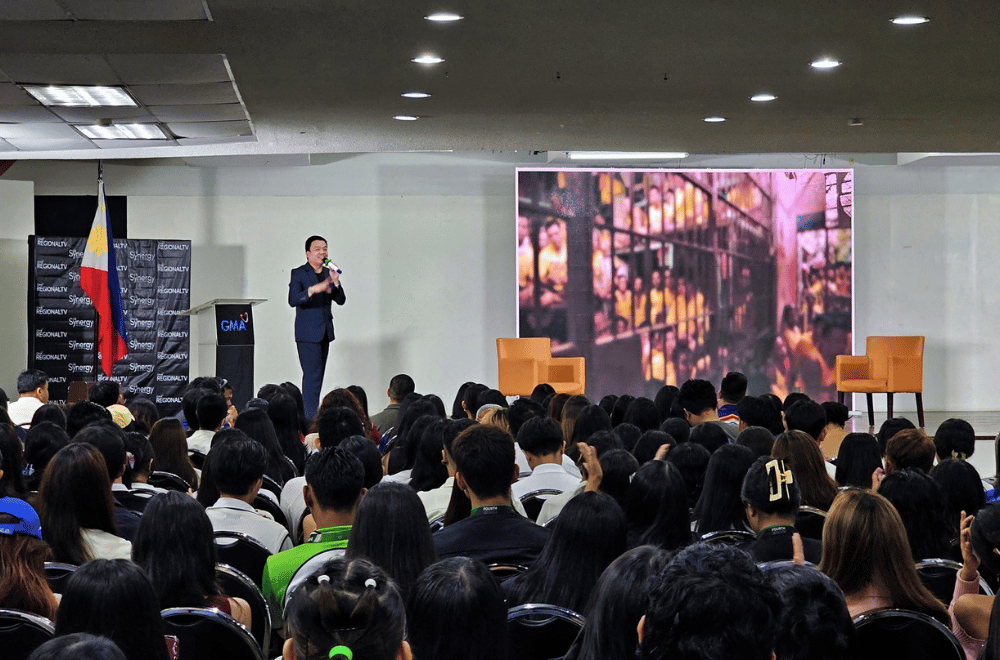
The 33rd Cebu Press Freedom Week opened not only with stories of courage but also with lessons that left lasting imprints on young minds.
At the GMA Masterclass held at the University of the Philippines (UP) Cebu, veteran journalist and 24 Oras anchor Emil Sumangil shared his journey of uncovering the truth, despite dangers to his safety, and his unwavering belief that journalism is a calling.
For many of the students in attendance, his words did not simply recount a career, they also became personal lessons in truth, faith, and responsibility.
JOURNALISM AS TRUTH-TELLING AND RESPONSIBILITY
Several students said the Masterclass deepened their understanding of journalism’s responsibility to pursue truth.
“Kinahanglan gyud nga magpabilin ta nga matinud-anon ug naay salig sa kamatuoran bisan pa og delikado,” Carla Mae Taneo, a first-year Communication student from the University of the Visayas (UV), said.
Taneo said the story of the missing sabungeros showed the harsh realities faced by the marginalized and the silenced.
For Kandice Diaz of Southwestern University (SWU) PHINMA, the session reminded her that journalists are more than just messengers.
“They go the distance for stories people themselves can’t tell, they risk their lives to save others’, and they carry the responsibility of safeguarding the truth in a time when lies are louder,” she said.
Others, like Endriane Bacalso from University of San Carlos (USC), believes the foundation remains constant no matter the risk.
“We must always return to the basics, with the principles and ethical practices of journalism firmly ingrained in everything we do,” she said.
BRAVERY, RISK, AND FAITH
The Masterclass also tackled the risks of investigative work and the faith that keeps journalists going.
For Stevie Cruz Taneo from SWU, the entire session could be summed up in four words, “The Epitome of Bravery.”
He recalled Emil’s words, “God wouldn’t put me in the situation if it wasn’t safe,” as a symbol of faith amid dangerous assignments.
High school students from St. Benedict Childhood Education Centre echoed the same inspiration.
“Journalists are the voice to the voiceless and the hope to the hopeless,” Caitlin Blanco said.
Her classmate, Bettina Santillan, added that investigative work often means “risking your safety and comfort, but it is necessary to expose these truths and give voice to the marginalized.”
For Julia Marie Estrella of Talisay City College, the lesson was clear: “Journalism is indeed the right path, but it is never an easy one.”
What struck her most was Sumangil’s reminder: “If I will not do it, who will?”
She said it showed the great responsibility journalists carry, putting themselves on the line for the sake of truth. “From him, I realized that journalism is not only a career, but also a calling that demands courage, sacrifice, and commitment.”
For Ezra Weigel from USC, who admitted he only partially understood Emil’s Tagalog, the lesson still came through clearly.
“It’s crazy for a man who has his life threatened to say, ‘Ang Lord mu bahala nako.’ It made me think maybe I’m crazy for not wanting to pursue the truth with so much reckless courage. His faith towards the job disturbs my being. It takes a leap of faith to be a journalist,” she said.
DEMOCRACY, JUSTICE, AND PUBLIC SERVICE
The Masterclass also brought about reflections on democracy and the journalist's role in public service.
“If journalism dies democracy will follow,” New Jane Bual of UV said. She called the event “an eye opener for all aspiring journalists.”
She stressed the need to protect journalists to safeguard democracy and human rights.
Carla Mae Taneo echoed this in her reflection.
“Silence does not mean justice is absent because when the truth rises it has the power to break that silence,” she said.
For Jeanel Labandero of Cebu Technological University (CTU), Emil’s work showed what courage means in practice.
“In a world that often rewards silence, he chose to speak. And that choice made all the difference,” she said.
Vincent Villariza of USC added that the lesson extended to the newsroom itself.
“Kuya Emil further expounds on the corroboration of firsthand sources by the newsroom researchers and makes sure that all the information being received and deliberated is credible and true. It really highlights the significance of news, especially for the people behind the cameras,” he said.
GROWTH AND HUMILITY IN JOURNALISM
Others drew inspiration from Emil’s career journey, seeing persistence and humility as central to the profession.
“Journalism is not an overnight success,” Rica Mae Datan of CTU said.
“It requires persistence, adaptability, and a genuine desire to serve the public through truthful and impactful storytelling,” she added.
For Mickaila Arcala of Talisay City College, success in storytelling meant living with integrity, working with passion, and standing firm in commitment.
“It reminded me that every story has the power to inspire change. This made me realize the weight of my responsibility to use my voice to inform, uplift, and make a difference,” she said.
For Clarish Maryjoy T. Pacres of Cebu Normal University (CNU), the session was a reminder of the grit and faith behind Sumangil’s story.
“He started as a production assistant who mostly photocopied papers, made coffee, or even received the frustrations of his higher-ups. It reminds us that there’s no actual shortcut to success,” she said.
She was struck by Sumangil’s candor about the risks of the job. “Journalism is not all about glitters and sparkles. Sometimes it is when you lie down in a cold prison cell… or even ride on an army tank in the middle of a battlefield.”
“As an aspiring journalist, the talk inspired and reignited the passion in me to write and voice the truth to the public when I thought I had lost it along the way,” Pacres added.
For Ma. Ehla Fatima Inanod of the University of San Jose – Recoletos (USJ–R), the Masterclass reinforced the need for grit and perseverance, while also reminding journalists and audiences alike of their shared responsibility for truth.
“As quoted by one of UP Cebu’s officials, being media literate and pursuing the truth is the collective and shared responsibility of both the journalists and viewers, because what’s at stake is our shared future,” she said.
Labandero, meanwhile, admired Emil’s humility in the face of high-risk work.
“He has been the man behind countless high-risk missions, consistently showing up when others may have stepped back… Yet he did it, with courage and clarity, never backing down from the responsibility that comes with telling the truth,” she said.
A LASTING IMPRESSION
For many participants, the Masterclass was a remindar that journalism is a path marked by risk, sacrifice, and faith, but also by service, courage, and the power to uphold democracy.
In the words of Emil Sumangil himself, journalism may not offer luxury, but it offers something more valuable: a life lived in service of the truth. And as the students’ reflections show, that message resonated deeply, planting seeds for the future of the profession.