






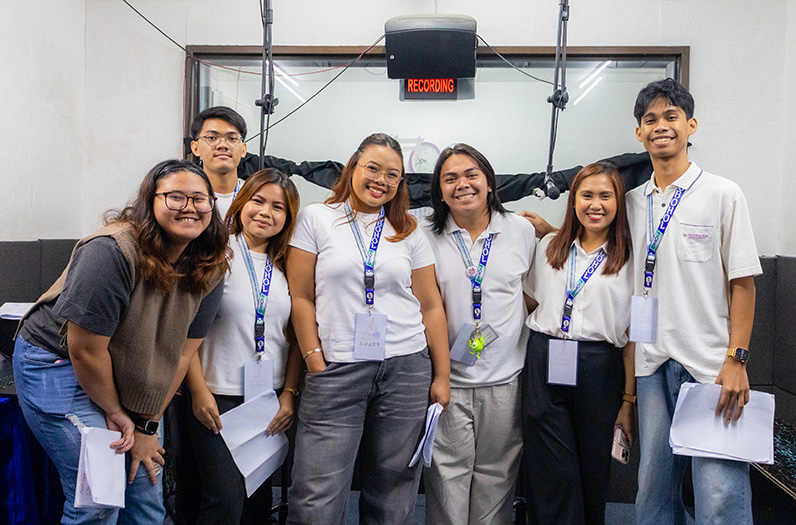
This article is written by Franz Aberilla, BA Communication student, leader of the UP Cebu radio drama team
In a medium where stories live through voice, sound, and imagination, the stage is invisible, but the impact can be felt deeply.
For us in the University of the Philippines Cebu Radio Drama Team, this invisible stage has recently become a platform to celebrate culture, heritage, and the enduring power of youth through storytelling.
I used to dream of competing in a radio category because it was initially the reason why I joined the campus radio. And, here it is now. I witnessed firsthand how a simple script transformed into a shared effort of voices, sound, and imagination.
The team emerged as champion in the Regional Culture and Arts Festival (RCAF) 2026. The victory earned UP Cebu a slot in the national competition where it will compete against top student productions from state universities and colleges nationwide.
This year’s festival also marked the debut of a new cluster, the Association of Sugbo and Bohol State Universities and Colleges (Asugbohol), which brought together participating institutions from Cebu and Bohol. These include Bohol Island State University (BISU), Cebu Normal University (CNU), Cebu Technological University (CTU), National Aviation Academy of the Philippines (NAAP), and University of the Philippines Cebu (UPC).
Composed of students from different academic programs, the UP Cebu team initially had varying ideas about how the narrative should unfold. Bringing together diverse perspectives, Mike Navales from BA Communication, Caleb Berandoy from BA Computer Science, Loriz Cuizon from BA Psychology, Ross Decena from BS Mathematics, and myself worked through these differences to shape the piece.
“Even if our backgrounds were different, the teamwork and trust we developed helped us collaborate well and contribute to the success of the radio drama team.” Decena said.
“Since I am already in my senior year, it was certainly a surprise for me, and I feel immensely grateful to have been given the opportunity and trust to represent our university,” Berandoy said.
With all joining such a competition for the first time, our experience in the campus radio, DYUP Sugbo, helped the group develop a strong collaborative dynamic driven by our individual passion for broadcasting.
We worked with dedication and teamwork and were guided by our coach, Assistant Professor Annie Perez-Gallardo, and mentored by Ms. Elle Aton, whose support helped refine the team’s performance for the competition.
“The group was actually not of my making but of the person I assigned as team leader, but the connection just clicked instantly. It was an honor to coach the team despite minor hiccups. They are highly motivated as well, which I am extremely proud of. I wouldn’t trade this experience for anything,” Perez-Gallardo said on team dynamics.
“This is my first time training people how to voice act. I was always the learner, never the teacher, and everything that I have learned in voice acting, I passed down to them. Seeing the fruits of their labor made all of the training worthwhile, and I take pride in it,” Aton said.
INSPIRATION BEHIND THE STORY
Amid the hum of preparations behind the scenes, our team carried a single story to the competition stage.
Titled “Bagting,” the radio drama follows Miguel, a college student tasked with returning a bell that his family has safeguarded for generations. As he carries the weight of this responsibility, the narrative explores themes of heritage, identity, and the role of younger generations in preserving stories that risk fading with time.
The piece was also a tribute to the late Cebuano journalist Max Limpag whose work documented Cebu’s history and culture. His research on the Boljoon pulpit panels inspired the drama’s message about journalism as a tool for recovering narratives that might otherwise be forgotten.
“As an aspiring media practitioner, I see it as a duty not only to stand for truth but also to honor the platforms that allow these stories to be told. Radio is one of them,” said Navales, one of the writers of Bagting. “Though the process involved numerous drafts, revisions, and late-night practices, seeing the story come to life made the victory even more meaningful,” he added.
Developing the piece required translating historical inspiration into an audio narrative where voice, dialogue, and sound guide the listener’s imagination. For the five-member team, weeks of collaboration were spent refining the script and shaping the characters, grounding the story in history while hoping to inspire future storytellers.
LOOKING AHEAD
Faced with yet another challenge to transform the winning script into Filipino for the national competition, we hold onto the synergies gained continuously throughout the regional experience.
“Beyond titles and awards, I really look forward to meeting the people from other state universities who’ll be coming with us to the nationals in Iloilo because this time, we won’t be competing against each other but representing the same region as one,” Cuizon added.
Now, the team's journey represents more than just the trophy but the opportunity to showcase radio drama as an art form that many worry will fade away slowly in time.
Alongside the radio drama team, several students from UP Cebu are also set to compete in the Philippine Association of State Universities and Colleges - National Culture and Arts Festival in Iloilo City. In the Musical Arts category, UPC students will represent the region in piano, violin, and songwriting. Meanwhile, the Literary Arts category has entries in Pagkukuwento, Extemporaneous Speech, Dramatic Interpretation, and Persuasive Oratory.
UP Cebu also secured strong representation in the Dramatic Arts division, achieving a sweep of championships in Short and Sweet Play (Dialogue), Short and Sweet Play (Musical), Duo Acting, and Pandalawahang Pag-Arte.
With our sights set on the nationals, the UP Cebu Radio Drama Team hopes to keep stories of heritage and history alive, proving that even on an invisible stage, the power of voice and imagination endures.