
We use cookies to ensure you get the best browsing experience. By continued use, you agree to our privacy policy and accept our use of such cookies. For further information, click FIND OUT MORE.
By LLANESCA T. PANTI
December 30, 2021
Throughout 2021, President Rodrigo Duterte has remained popular even as the country has struggled with containing the COVID-19 pandemic, with multiple international media organizations ranking the Philippines near the bottom of their recovery rankings.
However, this popularity has not made it easy for him to anoint a successor with five months left before Eleksyon 2022.
Duterte had initially chosen his longtime aide, incumbent Senator Christopher “Bong” Go, as his 2022 presidential bet, with his party PDP-Laban nominating the chief executive for the vice presidency. In August, however, Duterte said neither of them would run if his daughter, Davao City Mayor Sara Duterte, pursues the presidency.
Mayor Sara had been leading pre-election polls on possible presidential bets up until the period of filing of candidacy, but she ultimately decided to run for vice president under Lakas-CMD. She later agreed to be the running mate of former Senator Ferdinand “Bongbong” Marcos, Jr., son of the late dictator Ferdinand Marcos.
These developments have since prompted Go to withdraw his Eleksyon 2022 presidential bid. Duterte himself filed his candidacy for the Senate, which he later withdrew.
“It is really to spend time with his family after more than four decades ng serbisyo sa taumbayan,” Duterte’s acting spokesperson Karlo Nograles said. “For more than four decades of public service, as part of the prosecution service all the way up to being mayor, vice mayor, a member of Congress, back to vice mayor then mayor, then now, as president of the Republic of the Philippines, he wants to spend time, more time with his family.”
President Rodrigo Duterte and his longtime aide Senator Bong Go formally withdrew their respective candidacies for Eleksyon 2022 this month.
But for Professor Ador Torneo of the Department of Political Science and Development Studies of De La Salle University Manila, Duterte was simply caught off guard by his daughter’s decision that caused him to lose ground.
“It speaks of a plan that has not gone into fruition. If you will come to see how the President has been acting in the past couple of months, the President himself expected Sara to run for the presidency, so her running for vice presidency surprised, frustrated the President,” Torneo told GMA News Online.
“We don’t see much of that even if we have a weak party system. Generally, the president has a successor. And it did not make much sense that Sara would agree to run as vice president because she has been substantially leading the survey.”
The lack of an anointed one hurts Duterte’s position, according to Torneo.
“We have personality-driven politics, and many politicians gravitate around a major personality. With the president lacking a standard bearer, it weakens the party position and the position of the President,” he said.
While Sara is a frontrunner in the 2022 vice presidential race, Torneo said that her winning in 2022 would not necessarily galvanize her father’s supporters since the Constitution only grants the vice president very limited authority.
“Even if she wins the vice presidency, she will not have much authority to actually sustain the support of the President’s allies compared with when she is the president,” Torneo said.
Making things even more complicated is that Duterte has called Eleksyon 2022 frontrunner Marcos a weak leader, a stunning turnaround considering that he once called the dictator’s son as the next vice president even if Marcos lost the 2016 race to Vice President Leni Robredo.
Torneo said such winds of change are not surprising, considering that Marcos stood in the way of Sara’s feasible presidential bid.
“The President may not have not much issue with him running for vice president but it is different if you are gunning for the presidency at the expense of Sara Duterte. It is a different thing and the President was surprised, and he has made his exasperation public,” he pointed out.
President Rodrigo Duterte spoke virtually at the United Nations General Assembly in September.
Aside from the lack of a successor, the President is also facing the tall task of fully vaccinating 90 million Filipinos against COVID-19 by June 2022.
There are only around 47.8 million fully vaccinated Filipinos so far, short of the government target of 54 million by year end.
COVID-19 vaccination in the country started last March 1, but not before Duterte accused the European Union (EU) of hoarding the COVID-19 vaccine supply on February 1.
The EU refuted Duterte’s allegations, issuing a statement that the Philippines is among 92 low- and middle-income countries exempted from the European Union’s ban on the exportation of COVID-19 vaccines.
By February 10, Duterte said the Philippines was ready to work with the EU during the presentation of credentials of the EU Ambassador to the Philippines Luc Véron in a ceremony held in Malacañang.
Duterte also repeatedly thanked China for being the first country to donate Sinovac COVID-19 vaccines to the Philippines, saying the Philippines owes a debt of gratitude to China over such a gesture.
The President’s praises for China, however, did not prevent Beijing from further encroaching on the country’s exclusive economic zone (EEZ) in the West Philippine Sea by deploying over 200 Chinese vessels in the Julian Felipe Reef in March.
These incidents of China’s encroachment have been happening even though the Hague-based Permanent Court of Arbitration, in a July 2016 decision, already rejected China’s claim of sovereignty in the entire South China Sea, a portion of which Manila calls West Philippine Sea.
The same Hague court decision also ruled that the Spratly Islands, Panganiban (Mischief) Reef, Ayungin (Second Thomas) Shoal and Recto (Reed) Bank are within the Philippines’ Exclusive Economic Zone (EEZ) and outlawed China’s aggression against Filipino fisherfolk within the Philippine EEZ and the Panatag (Scarborough) Shoal which is a common fishing ground.
Amid the territorial dispute, Duterte has maintained close relations with China, much to the chagrin of critics who bring up his campaign pronouncement to ride a jetski and plant a Philippine flag on territories in the West Philippine Sea.
The President ultimately said that the Philippines will not pull out its ships in the West Philippine Sea despite the country’s “debt of gratitude” to China, saying he is willing to die to defend his position. In September, he also addressed the UN General Assembly via video message, saying the country’s 2016 arbitral win on the South China Sea dispute was a “win-win solution for all.”
China’s aggression, however, continued. The China Coast Guard fired water cannons at two Philippine vessels en route to deliver supplies to troops aboard BRP Sierra Madre at Ayungin Shoal last November 16. The Chinese government justified the attacks by saying that the Philippine vessels “trespassed” and that Chinese forces were just doing their duty to protect Chinese territory.
The incident was eventually resolved and the supply reached the Philippine troops. Thereafter, Duterte condemned the action of Chinese ships attacking Philippine vessels en route to Ayungin Shoal in the West Philippine Sea via water cannon, saying such action is abhorrent.
Likewise, Duterte also decided to retain the Visiting Forces Agreement (VFA) with the United States, with then presidential spokesperson Harry Roque saying that the US government’s COVID-19 vaccine donation, at 13.2 million doses at the time, was a factor in keeping the VFA with the Americans intact.
These moves, on top of COVID-19 vaccine procurement by the government, bore fruit by mid-November when the government was able to extend the coverage of COVID-19 vaccination to those aged 12 to 17 due to stable COVID-19 vaccine supply.
The country, however, recorded its first case of the more infectious Omicron variant just three weeks after the expanded COVID-19 vaccine coverage, underscoring the need to ramp up the vaccination of the populace to create a sense of normalcy and revive the economy.
“There is more to be done. The substantial COVID-19 vaccination coverage is limited in Metro Manila, Cebu and Davao, and the recovery depends on the people’s confidence to go out to resume activities even while wearing a face mask,” Torneo said.
“Generally, the public has been confident with the lesser number of cases due to increased vaccine coverage and other measures implemented by the government in which the people have been largely cooperative. People are taking advantage of the chances to see each other now that the cases are down amid Christmas holidays, but for how long or can this be sustained? We can expect cases to start rising again in January, but the question is how much will the increase be,” he added.
The Senate Blue Ribbon Committee has been conducting a probe on government purchases on pandemic supplies, earning the ire of President Rodrigo Duterte.
The President has also been adamant in defending the administration and his allies amid the ongoing Senate blue ribbon committee probe into government purchases of pandemic supplies.
Some P8 billion worth of these purchases came from start-up firm Pharmally Pharmaceutical Corporation, which has been at the center of the probe that has exposed its supposed ties with Michael Yang, a former Duterte adviser.
Duterte has lashed out at various Senate members for the probe, saying they were wasting the time of government officials. went as far as ordering Cabinet members to get a clearance from him first before they can attend the Senate investigation.
His tirades, however, have failed to stop the Senate from conducting the inquiry that has led to the arrest of Pharmally Pharmaceutical Corporation executives Twinkle Dargani and her brother Mohit Dargani in Duterte’s hometown of Davao City. Prior to their arrest, the Senate blue ribbon committee cited the siblings in contempt after they failed to provide the necessary documents being asked by the lawmakers.
President Rodrigo Duterte is also facing a possible International Criminal Court (ICC) probe over alleged crimes against humanity due to the killings in his war on drugs.
Beyond his term, Duterte is also facing a possible International Criminal Court (ICC) probe over alleged crimes against humanity due to the killings in his war on drugs, arguably the centerpiece program of the his administration.
Duterte got a reprieve when the ICC granted the Philippine government’s request to defer the probe pending investigation by local authorities this month.
Despite the deferral, the Office of the ICC Prosecutor Karim Khan has clarified that gathering evidence will continue.
In response, Duterte insisted that he will never be tried before the ICC but expressed willingness to undergo a probe and even prosecution by local authorities.
Torneo said the President has long laid the groundwork for dodging the ICC, starting with the Philippine government withdrawing from the Rome Statute that established the ICC back in March 2019.
“He has been consistent in asserting that this should be done by local authorities that we even withdrew from the Rome Statute. Besides, he has more nominees in the Supreme Court, they have more clout in the local court system, so that would be preferable,” he said.
“It is fair to interpret that he will avoid being subjected to prosecution or being tried under the ICC. The ICC process may take long, but I imagine that is an unpleasant experience for anybody because it will be consistently in the news and you will be subject to the court of public opinion. The President will try to avoid that. Senators, Chief Justice, even a former president show up sick when they are trying to avoid prosecution, so it is safe to say nothing is off the table,” he added.
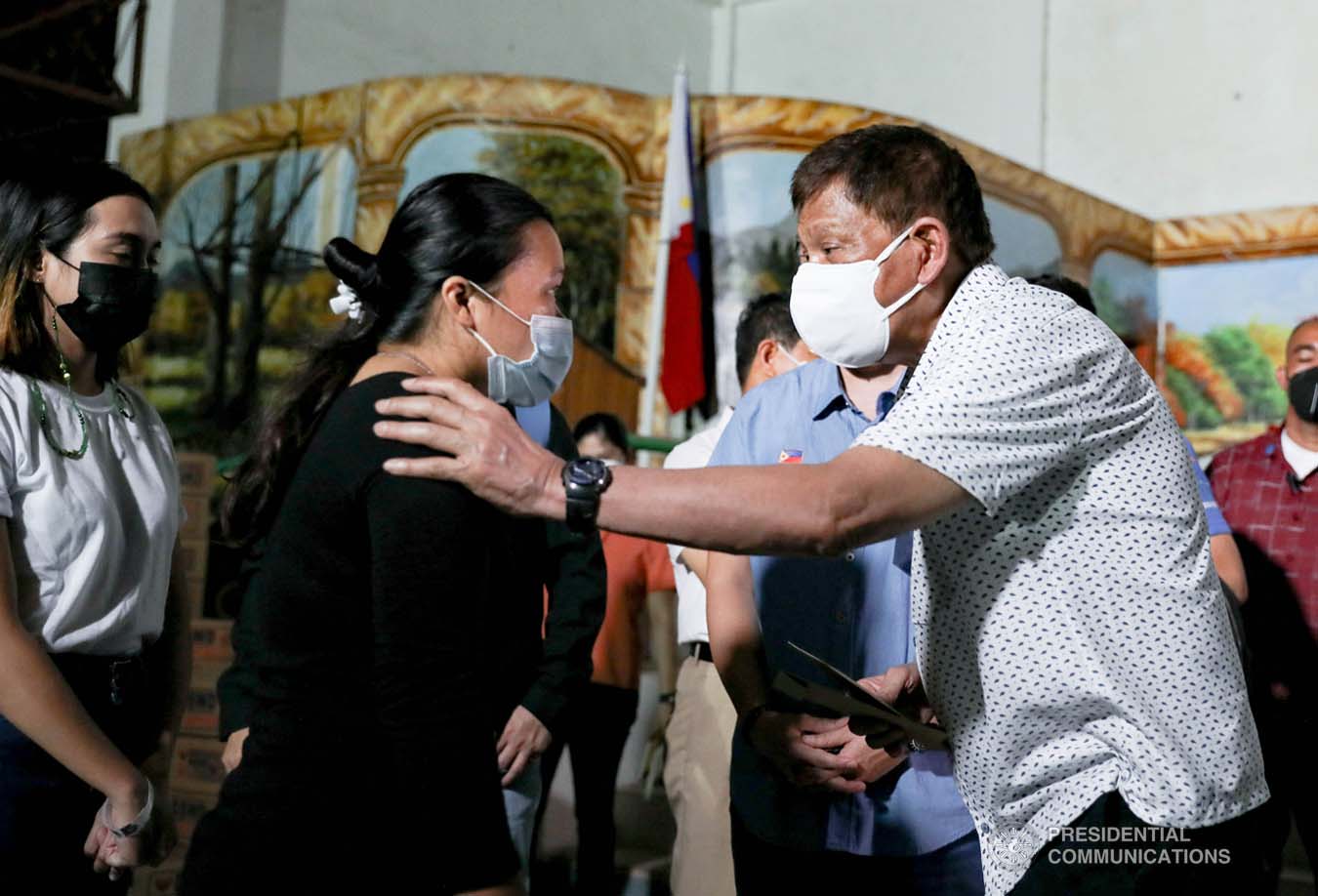
President Rodrigo Duterte meets survivors of Typhoon Odette in Tisa, Cebu City on December 23, 2021. ALFRED FRIAS / PRESIDENTIAL PHOTO
Things got even harder in the last month of the year, with Typhoon Odette battering 11 areas just a week before Christmas day. The affected regions are Mimaropa, Regions 5, 6, 7, 8, 9, 10, 11, and 12, Caraga, and BARMM.
This prompted Duterte to declare a state of calamity in Regions 4B, 6, 7, 8, 10 and 13 heavily devastated by Typhoon Odette, and he lamented that the government is scrimping for resources to aid Odette victims amid the pandemic expenses.
Based on government records as of December 28, the total cost of damages to agriculture, government and private-owned infrastructure and houses brought by Odette is already at P22 billion.
Acting presidential spokesperson Nograles, however, assured that the Duterte administration will always look for resources to fund such budget requirements for aiding Odette victims.
So far, the Deparment of Budget and Management has released P2 billion to local government units to aid in their recovery efforts.
