
We use cookies to ensure you get the best browsing experience. By continued use, you agree to our privacy policy and accept our use of such cookies. For further information, click FIND OUT MORE.
Sara Duterte became the first Philippine vice president to be impeached after 215 lawmakers backed the verified complaint against her.
As the number of endorsers exceeded one-third of the membership of the House of Representatives, the complaint went straight to the Senate as provided for in the 1987 Constitution. A two-thirds vote by the Senate is required to convict and remove Duterte from office, which means that at least 16 senators must vote.
According to the complaint, Duterte was impeached "based on the grounds of culpable violation of the Constitution, betrayal of public trust, graft and corruption, and other high crimes."
The impeachment complaint largely stemmed from the House good government and public accountability panel's inquiry on the use of confidential funds by the Office of the Vice President (OVP) and the Department of Education (DepEd) under Duterte's leadership.
During the House panel's inquiry, it was found that the Commission on Audit (COA) issued a notice of disallowance on the OVP’s use of P73 million confidential funds within 11 days in 2022.
The COA said the OVP did not submit documents showing the success of information gathering and/or surveillance activities to support the acknowledgment receipts for around P69 million of payments of rewards in cash, various goods, and medicines.
Duterte stood pat there was no misuse of the funds.
The complaint also focused on a death threat she made against the president, his wife and the House speaker last year. She said in an online news conference on November 23 that she had hired an assassin to kill President Ferdinand Marcos Jr., his wife and Romualdez if she were killed.
Duterte later on said that her “assassination” statement was not a threat, stressing she only highlighted the alleged threat to her security.
The impeachment complaint accused Duterte as well of undermining the Marcos government’s policies, mentioning her silence over China’s increasing aggression in the disputed waters.
On June 10, the Senate convened as the impeachment court for Duterte’s trial expected to start the next month amid a nation waiting for another political spectacle.
The Supreme Court (SC) in July declared the Articles of Impeachment against Duterte as unconstitutional, barred by the one-year rule under Article XI Section 3 paragraph 5 of the Constitution. The Senate in August voted to transfer the impeachment complaint to the archives, following the SC decision.

The Articles of Impeachment contain the grounds upon which the impeachable officer may
be convicted, and consequently removed from office, after the trial held at the Senate.
ARTICLE I
Contracting an assassin and plotting to murder or assassinate President Ferdinand Marcos Jr., First Lady Liza Araneta-Marcos, and Speaker Martin Romualdez as publicly admitted by her in a live broadcast.
(Betrayal of public trust, culpable violation of the Constitution)
ARTICLE II
Malversation of confidential funds of the Office of the Vice President and the Department of Education.
(Betrayal of public trust, graft and corruption)
ARTICLE III
Bribery and corruption in the Department of Education by giving out cash to several education officials.
(Betrayal of public trust, bribery and/or graft and corruption)
ARTICLE IV
Amassing unexplained wealth and failing to disclose all her properties and interests in her Statement of Assets Liabilities and Net.
(Culpable violation of the Constitution, betrayal of public trust)
ARTICLE V
Involvement in extrajudicial killing through the Davao Death Squad.
(Other high crimes, including the high crime of murder and conspiracy to commit murder)
ARTICLE VI
Persistently and repeatedly committing acts aimed to destabilize the government, challenge the authority of the incumbent president, incite sedition and utter disrespect for authority. These were manifested when she refused to attend the State of the Nation Address in 2024 and appointed herself as “designated survivor” and when she took part in a rally in Davao City aimed to urged the President to resign.
(Betrayal of public trust, culpable violation of the Constitution, other high crimes)
ARTICLE VII
The totality of the Vice President’s conduct, as second highest official of the land.
(Betrayal of public trust, culpable violation of the Constitution, graft and corruption)

December 2 – Civil society organizations, religious leaders, sectoral representatives, and families of victims of extrajudicial killings filed the first impeachment complaint against Duterte. It was endorsed by Akbayan Party-list Representative Perci Cendaña.
The complaint stemmed from Duterte’s alleged culpable violations of the 1987 Constitution, graft and corruption, bribery, betrayal of public trust, and other high crimes.
December 4 – More than 70 individuals from various sectors filed the second impeachment complaint against Duterte, which was endorsed by House Deputy Minority Leader and ACT Teachers party-list Representative France Castro, Gabriela Women's party-list Representative Arlene Brosas, and Kabataan party-list Representative Raoul Manuel.
The complainants argued that Duterte betrayed public trust by her “abuse of discretionary powers” over confidential funds, her disregard for transparency and accountability, and her dereliction of duty over her willful refusal to recognize congressional oversight during budget deliberations.
December 9 – Duterte said she welcomed the filing of impeachment complaints against her because only she is the subject of the supposed attacks, which do not include her former and current colleagues at the OVP and DepEd.
The Vice President said that this would also provide her the opportunity to finally answer allegations against her.
December 19 – A third impeachment complaint was filed against Duterte by religious groups, priests, and lawyers for alleged betrayal of public trust, graft and corruption, among others, over alleged misuse of at least P612 million worth of confidential funds.
The complaint was endorsed by Camarines Sur Rep. Gabriel Bordado and House Deputy Minority Leader and AAMBIS-OWA party-list Rep. Lex Anthony Colada.
December 25 – Duterte said her father, former President Rodrigo Duterte, will be one of her lawyers for the three impeachment complaints she is facing.
January 8 – House Deputy Minority Leader and ACT Teachers party-list Representative France Castro, former Bayan Muna party-list Representative Teddy Casiño, ex-Gabriela party-list Representative Liza Maza, among others, called on members of the House of Representatives to impeach Duterte within the year.
January 10 – House Secretary General Reginald Velasco confirmed that the three pending impeachment complaints against Duterte have all been verified, with a fourth one possibly in the pipeline.
January 13 – The Iglesia Ni Cristo held a massive National Rally for Peace, drawing 1.5 million people, to support President Ferdinand Marcos Jr.'s stance against impeachment plans vs. Duterte.
January 17 – Marcos stressed that this is not the right time to undertake an impeachment process. The President earlier expressed belief that the impeachment process will not benefit the lives of Filipinos.
February 3 – Velasco said he will transmit the three impeachment complaints filed against Duterte to the Office of the Speaker.
February 5 – The House impeached Duterte after 215 members endorsed a fourth impeachment complaint against her.
February 6 – According to a report on "24 Oras,” Duterte had already denied most of the allegations in the impeachment complaints even before they were filed at the House of Representatives.
February 18 – Duterte filed a petition with the Supreme Court challenging the validity and constitutionality of the fourth impeachment complaint against her.
February 27 – Senate President Francis “Chiz” Escudero released the timetable for procedures, including July 30 as the tentative start of the impeachment trial.
February 28 – The House formed the Impeachment Secretariat, composed of 134 individuals, which would provide support services to House prosecutors.
March 13 – Former President Rodrigo Duterte, who is part of Sara Duterte’s defense team, was surrendered to the custody of the International Criminal Court (ICC) and taken to the Hague Penitentiary Institution or the Scheveningen Prison to await trial for alleged “crimes against humanity” in his administration’s war on drugs.
March 25 – House Minority Leader and 4Ps party-list Representative Marcelino Libanan was named the lead prosecutor for the impeachment trial of Duterte.
March 25 – Libanan, on behalf of the prosecution team, asked Senate President Escudero to order Duterte to answer the Articles of Impeachment against her.
May 14 – Former senator Leila de Lima and human rights lawyer Chel Diokno, both nominees of their respective party-list groups in the May 9 elections, accepted invitations to join the prosecution panel.
May 22 – Escudero informed House Speaker Martin Romualdez that the Senate is ready to receive the House of Representatives panel of prosecutors for the reading of impeachment charges against Duterte on June 2.
He also said that the Senate will convene as an impeachment court the following day, June 3.
May 29 – The Senate postponed the presentation of the articles of impeachment from June 2 to June 11. Escudero said the Senate and the House needed to prioritize the passage of the items in the administration's legislative agenda before the 19th Congress adjourned sine die on June 14.
June 2 – Escudero said that with only a few plenary sessions remaining before the 19th Congress adjourned, senators in the 20th Congress will get the final say on whether or not the impeachment trial of Vice President Sara Duterte will push through.
He also said he should not be blamed for the delays because the House took four months before sending the impeachment complaint to the Senate.
June 3 – Opposition lawmakers and impeachment complainants from the Makabayan coalition questioned the delays in convening the impeachment court.
June 4 – Malacañang maintained that President Marcos would not intervene in the impeachment trial against Duterte following debates on whether the trial can cross over into the 20th Congress.
June 4 – Escudero denied that an alleged Senate resolution dismissing the impeachment case against Duterte has been filed in the upper chamber. A document allegedly seeking the declaration of Duterte's impeachment case as "de facto" dismissed circulated on social media earlier in the day.
Later, Senator Ronald "Bato" dela Rosa on Wednesday admitted that he was behind the Senate resolution seeking to dismiss the impeachment case.
June 5 – Atty. Christian Monsod, one of the framers of the 1987 Constitution, said dismissing the Duterte impeachment would violate the Constitution. He also said Duterte's impeachment case can continue in the 20th Congress because the Senate is a continuing body.
June 9 – Escudero took his oath as the presiding officer of the impeachment court in the trial of Duterte.
June 10 – The Senate convened as the impeachment court in the trial of Duterte after senators took their oaths as senator-judges.
June 10 – The impeachment court voted to return the Articles of Impeachment to the House of Representatives without dismissing or terminating the case until such time that: The House of Representatives certified to the non-violation of Article XI, Section 3, paragraph 5 of the Constitution, which provides that “No impeachment proceedings shall be initiated against the same official more than once within one year; include the circumstances on the filing of the first three impeachment complaints"; and the House of the 20th Congress communicated to the Senate that it was willing and ready to pursue the impeachment complaint against the Vice President.
Those who voted to return the articles of impeachment to the House were: Escudero and Senators Ronald “Bato” Dela Rosa, Robin Padilla, Christopher Lawrence "Bong" Go, Francis Tolentino, Imee Marcos, Cynthia Villar, Mark Villar, Jinggoy Estrada, JV Ejercito, Ramon Revilla Jr., Joel Villanueva, Lito Lapid, Alan Peter Cayetano, Pia Cayetano, Loren Legarda, Raffy Tulfo, and Juan Miguel Zubiri.
The negative votes came from Minority Leader Aquilino "Koko" Pimentel III, Deputy Minority Leader Risa Hontiveros, and Senators Grace Poe, Sherwin Gatchalian, and Nancy Binay.
June 11 – The House of Representatives adopted House Resolution 2346 certifying that the impeachment proceedings initiated vs. Duterte fully complied with the 1987 Constitution.
June 11 – Senate issued the writ of summons to Duterte to answer the articles of impeachment against her.
June 23 – Duterte responded to the Senate summons asking the impeachment court to dismiss the verified impeachment complaint filed against her for being illegal, saying that it violated the one-year bar rule under the 1987 Constitution.
Duterte also entered a “not guilty” plea in the verified impeachment complaint.
June 25 - In compliance with the Senate impeachment court’s order, the House of Representatives submitted a certification that the impeachment complaint it filed against Duterte is in accordance with the Constitution.
July 1 - House prosecutor and Akbayan Rep. Chel Diokno said that the Senate impeachment court's order for a second certification, regarding the House of Representatives under the 20th Congress' willingness to pursue the impeachement could impair the prosecution's case.
July 2 - Senate impeachment court spokesperson Atty. Regie Tongol denied that the certifications being required from the House of Representatives were “traps or measures to impede” the impeachment trial.
July 8 - The Supreme Court (SC) required the House to submit information regarding the status of the first three impeachment complaints filed against Duterte, the exact dates these were endorsed, and whether the secretary general possesses discretion on when to transmit these to the speaker of the House of Representatives.
Aside from this, the Court also asked the House to provide the basis and authority of the secretary general to refuse the transmittal of the complaints.
July 21 — Senate President Escudero said that he will propose to his fellow senators that the impeachment court for the trial of Duterte begin on August 4 — a week after the Senate and the House of Representatives open their first regular session for the 20th Congress.
July 25 — The Supreme Court declared the Articles of Impeachment against Duterte as unconstitutional.
Voting 13-0, the SC ruled unanimously, deeming that the Articles of Impeachment are barred by the one-year rule under Article XI Section 3 paragraph 5 of the Constitution.
July 25 — Supreme Court Associate Justice Ramon Paul Hernando said the House of Representatives took ''deliberate’’ actions to circumvent the one-year bar rule in relation to the impeachment proceedings. He called it "a technically legal but highly immoral maneuver."
July 28 — The Senate formally opened the first regular session of the 20th Congress.
August 4 — In a motion for reconsideration, the House of Representatives asked the SC to reverse its decision junking the impeachment case, saying it should be allowed to perform its exclusive duty to prosecute an impeachable official, and the Senate's to try the case.
August 6 — The Senate voted to transfer to the archives the Articles of Impeachment against Vice President Duterte, following the decision of the SC to declare her impeachment unconstitutional.
With 19 votes for, four against, and one abstention, the Senate archived the impeachment complaint.

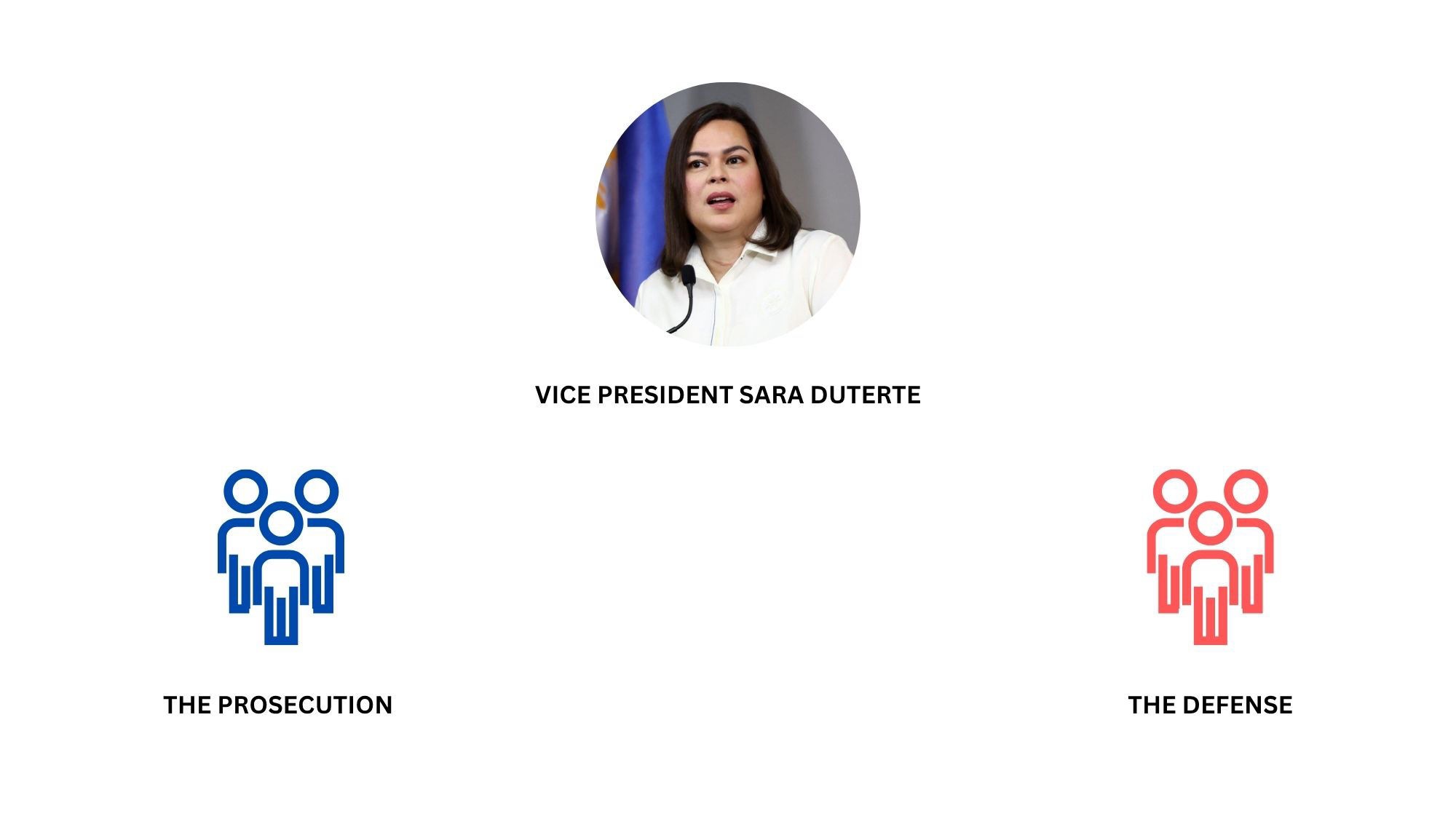
Vice President Sara Duterte
Sara Duterte is the 15th Vice President of the Philippines and the first in her position to get impeached.
She is the second child of former president Rodrigo Duterte with his ex-wife Elizabeth Zimmerman. She is married to lawyer Manases “Mans” Carpio and mother to their three children nicknamed Sharky, Stingray, and Stonefish.
Duterte earned her Bachelor of Science in Respiratory Therapy degree from the San Pedro College in Davao City, and received her Juris Doctor degree from the San Sebastian College – Recoletos in Manila.
Before joining politics, Duterte briefly served as a court attorney at the Supreme Court in 2006. She was then elected vice mayor of Davao City from 2007 to 2010 and became the youngest and first lady mayor of the city from 2010 to 2013. In 2016, she was elected again as Davao City and served for two consecutive terms until she decided to run for vice presidency in 2022, as the running mate of Marcos Jr.
After the Marcos-Duterte tandem won the 2022 elections by a landslide, the Vice President was appointed as secretary of the Department of Education. She resigned as Education chief in June 2024.
Prosecution Panel
Romeo Acop, Antipolo City 2nd District
• Member of 15th, 16th, 17th Congress
• Former chief of then Criminal Investigation Service, now the Criminal Investigation and Detection Group
• Bachelor of Laws, Jose Rizal University
Joel Chua, Manila 3rd District
• Chairperson of the House Committee on Good Government and Public Accountability
• Abogado ng Distrito Program (2004-2022)
• Bachelor of Laws, San Sebastian College-Recoletos
Leila De Lima, Mamamayang Liberal Party-list
• Former Senator, Justice Secretary and chairperson of Commission on Human Rights
• Bachelor of Laws, San Beda College
*Not yet officially elected by plenary
Lorenz “Nonoy” Defensor, Iloilo 3rd District
• Former senior partner at Salazar Enrile Defensor & De Mata Law Offices
• Constitutional Law lecturer, Manuel L. Quezon University School of Law
• Bachelor of Laws, University of Sto. Tomas
Jose Manuel “Chel” Diokno, Akbayan Party-list
• Former Dean of the De La Salle University Tañada-Diokno School of Law
• Member of the Free Legal Assistance Group (FLAG) since 1989 and chairperson since 2004
• Served as a private prosecutor and team leader during the impeachment proceedings against then President Joseph Estrada from 2000 to 2001
• Bachelor of Laws, University of the Philippines
*Not yet officially elected by plenary
Jonathan Keith “John” Flores, Bukidnon 2nd District
• Partner, Europa Dacanay Cubedo Europa and Flores Law Office
• Bachelor of Laws, Ateneo de Davao University
Ramon Rodrigo “Rodge” Gutierrez, 1-RIDER Party-list
• Counsel, Gutierrez Law Office
• Bachelor of Laws, Ateneo de Manila University College of Law
Marcelino Libanan, 4PS Party List
• Member of 11th, 12th, 13th Congress
• Managing Partner, Libanan Law Ofice
• Bachelor of Laws, Divine Word University Tacloban
Gerville “Jinky Bitrics” Luistro, Batangas 2nd District
• For Department of Justice State Counsel
• Bachelor of Laws, University of Batangas College of Law
Arnan Panaligan, Oriental Mindoro 1st District
• Technical Assistant, Supreme Court of the Philippines
• Bachelor of Laws, Ateneo de Manila Law School
Ysabel Maria “Atty. Bel” Zamora, San Juan Lone District
• Former partner of Zamora & Poblador Law Office
• Bachelor of Laws, University of the Philippines College of Law
Defense Team
Lindon Miguel Bacquel
• Associate at the Fortun, Narvasa, and Salazar law firm. He earned his Legal Management degree and Bachelor of Laws at the Ateneo de Manila University.
Roberto Batungbacal
• Senior associate at the Fortun, Narvasa, and Salazar law firm. He earned his degrees in Management Economics and Law from the Ateneo de Manila University, and was admitted to the Philippine Bar in 2019.
Ralph Bodota
• Manages R. Bodota Law firm. He is a Certified Public Accountant, he earned his Bachelor of Laws from Arellano University School of Law.
Miguel Carlos Fernandez
• Associate at the Fortun, Narvasa, and Salazar law firm. He graduated with a B.S. Economic degree at University of the Philippines and Bachelor of Laws at the Ateneo de Manila University.
Francesca Marie Flores
• Associate at the Fortun, Narvasa, and Salazar law firm. Earned her B.S. Management degree at Ateneo de Manila University and her Bachelor of Law at University of San Carlos.
Maria Selena Golda Fortun
• Associate at the Fortun, Narvasa, and Salazar law firm. She earned her Business Administration degree at the University of the Philippines and her Master of Laws specializing in criminal justice and criminology at University of New South Wales.
Philip Sigfrid Fortun
• Founding member of the Fortun Narvasa & Salazar law firm which has been handling the Vice President’s SC petition. He is a known criminal defense lawyer and has over 35 years of litigation experience.
David Ronell Golla VII
• Associate at the Fortun, Narvasa, and Salazar law firm. He graduated with a Business Administration degree and earned his Bachelor of Laws at Far Eastern University-Makati.
Justin Nicol Gular
• Senior associate at the Fortun, Narvasa, and Salazar law firm. He earned his Bachelor of Laws from University of San Carlos.
Reynold Munsayac
• Senior associate at the Fortun, Narvasa, and Salazar law firm. Earned his Bachelor of Laws from San Sebastian College. Former acting chairman of the Presidential Commission on Good Government.
Carlo Joaquin Narvasa
• Senior associate at the Fortun, Narvasa, and Salazar law firm. He earned his AB English Literature and Bachelor of Laws from Ateneo de Manila University.
Gregorio Narvasa II
• Founding member of the Fortun Narvasa & Salazar law firm. He is the son of late Chief Justice Andres Narvasa, who served as defense counsel of former president Joseph Estrada in his impeachment trial.
Michael Wesley Poa
• Former spokesperson of Vice President Sara Duterte at the Department of Education, when she was its head. Earned his Bachelor of Laws from the University of the Philippines.
Clarlaine Radoc
• Associate at the Fortun, Narvasa, and Salazar law firm. Finished Management Accounting and Bachelor of Laws at the University of San Carlos.
Sheila Sison
• Partner lawyer at the Fortun Narvasa & Salazar law firm. She specializes in criminal litigation and is the lead counsel in several Sandiganbayan cases.
Mark Vinluan
• Former associate at the Fortun, Narvasa, and Salazar law firm. Current partner at Vinluan Law Office. He earned his Bachelor of Laws at Ateneo de Manila University.
Senator-Judges
Retained from 19th Congress
Francis “Chiz” Escudero, Senate President
• elected senator in 2007, 2013, 2022
• a member of the Nationalist People’s Coalition
Alan Peter Cayetano
• elected senator in 2007, 2013, 2022
• a member of the Nacionalista Party
Pia Cayetano
• elected senator in 2004, 2010, 2019, 2025
• a member of the Nacionalista Party
Ronald "Bato" Dela Rosa
• elected senator in 2019, 2025
• a member of PDP Laban
Joseph Victor "JV" Ejercito
• elected senator in 2013, 2022
• a member of the Nationalist People’s Coalition
Jinggoy Estrada
• elected senator in 2004, 2010, 2022
• a member of the Puwersa ng Masang Pilipino
Sherwin Gatchalian
• elected senator in 2016, 2022
• a member of the Nationalist People’s Coalition
Christopher Lawrence Go
• elected in senator in 2019, 2025
• a member of PDP Laban
Risa Hontiveros
• elected senator in 2016, 2022
• a member of Akbayan
Manuel "Lito" Lapid
• elected senator in 2004, 2010, 2019, 2025
• a member of the Nationalist People’s Coalition
Loren Legarda
• elected senator in 1998, 2007, 2013, 2022
• a member of the Nationalist People’s Coalition
Imee Marcos
• elected senator in 2019, 2025
• a member of the Nacionalista Party
Robinhood Padilla
• elected senator in 2022
• a member of PDP Laban
Raffy Tulfo
• elected senator in 2022
• Independent
Joel Villanueva
• elected senator in 2016, 2022
• Independent
Mark Villar
• elected senator in 2022
• a member of the Nacionalista Party
Juan Miguel "Migz" Zubiri
• elected senator in 2016, 2022
• Independent
Senator-Judges
Outgoing from 19th Congress
Maria Lourdes Nancy S. Binay
• elected senator in 2013, 2019
• a member of the United Nationalist Alliance
Aquilino “Koko” Pimenntel III
• elected senator in 2013, 2019
• a member of PDP Laban
Grace Poe
• elected senator in 2013, 2019
• Independent
Ramon Bong Revilla Jr.
• elected senator in 2004, 2010, 2019
• a member of Lakas-CMD
Francis “Tol” Tolentino
• elected senator in 2019
• a member of the Partido Federal ng Pilpinas
Cynthia Villar
• elected senator in 2013, 2019
• a member of the Nacionalista Party
Senator-Judges
Incoming 20th Congress
Benigno Paolo Aquino IV
• elected senator in 2013, 2025
• a member of Katipunan ng Nagkakaisang Pilipino
Panfilo “Ping” Lacson
• elected senator in 2001, 2007, 2016, 2025
Rodante Marcoleta
• elected senator in 2025
• a member of SAGIP party-list
Francis “Kiko” Pangilinan
• elected senator in 2001, 2007, 2016, 2025
• a member of the Liberal Party
Vicente Sotto III
• elected senator in 1992, 1998, 2010, 2016, 2025
• a member of the Nationalist People’s Coalition
Erwin Tulfo
• elected senator in 2025
• a member of ACT-CIS party-list
Camille Villar
• elected senator in 2025
• a member of Nacionalista Party

What is impeachment?
Impeachment is a process or proceeding discussed in Article XI of the 1987 Constitution of the Philippines under "Accountability of Public Officers." Impeachment may lead to the removal of a public official from office for serious crimes or misconduct such as violation of the Constitution, treason, bribery, graft and corruption, other high crimes, or betrayal of public trust.
Which public officials may be impeached?
Section 2 of Article XI lists these officials as those that can be removed from office on impeachment:
1. The President
2. The Vice-President
3. The Members of the Supreme Court
4. The Members of the Constitutional Commissions
5. The Ombudsman
Other public officers and employees may also be removed from office, but not by impeachment.
What are the “Articles of Impeachment?”
According the the UP College of Law, the Articles of Impeachment “contain the grounds upon which the the impeachable officer may be convicted, and consequently removed from office, after the trial held at the Senate.”
The impeachment process begins at the House of Representatives where any member or citizen can file a verified complaint which shall be endorsed by any House member. After conducting a hearing and by a majority of votes by the panel members, the House committee shall submit a report to the House within sixty session days.
“A vote of at least one-third of all the Members of the House shall be necessary either to affirm a favorable resolution with the Articles of Impeachment of the Committee, or override its contrary resolution. The vote of each Member shall be recorded,” according to Sec 3 (3) of Article XI.
“In case the verified complaint or resolution of impeachment is filed by at least one-third of all the Members of the House, the same shall constitute the Articles of Impeachment, and trial by the Senate shall forthwith proceed,” it added.
What is an impeachment trial?
The Senate, according to the Constitution, has the sole power to try and decide all cases of impeachment.
The approved House resolution is thus endorsed to the Senate which will try the impeached official.
Based on Senate Rules, the impeached official will be called to answer to each charge in the Articles of Impeachment. According to the UP College of Law primer, the Senate will hear arguments and witnesses from both the prosecution the defense.
An official shall be convicted if two-thirds of the Senate votes for conviction.
If an official is convicted, judgment consists of removal and disqualification to hold any office under the Republic of the Philippines.
How is a replacement chosen?
According to the Constitution, in the event of a vacancy in the Office of the Vice-President, the President shall nominate a Vice-President from among the members of the Senate and the House of Representatives.
The nominee shall assume office upon confirmation by majority vote from among the Members of the Senate and the House, which will vote separately.

