

 GMA Brandtalk
 Tracking
 Archives

WATCH: Lava effusion, collapse-fed PDCs anew at Mayon Volcano
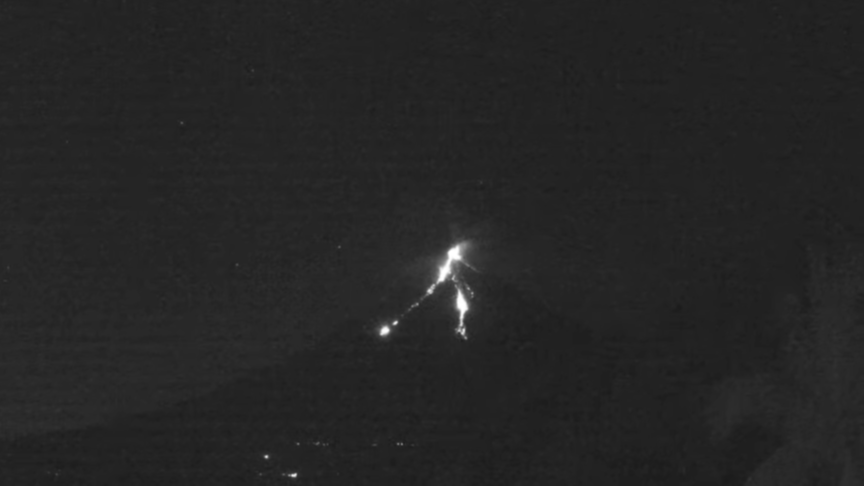
The Philippine Institute of Volcanology and Seismology (PHIVOLCS) logged fresh occurrences of lava effusion with collapse-fed pyroclastic density currents (PDCs) on Mayon Volcano at past midnight Tuesday.
This is as the volcano’s effusive eruption persisted for the 141st day on May 26, 2026.
State volcanologists shared sped-up camera footages of lava effusion with collapse-fed PDCs along Mayon Volcano’s Bonga, Basud, and Mi-isi gullies, which were recorded at 10:53 p.m. and 11:42 p.m. Monday, and at 12:32 a.m. Tuesday.
Mayon Volcano is on its 141st consecutive day of effusive eruption, generating incandescent lava flows, PDCs or “uson,” and rockfalls.
READ: WATCH: Meteor comes close to slopes of Mayon Volcano
Earlier on Monday night, PHIVOLCS also observed the occurrence of lava effusion with collapse-fed PDCs and minor Strombolian activity at the volcano.
The lava effusion with collapse-fed PDCs flowed along Mi-isi and Basud gullies at 7:20 p.m. and 7:26 p.m. of May 25.
In total, eight "uson" activities were monitored over the volcano, compared to zero incidents the day before.
Aside from the PDCs, more volcanic earthquakes were also monitored over the past 24 hours, PHIVOLCS said in its bulletin issued Tuesday morning.
PHIVOLCS said Mayon recorded 57 volcanic earthquakes including 14 volcanic tremors lasting from three to 80 minutes. This was higher than the 45 volcanic earthquakes and four volcanic tremors logged in the previous report.
The number of rockfalls events decreased from 290 to 286.
Also, the amount of sulfur dioxide emission from the volcano decreased from 1,216 tonnes on Sunday to 1,124 tonnes on Monday.
A moderate emission plume was observed rising 300 meters above the crater and drifting west and west-southwest.
The crater glow remained “fair” and visible to the naked eye.
Ground deformation data showed short-term deflation of the edifice with shorter-term inflation on the northeastern flank.Mayon Volcano remains under Alert Level 3, which means a state of intensified unrest or magmatic unrest.
Entry into its six-kilometer Permanent Danger Zone (PDZ) is prohibited. Authorities warned against unnecessary activity in the extended danger zone (EDZ).
Flying any aircraft close to the volcano is also prohibited due to potential ash and ballistic hazards.
Mayon Volcano could generate rockfalls or landslides or avalanches; ballistic fragments; lava flows and lava fountaining; pyroclastic density currents; moderate-sized explosions; and lahars during heavy and prolonged rainfall. —with a report from Joviland Rita/JMA/KG, GMA News

