





Before we took our turn to take the stage, Jaemark Tordecilla said he felt he had come “full circle.”
He meant that our six-year-old brainchild at GMA News, a modest pandemic-era podcast with two talking heads, had come of age as a full-fledged show with a live audience.
At the onset of the pandemic, Jaemark, then editor-in-chief of GMA News Online, envisioned a platform where we could examine the urgent questions of a world in crisis while safely confined at home. He named it Quarantined with Howie Severino.
We interviewed every covid expert and policymaker we could book, helping both our audience and ourselves make sense of one of the most confounding and frightening crises of our lifetimes.
As the emergency eased, we rebranded as The Howie Severino Podcast and broadened our scope. Artists and writers joined government officials and political leaders on our guest list.
Eventually, we could occasionally leave our screens and venture into the field to record interviews face-to-face in museums and even along the Taal lakeshore.
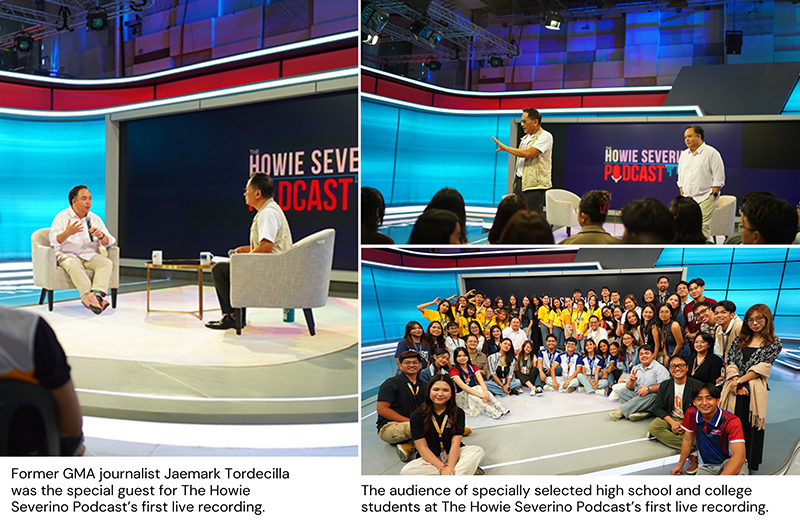
Last Wednesday marked another milestone: our first live recording. Our venue was none other than the 24 Oras studio, briefly transformed for our show before returning to its role as the network’s flagship news set. About 50 bright, carefully selected high school and college students from Metro Manila and nearby provinces formed our audience.
Our topic was AI and how it is reshaping the world, especially journalism.
There was no more fitting guest than Jaemark. Not just because he helped create the show, but because he has emerged as one of the country’s leading voices on how AI can empower journalists. After a year at Harvard thinking about and developing AI applications for newsrooms, he has returned home to urge media organizations here and abroad to embrace the technology before they are left behind.
His message is clear: AI can make us better at what we do. It can help uncover patterns of corruption, flag anomalies across vast datasets, and sharpen our ability to pursue the truth. For newsrooms around the country, he’s the AI guru.
During the live recording and the workshop that followed, Jaemark fielded probing questions from our Gen Z audience: concerns about the risks of weaponized AI and the guardrails needed to contain its power.
One idea stood out to me: AI’s potential to democratize access to the law. Jaemark demonstrated a tool that can translate, with a voice, Philippine laws from English into major Filipino languages: still imperfect, but potentially a game changer.
For too long, our legal system has been gated by language. Laws written in English are accessible mainly to the highly educated, leaving many Filipinos vulnerable to those who can interpret, or manipulate, the laws of the land. Jaemark demonstrated that AI can become a tool not of exclusion, but of empowerment.
Still, one student raised an important point: we’re learning all this, but what about everyone else? How do we prevent AI from widening the digital divide?
I volunteered an answer: every transformation needs a vanguard. Change does not spread on its own. It requires people willing to drive it. That is now your role, all of you in the room, to bring these conversations into your schools and communities, so knowledge does not remain concentrated among a few.
Journalists, too, must catch up. Ironically, Jaemark noted that many in the profession have been slow to harness AI’s potential in the pursuit of truth.
As I sat on stage, I thought again about that “full-circle moment.” For me, it stretched beyond the podcast we started in 2020.
I was transported back to a small restaurant along Tomas Morato Avenue in QC in 2009, where I encouraged a young web developer at GMA to consider a career in journalism. That was Jaemark. He had helped set up my blog, back when blogging was still faddish, and I had noticed his own writing online, marked by flair and range.
Consequently, we would later become colleagues in the journalism community, where he eventually succeeded me as editor of GMA News Online. From there, he built digital teams that would go on to support projects like this podcast, now under GMA’s Digital Innovation Lab led by Bernice Sibucao. The lab shepherded the show from its modest beginnings to our network’s flagship stage.
After his Harvard fellowship, Jaemark emerged as a trailblazer in the country’s nascent AI space. His timing could not have been better. AI is being met with both excitement and apprehension, and his message cuts through the noise: understand it, set clear guidelines, then experiment and integrate what works.
I know smart people who are still very wary and even resistant. But to resist AI is to resist the dawn.
Journalists often say that “sunlight is the best disinfectant.” The hope now is that a new vanguard will wield this technology to let in more light: to illuminate, scrutinize, and ultimately, strengthen our democracy.
(The podcast episode with Jaemark Tordecilla and a live audience is coming soon!)

We use cookies to ensure you get the best browsing experience. By continued use, you agree to our privacy policy and accept our use of such cookies. For further information, click FIND OUT MORE.