





Over 40 years ago, I was attending orientation as a rookie teacher at Ateneo High School, just a year out of college. One of the speakers that day was none other than Fr. Bienvenido “Ben” Nebres, the Jesuit Provincial at the time — the leader of all Jesuits in the Philippines.
It was so long ago I only recall one thing he said, mainly because I found it funny.
“We Jesuits have an age problem,” he said, pausing before spelling it out with a wide smile, “A-G-E. You have to be careful these days.”
That triggered loud chuckles in the room. This was 1984, when a terrifying new disease, AIDS, had just begun to spread in the Philippines. Heaven forbid any of us rookies misheard him say the Jesuits had an AIDS problem. But the venerable priest, then in his mid 40s, just wanted to make sure we heard it right, while passing it off as an inside joke.
At the time, it seemed absurd to think of the Jesuits as having an age problem.
These were crucible years when Nebres and Fr. Joaquin Bernas were in their prime while leading the Jesuits in standing up to the dictatorship. Bernas, then the 51-year-old president of Ateneo de Manila University, was a constitutional scholar and outspoken defender of human rights. Nebres, a mathematician with a Stanford doctorate, would eventually succeed him at age 53 and become the university's longest-serving president. Together, they helped transform Ateneo into a sanctuary for free speech and a breeding ground for democratic alternatives during one of the nation's most turbulent periods.
Back then, Jesuit leadership appeared inexhaustible. Today, Fr. Ben's joke feels less like a punchline and more like a prophetic warning that went unheeded.
Ateneo de Manila University is currently grappling with one of the gravest crises in its modern history, and attention has naturally focused on the institution's response to the tragedy in Aurora. Yet the deeper crisis predates this single episode and may outlast it.
The problem is not age itself, nor can it be pinned entirely on one man. The underlying dilemma is structural: the Ateneo continues to limit its leadership to a shrinking, graying circle of candidates, starving a complex modern university of the very talent pool it needs to survive.
When university president Fr. Bobby Yap, SJ, 67, finally faced the public after days of mounting criticism, many observers felt the university's response had been hesitant, fragmented, and reactive at a moment when decisive leadership was needed. Cruelly, it had to happen just as his term as university president was winding down.
As former Ateneo dean Tony La Viña, a close friend of Fr. Bobby, recently observed, while the Ateneo president followed his pastoral instincts as a priest, “the institutional work has lagged… Transparency. Accountability. Clarity of communication. The ability to speak to many different publics, not just one. The courage to unite a fractured community rather than wait for it to settle on its own.”
Beyond that immediate assessment, a larger, existential question has become critical: does the Ateneo have access to the widest possible pool of leadership talent at a moment when modern universities face increasingly complex challenges?
The Ateneo community is teeming with brilliant, accomplished minds: scholars, executives, and visionaries who love the institution deeply. Yet, nearly all of them are automatically disqualified from the presidency simply because they do not belong to the ultra-exclusive Jesuit order.
The Society of Jesus is hardly alone in confronting demographic realities. Religious orders around the world are smaller and their members older than they once were. The Jesuits remain one of the most respected educational institutions in the Catholic world, but even they cannot escape the arithmetic of declining vocations.
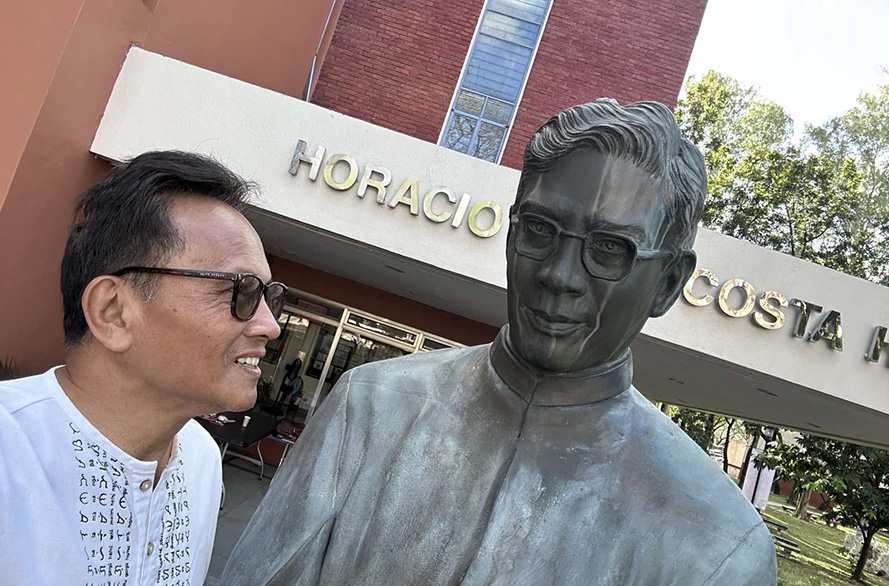
When my father attended Ateneo in the 1950s, many of his professors were Jesuit legends — among them, Fathers Irwin, Bernad, Arevalo, Reuter, and his favorite, Horacio de la Costa, after whom I was named. Yet, when my son graduated from Ateneo just last year, he told me he did not have a single Jesuit teacher throughout his four years. When I lived in Cervini dormitory on campus in the 1970s, we always had at least two Jesuits living with us, and I’d sometimes get invited for dinner at the Jesuit residence. My son, also a Cervini dormer, never had that kind of interaction.
That simple fact says much about how dramatically the university and Society of Jesus have changed.
To be clear, this is less a critique of the Jesuits than it is a challenge to an artificially restricted talent pool. That restriction may once have made sense when Jesuits were abundant and embedded in nearly every aspect of university life. It is far less convincing today.
If the Jesuits can move beyond the assumption that only members of the order can lead their universities, Ateneo could draw from the finest leadership talent available — including laypeople, women, and members of the LGBTQ+ community.
The university has successfully navigated profound change before. Ateneo has been co-educational for half a century. What was once controversial is now accepted as entirely natural. Few alumni would seriously advocate returning to the all-male university of my father’s era.
The same evolution has already occurred elsewhere within the Ateneo system. The all-boys high school where I taught has steadily transitioned to co-education since 2016, consistently counting young women as among its top students.
When I was a novice teacher in the 1980s, our principal was Fr. Luis Candelaria, SJ, a charming and intelligent man but so advanced in years that he had once taught my father in the same high school.
But in our orientation batch was a harbinger of a new era: Carmela “Mel” Canlas, a young math teacher who would eventually marry another rookie from our cohort, Jun-Jun Oracion.
Unlike me, Mel stayed. She earned a doctorate, rose steadily through the ranks, and eventually became the first woman to serve as principal of Ateneo de Manila High School. She is today known nationally as a leader in the education sector.
The school did not lose its identity under her leadership. It, in fact, flourished.
Her success demonstrated something important: excellence, mission, and institutional soul are not confined to gender, clerical status, or religious vows. They can be carried forward by those who embrace the values of the institution, regardless of whether they belong to a religious order.
The Ateneo can do the same at the university level. It can remain proudly Jesuit in spirit while recognizing that institutional identity and clerical leadership are no longer the same thing. It is time to come down from the hill and trust the very people it spent generations forming into "persons for others."
Four decades ago, Fr. Ben Nebres joked about the Jesuits' graying vanguard. Today, that wisecrack has aged into a systemic reality. It is a challenge the university can no longer afford to ignore.

We use cookies to ensure you get the best browsing experience. By continued use, you agree to our privacy policy and accept our use of such cookies. For further information, click FIND OUT MORE.