






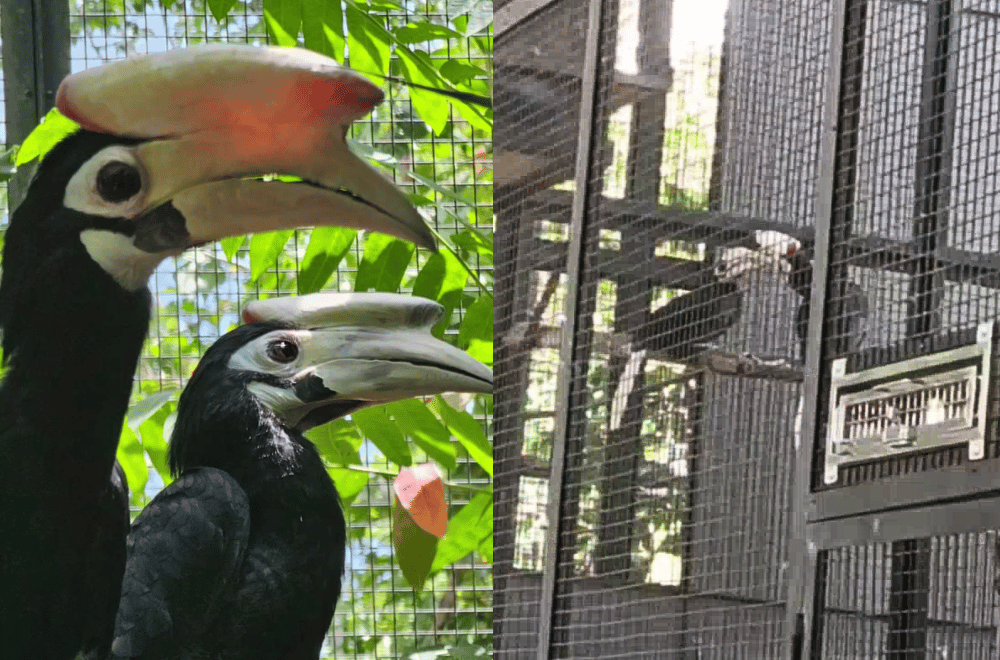
The morning chorus in Narra, Palawan, may soon grow even louder. For the first time, conservationists have bred the Palawan hornbill in captivity successfully, a milestone for the species and those working to protect it.
For conservationists Indira Lacerna-Widmann and her husband, Peter Widmann, those calls mark a long-awaited milestone.
For the first time, Katala Foundation, Inc. (KFI) has successfully bred the Palawan hornbill (Anthracoceros marchei) in captivity, a breakthrough that adds another success story to the group’s long-running conservation work in the province.
“We’ve worked with hornbills for years, but to finally see them breed under managed care here in Palawan, that’s something we’ve only hoped for,” Indira, KFI’s Executive Director, said.
FROM COCKATOOS TO HORNBILLS
Founded in 1998, Katala Foundation is best known for saving the critically endangered Philippine cockatoo (Cacatua haematuropygia) from the brink of extinction. Through years of habitat protection, nest guarding, and collaboration with local communities, the foundation helped restore the bird’s population, particularly on Rasa Island in Narra.
The Widmanns said the success of that program paved the way for broader conservation efforts; including those for the Palawan hornbill, a species considered “Vulnerable” by the International Union for Conservation of Nature (IUCN).
“The hornbill is part of the same ecosystem as the cockatoo,” Peter said.
“Protecting one species often means protecting many others that share the same forest,” he added.
A LONG PROCESS OF TRUST, CARE
Breeding hornbills in captivity is far from simple.
The birds are reclusive and follow intricate nesting behaviors, the female seals herself inside a nest cavity for months during incubation, relying entirely on the male for food until the chicks are ready to emerge.
To simulate these natural conditions, KFI’s team carefully designed artificial nest boxes and monitored the birds’ behavior over several months.
“You can’t force wildlife to adapt overnight,” Indira explained.
“It took years of learning, observation, and patience before we got it right,” she added.
In July 2025, their efforts paid off as two chicks successfully hatched and left their artificial nests, the first captive-bred hornbills recorded under KFI’s care.
LEARNING FROM EXPERIENCE
The Widmanns said this success offers valuable insights that could help conservation breeding for other threatened species, such as the critically endangered Sulu hornbill.
“Learning from this experience of how to breed the Palawan hornbill, we can hopefully assist similar programs in the future,” Indira said.
The couple also highlighted how ex-situ conservation, or breeding animals outside their natural habitat, can support on-site conservation efforts.
“Environmental pressures are moving faster than our capacity to respond,” Indira said.
“Breeding programs like this help us keep pace. They give us a way to prevent species from disappearing altogether,” she added.
COMMUNITY AT THE CORE
Beyond the technical work, the Widmanns believe community involvement remains key to conservation. Many of KFI’s local partners were once involved in wildlife hunting and trapping, but now serve as wardens, guides, and advocates for protection.
“People are the foundation of conservation,” Peter said. “When they see that protecting wildlife brings pride and opportunity, they become its best defenders,” he added.
LOOKING AHEAD
The breeding success of the Palawan hornbill is only the beginning, the Widmanns said. The foundation plans to continue refining its conservation breeding programs for other endangered species, including the Palawan forest turtle and the Calamian deer.
“Every success like this keeps us motivated,” Indira said.
“It reminds us that conservation is slow, but it works, as long as you keep going,” she added.
From the forests of Narra to the isolated corners of Palawan where these birds once freely roamed, the call of the Talusi is a promise that Palawan’s forests can still heal.
Each successful hatch is a reminder that saving a species begins not with grand gestures, but with patience, persistence, and people who choose to care.