We use cookies to ensure you get the best browsing experience. By continued use, you agree to our privacy policy and accept our use of such cookies. For further information, click FIND OUT MORE.
Make this your preferred source to get more updates from this publisher on Google.
Appreciating only 0.07 percent against the US dollar over the past year, Bangko Sentral ng Pilipinas (BSP) Governor Amando Tetangco Jr. said on Thursday the Philippine peso was the least volatile currency in Asia. Tetangco noted that the peso appreciation was slower than the Singapore dollar's 1.14 percent and the Indonesian rupiah's 1.5 percent. The Malaysian ringgit gained 3.23 percent and not far behind, the Thai baht appreciated 3.67 percent, while China’s yuan posted 4.07 percent gain, and the Japanese yen 4.5 percent. First Metro Investment Corp. and the Capital Markets Research unit of the University of Asia and the Pacific have noted that the slower appreciation of the peso translates to higher peso equivalent of dollar earnings of dependents of overseas Filipinos. Exporters and business process outsourcing (BPO) firms also gain from the slower rise of the peso against the US dollar. Tetangco has noted that the US accounts for 75 percent of the Philippines' BPO business.
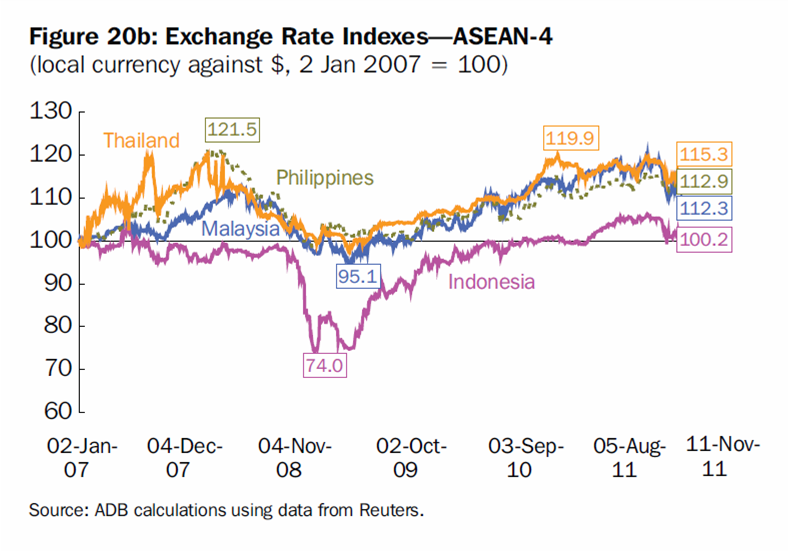
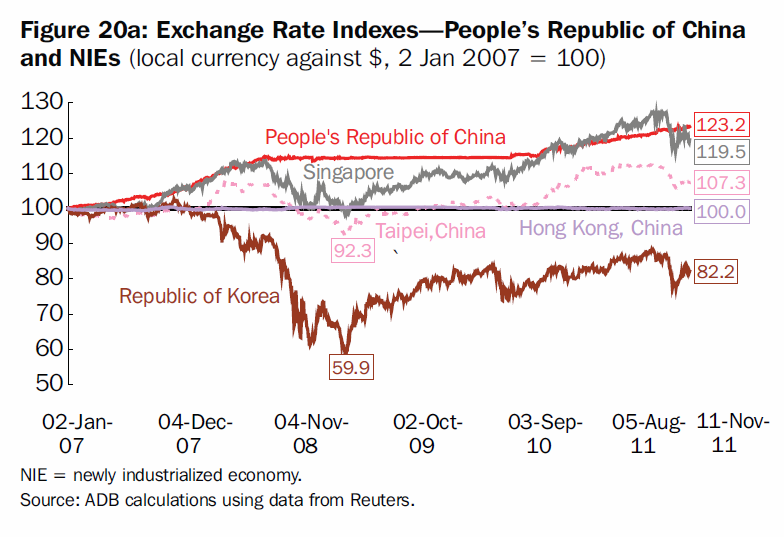
Using Reuters data, the Asian Development Bank showed in its Dec. 2011 Asian Economic Monitor that the PHL peso is among the less volatile currencies in Asia. The dotted red line is the data curve for the peso.
Tetangco said the peso’s lower volatility made it more competitive against other currencies. The BSP in past policy statements had vowed to “smoothen” the fluctuation of the peso-dollar exchange rate so businesses and dependents of overseas Filipinos sending remittances can be assured of predictability in their finances. The Asian Development Bank (ADB), in its Asian Economic Monitor (AEM) report for December 2011, said that from January to November this year China’s renminbi “appreciated the most, gaining 3.9 percent while Viet Nam’s dong depreciated the most, losing 7.2% given the large current account deficit and low foreign exchange reserves." In the Dec. 2011 AEM, which used Reuters data for its computations, the peso appreciated only 1.1 percent versus the renminbi’s 3.9 percent, the rupiah’s 0.2 percent, and Singapore dollar’s 0.3 percent. “In general, currencies that appreciated against the US dollar also appreciated against their baskets of trade-weighted currencies—whether unadjusted or adjusted for inflation,” the ADB said in the latest AEM. As to volatility, which refers to the swings or fluctuations from highs to lows, the AEM said that “since mid-year, exchange rate indexes in emerging East Asia showed increased volatility” but the data curve of the peso has been smoother than those of other Asian currencies. — ELR, GMA News


 GMA Brandtalk
 Tracking
 Archives