We use cookies to ensure you get the best browsing experience. By continued use, you agree to our privacy policy and accept our use of such cookies. For further information, click FIND OUT MORE.
Make this your preferred source to get more updates from this publisher on Google.
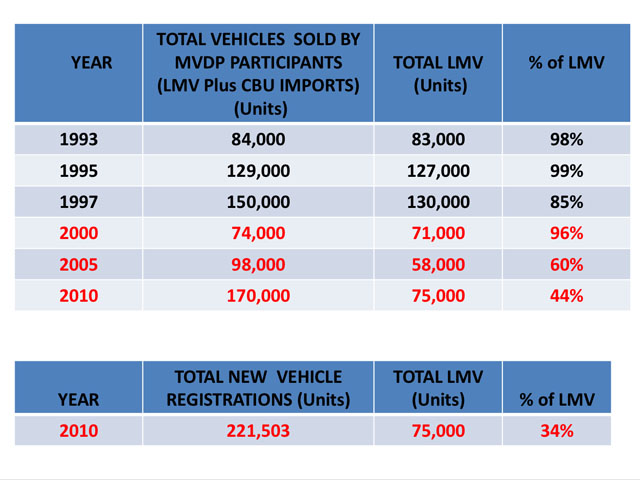
Facing the reality of plunging sales, competition from rebuilt or reconditioned units, and lower tariffs in Southeast Asia, the major car companies and parts makers in the Philippines asked the Aquino administration for “support” lest they “disappear a few years from now.” The Philippine Automotive Competitiveness Council Inc. (PACCI) presented the key elements of their 2012-2020 industry roadmap, which is still a “work in progress,” but they intend to submit it to the Department of Trade and Industry (DTI) by March. The draft was presented to the media on Tuesday.
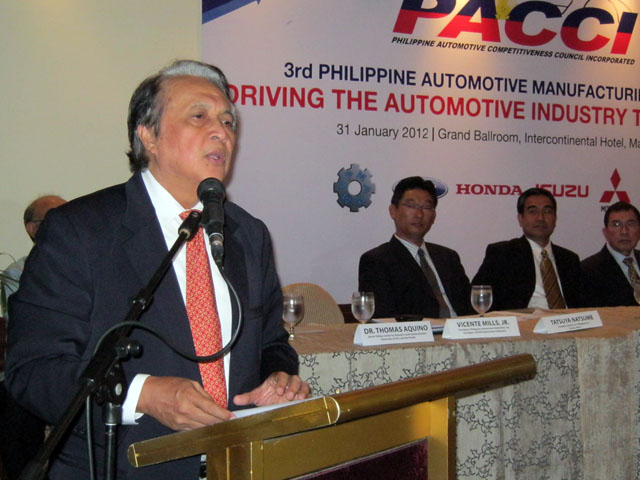
Philippine Automotive Federation president Vicente Mills Jr. presents the draft auto manufacturing industry roadmap seeking support measures from government to help the sector recover from steep decline. Earl Rosero
Feliciano Torres, president of Yazaki Torres Mfg. Inc. and PACCI chair, said in the media briefing that the car industry could vanish if the situation “is not addressed properly” by concerned sectors, including government. Torres and Philippine Automotive Federation president Vicente Mills, Jr. explained that with their production down to roughly a third of 250,000 capacity, the industry needs support to achieve economies of scale through lower costs and overall economic growth that will enable more Filipinos — the middle class in particular — to buy new cars. Mills said gross domestic product growth of 5 to 6 percent over the next several years would enable more of the middle class to afford new cars. He noted that auto loan financing in the country is “relatively expensive” compared to rates in the region. He pointed out that the cost of locally assembled vehicles is comparable to regional prices. “The problem is not the cost but affordability,” said Mills, who acknowledged that the motorcycle is still the “entry level” motorized land vehicle of choice for many Filipinos who cannot afford a new car. Torres said the gap between their output and demand as indicated by the actual number of motor vehicle registered represents an “opportunity we don't want to miss.” Economies of scale PACCI estimates that if the industry could get even just a 60 to 70 percent share of the forecast demand of 330,000 units in 2015, the economies of scale is achieved. Mills showed in PowerPoint presentation that the Philippines is near the key $2,500 per capita income level at which people in other countries experience greater buying power for goods like cars. With Filipinos' per capita income at $2,299 in 2010, Mills said the country “is at the cusp” of being able to afford goods that have so far eluded most of its citizens. In a huddle with reporters after the briefing, Torres said their hope is that President Benigno Aquino III will issue an executive order that will define the “support” his administration will extend to the auto and auto parts industry. Among the options and “reference points” the PACCI may submit to the DTI are lower excise taxes and delay to 2020 the lowering of tariffs for cars under 3 liters and utility vehicles lighter than 3 tons. They also hope to secure some incentives to specific sub-sectors of the industry and better enforcement on laws and policies. Mills said investments of P30 billion over the next eight years can help the sector recover and poise for full integration to the Southeast Asian market. Dr. Thomas Aquino of the University of Asia and the Pacific (UA&P) said every peso invested in the automotive sector leads to P4 worth of economic output. Dr. Aquino is a former DTI undersecretary.
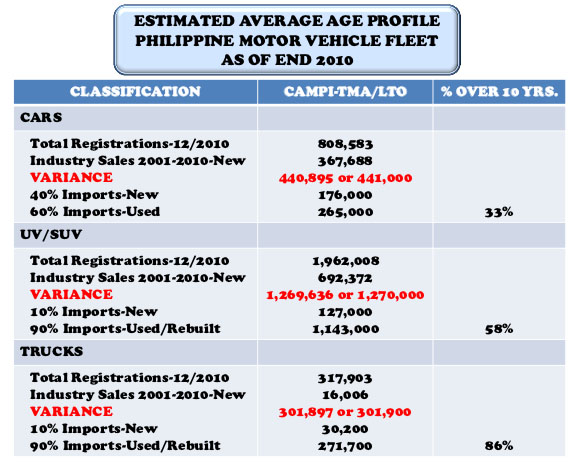
Old vs. new cars The PACCI industry roadmap, developed in tandem with the UA&P, will also present the impact more new cars will have on the country in terms of improved road safety, less road mishaps, better fuel efficiency, and clean air. Citing the wide gap between the number of new cars — imported and locally assembled — and the vehicle registration statistics, PACCI estimates that 55 percent of all registered four-wheel vehicles are 10 years old and older. The "age profile" is worst for trucks, 86 percent of which are at least 10 years old. The profiling showed 66 percent of buses are aged. Incentives Mills noted that the industry has a “weak supply base” and “capability gaps” which the PACCI-UA&P analysis said includes having only two tool and die manufacturers and three stamping plants and 50 active makers of minor parts. Components of the support package need not all come out at the same time, Torres clarified. He expressed the hope that if all falls in place not later than 2015, the country would still have time to vie for its share in the Southeast Asian market, where Mills said Vietnam is emerging as the Philippines' key competition. Torres said he realizes that government “will be choosy in what incentives to give” and will want to see the returns for every incentive it will grant. Finance Secretary Cesar Purisima, one of President Aquino's key economic advisers, earlier said that “(t)he one main thing that we are going to review is our fiscal incentives. In fact, we have to be smarter with fiscal incentives.” Purisima said his department will push for a “Fiscal Incentives Rationalization Bill that will remove redundant incentives to reduce the fiscal costs and ensure that incentives will be given only to those who need them.” — VS, GMA News


 GMA Brandtalk
 Tracking
 Archives

 Economies of scale PACCI estimates that if the industry could get even just a 60 to 70 percent share of the forecast demand of 330,000 units in 2015, the economies of scale is achieved. Mills showed in PowerPoint presentation that the Philippines is near the key $2,500 per capita income level at which people in other countries experience greater buying power for goods like cars. With Filipinos' per capita income at $2,299 in 2010, Mills said the country “is at the cusp” of being able to afford goods that have so far eluded most of its citizens. In a huddle with reporters after the briefing, Torres said their hope is that President Benigno Aquino III will issue an executive order that will define the “support” his administration will extend to the auto and auto parts industry. Among the options and “reference points” the PACCI may submit to the DTI are lower excise taxes and delay to 2020 the lowering of tariffs for cars under 3 liters and utility vehicles lighter than 3 tons. They also hope to secure some incentives to specific sub-sectors of the industry and better enforcement on laws and policies. Mills said investments of P30 billion over the next eight years can help the sector recover and poise for full integration to the Southeast Asian market. Dr. Thomas Aquino of the University of Asia and the Pacific (UA&P) said every peso invested in the automotive sector leads to P4 worth of economic output. Dr. Aquino is a former DTI undersecretary.