

 GMA Brandtalk
 Tracking
 Archives

ADVERTISEMENT
Filtered By: Lifestyle
Lifestyle
Theater: Not crazed enough in 'Doc Resureccion'
+
Make this your preferred source to get more updates from this publisher on Google.
It seems simple enough. “Doc Resureccion: Gagamutin ang Bayan” written by Layeta Bucoy is about corruption, and the grand dream of one doctor, Jess (Riki Benedicto), who wants to change the business of politics in the small town he grew up in. It is about having his cousin Boy Pogi (Jonathan Tadioan), with the same last name, run as a nuisance candidate, paid for by the all-powerful political family that had been running the town since time immemorial. It is about a conversation that needed to be had between Jess and Boy Pogi, a conversation that carries the audience through not just their family history, but also the town’s political landscape.
That in the course of this conversation the audience is set up for laughter is not so much surprising as it is painful: such is our apparent ability at finding humor in the most absurd, because it is the most dire of situations. This is a one-act play that happens in the most impoverished of fishing villages, now worse off than when Jess and Boy Pogi were kids, with more pollution, no running water, no electricity. More importantly, there is no clear sense of change or hope.
In fact the state of affairs is wretched. That it is all familiar, that we already know this of the nation, is at the core of the task mapped out in front of this play. Because portrayals of poverty are easy for us, if not default; because portrayals of poverty always run the risk of romanticization.
For “Doc Resureccion” the suspension of romance happens because there is the wretchedness to deal with. Feces are thrown into the sea, as a drunkard of a man sleeps soundly in a boat as decrepit as himself. The set establishes not just woebegone conditions, but the pits of poverty as we can only imagine it. Here is a space we do not go into, here is a place that is not for us. And we realize it because Boy Pogi’s mother Mang (Sherry Lara) articulates it about Jess: how did you get in here? How will you get out of here?
But what’s also here is not just literal place but also figurative space, created by words painfully pointed, relationships rendered stable by living conditions that are nothing but unstable, yet everything and static. Here is the tragedy of such poverty: it seems to have nowhere to go but up, and yet it is also an end in itself. This is a feeling that “Doc Resureccion” renders through the rest of the conversations in this narrative.
Here, where Boy Pogi and Elsa (Rayna Reyes) represent a relationship we can barely imagine, where sex and desire are as dirty as the surroundings, romance is nothing but a thing of the past and cuss words riddle the relationship. Here, where everyone is in exactly the same place – Mang sells patis for a living, Boy Pogi waits for the tide to turn and in order to harvest some fish from the dying sea, Pang sleeps through the days, Elsa is the prostitute both Boy Pogi and Jess had as teenagers, and her oppression has but turned into one that is within marriage.
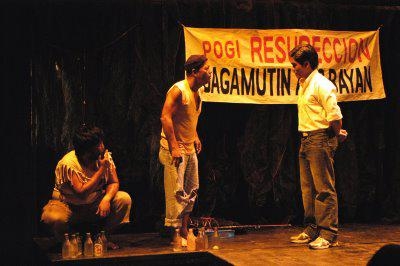 "Doc Resureccion Gagamutin ang Bayan" would've gained points for ending with the crazy. Photo from CCP
 And yet the bigger conversation here remains that between Jess, the Resureccion who is the hopeful idealist, prodigal son of the town, and Boy Pogi, the one who was left behind and has become the dreg of society, reprezent!
Here the conversation feels long drawn out, which might be justified by the fact that Jess and Boy Pogi speak in different languages, the former in rhetoric that’s about change, the latter living off of the silences of corruption. It can also be the fact that what underlies the conversation is the invocation of familial ties, where Jess insists we are cousins, bound by blood, do this for me. And Boy Pogi is operating on not just having been left behind, but being treated as distantly as possible even as Jess and family had come back home – not to the fishing village, but to the more developed area of town, where there’s a hospital to practice medicine in, and a school for the kids.
At some point in this conversation it becomes clear that what had wrought havoc on this relationship was not so much literal distance, as it was the shifts in social class that meant a bigger line drawn between the two cousins. It is at this point that the stereotypical representations of the idealist young and clean politician, and the lumpen proletariat that corrupt politics live off of become a tad bit too textbook for comfort.
Which might have a lot to do with characterizations here. For while these might be characters we rarely see, they are nothing extraordinary or different from what we expect. And in the course of the story, there is no moment in which we are forced to rethink a character, much less the system that allows for this narrative to exist. And no, this is of no fault of the cast that was on all counts competent, nor of a production that only really lacked the sounds of the sea, or the noise of the space, that would’ve allowed for a better portrayal of conditions.
If at all, it could only be the fact that the narrative was going in the direction of an ending that on most counts was anti-climactic. Because it could have ended with craziness, the one that’s brought on by corruption in the lifeblood of the man who’s got nothing to lose. Instead it ended with the sheen of normalcy, where Boy Pogi’s persona is revealed not just as a representation of corruption, but even more so as member of a family that knew of this eventual end. It’s an unraveling that lent nothing to the narrative at all.
It would’ve made more sense for “Doc Resureccion” to end with murder and not an explanation for what motivated it. It could’ve ended with corruption bringing out the crazies instead of making it a narrative of family relationships gone awry. And it could’ve ended without the nostalgia of two little boys coming to represent the past of Jess and Boy Pogi, as if all it takes is a new generation to shine some light on hope.
Especially since there is no sense of hope here, not even with the rhetoric of Jess, precisely because he is all too familiar and we’ve heard it all before. In fact his silencing might have been the most truthful portrayal of how things can and will only get worse, and for towns such as that in “Doc Resureccion: Gagamutin ang Bayan” there is no cure for ailments that are about being kept in the deepest of pits that social disparity continues to create and live off of. Here is a dead end in itself, the crazy and the optimistic included. The cure is far from what’s onstage. –KG, GMA News
“Doc Resureccion: Gagamutin ang Bayan” is a Tanghalang Pilipino production, written by Layeta Bucoy and directed by Tuxqs Rutaquio. It is part of “Eyeball: New Visions in Philippine Theater” which caps the Cultural Center of the Philippines’ 25th Theater Season. It runs until February 11, 2012.
Katrina Stuart Santiago writes the essay in its various permutations, from pop culture criticism to art reviews, scholarly papers to creative non-fiction, all always and necessarily bound by Third World Philippines, its tragedies and successes, even more so its silences. She blogs at http://www.radikalchick.com. The views expressed in this article are solely her own.

