

 GMA Brandtalk
 Tracking
 Archives

ADVERTISEMENT
Filtered By: Topstories
News
UP physicist: Govt overreacting to North Korea rocket
+
Make this your preferred source to get more updates from this publisher on Google.
April 12, the first day of North Korea’s launch window for the test flight of its rocket-propelled ‘weather satellite’ passed without incident as the Pyongyang canceled the launch due to bad weather.
North Korea earlier said they would try to launch between April 12 to the 16th.
The cancellation prompted local civil defense officials to temporarily lift the ban on flights and sailing of seafaring vessels through the expected flight path and debris field.
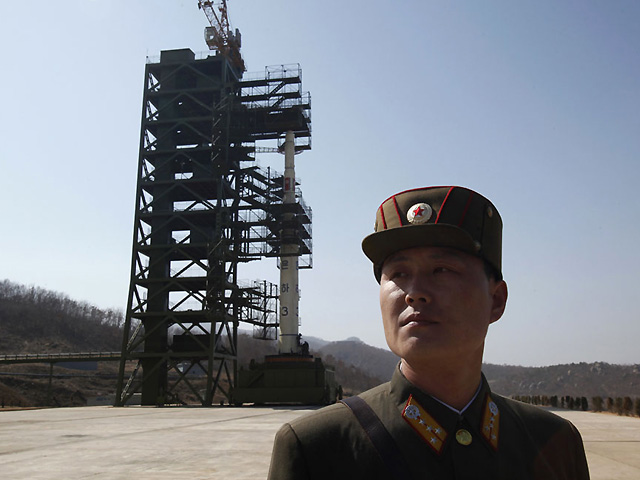
A soldier stands guard in front of the Unha-3 (Milky Way 3) rocket sitting on a launch pad at the West Sea Satellite Launch Site, during a guided media tour by North Korean authorities in northwest Pyongyang on Sunday. Reuters/Bobby Yip
Their most recent one was in 2009 when they used the rocket Unha-2 or Galaxy-2, which is similar to what is planned to be launched this month.
Both rockets use three stages to boost its satellite to its orbit. The only difference is that the direction of the upcoming test flight is from north to south while the Unha-2 flew eastward over Japan. The DPRK claimed that they have successfully placed a Kwangmyŏngsŏng-2 (Bright Star-2) into orbit using Unha-2.
Three stages of boost
What does it mean to have three stages in a rocket?
The target of the rocket launch is to reach a certain velocity and height so that it can deploy its payload – the satellite – into a stable orbit.
This is done by firing successive rockets—called stages—to progressively increase its speed.
Once the fuel is spent, each stage is discarded, separated from the rest of the rocket and allowed to fall down to the earth.
The first stage provides enough lift to propel the whole rocket from the ground. The second stage functions in a similar manner. Both stages are discarded when their fuel runs empty.
A third stage then bridges the remaining gap and positions the satellite to orbital height.
Once the first and second stages are separated from the main body of the rocket, these pieces follow a projectile motion until splashdown.
For the planned satellite launch, the first stage of the rocket is expected to fall into the sea somewhere west of South Korea, just a few hundred kilometers from its launch site.
The second stage's splashdown area is around 200 kilometers away to the east of Philippines.
Will it hit the Philippines?
One concern is that the second stage will overshoot its splashdown area and fall somewhere inside the Bicol region or beyond.
This can only happen if the second stage either separates from the third at a faster velocity than it was supposed to, or if it was launched at a different angle which makes its range longer.
When you throw a rock, you can increase its range by either of two things. Throw it harder (i.e. make it leave your hand faster) or change the angle at which you would launch it.
One should note that the North Korean rocket’s splashdown range already takes into consideration a wide margin of error, as evidenced by the wide area that they reported to the international maritime authorities.
Another concern is that the second stage can hit Cagayan Valley and Eastern Luzon.
There is a small possibility that this will happen if the second stage booster was launched at angle slightly to the west of its original path. This mistake is unlikely and would entail around 3 to 4 degrees of error to the west. Yet note again that the projected splashdown range has already taken into account around a wide margin of error in the rocket's flight.
Another concern raised by the government is that if the second stage explodes, debris might reach the Philippines. This is something easier to dispel.
When a moving object explodes while in flight, the center of mass of its constituent parts will still follow the path of the original object. This is a well-known result of the physics of inertial motion.
What this means is that, even in the unlikely case that the second stage booster explodes in mid-air, its projected trajectory will remain within the original path – give or take a few meters due to the explosion.
This debris will not veer far from the original splashdown target. One should note that the second stage, when separated from the rocket, is essentially just a spent shell without fuel or explosive parts in it.
It could however break up or burn up upon re-entry in the atmosphere but its pieces will still be near the original trajectory and will fall nearby the expected splashdown area.
One can wonder why there is all the hoopla about this satellite test.
South Korea itself tested two rockets several years ago. It tried to launch a satellite at Naro last August 25, 2009 and another last June 10, 2010. Both tests failed to deploy a satellite in orbit.
What was more interesting was that the path that was taken by these rockets to launch the satellites were similar to that planned by the North Koreans we heard neither panic nor warnings from the government.
Debris from the South Korean test fell in Darwin, Australia.
The overreaction of the Aquino government to the launch belies its sincerity in facing the supposed risks.
Rather than seeking a dialogue with the Pyongyang, it would rather join the fray and panic with other countries such as the US, Japan, South Korea and Taiwan.
Its "disaster preparedness" is unprecedented in this instance since we do not see such a level of preparation and activity when typhoons arrive in the country.
It seems that the government has proved that it can indeed mobilize and prepare for a very small risk from space debris, imagined or otherwise, but it seems to be just Noynoying when other disasters strike. — ELR/TJD/HS, GMA News
Dr. Tapang is a physicist and chair of the AGHAM-Advocates of Science and Technology for the People.

