We use cookies to ensure you get the best browsing experience. By continued use, you agree to our privacy policy and accept our use of such cookies. For further information, click FIND OUT MORE.
Make this your preferred source to get more updates from this publisher on Google.
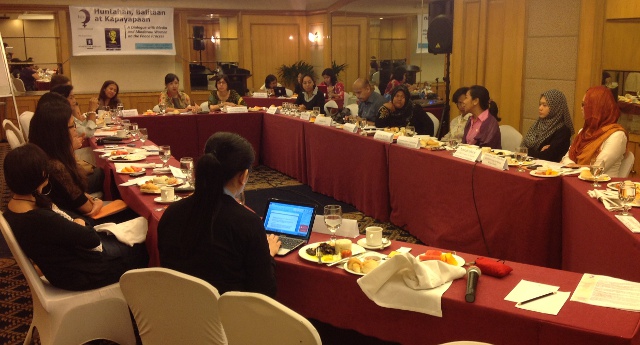
At “Huntahan, Balitaan at Kapayapaan: A Dialogue with Media and Mindanao Women on the Peace Process” at the Richmond Hotel in Pasig City on February 4, Maimona Musa Didatu-Bayan and other women spoke about their experiences in wartime. Photo from the Isis International website
Forced to flee during the all-out war in Mindanao, Maimona Musa Didatu-Bayan and her family struggled for almost a decade to rebuild their lives. Her story is just one of those from millions of women whose voices are left unheard as they are portrayed merely as victims of war. Maimona lived in a far-flung area in Maguindanao province, but were forced to leave their home when former President Joseph Estrada declared the all-out war against the Moro Islamic Liberation Front in 2000. "Masakit pero we have to prefer to leave our locality kay sa matamaan kami ng bomba," she said during "Huntahan, Balitaan at Kapayapaan: A Dialogue with Media and Mindanao Women on the Peace Process" held on February 4. Carrying what they could, Maimona's family fled. Her aunt, who was pregnant with twins, gave birth in a tunnel, while all around them the bombing continued. The twins did not survive. They made their way to an evacuation center in Parang, Maguindanao, but their troubles were far from over. "Hindi ka makakain, hindi gaya sa bahay mo. Natutulog ka nang walang banig," she said. Although they were able to escape danger, life in the evacuation center was also very difficult. Since they had no way to make a living, they tried to sell produce from their farm. But even that was not allowed. "Nagtinda-tinda kami. Para lang mabuhay. Pero 'di naman pupuwede. Pinagbabawalan kami. Pumupunta kami sa farm namin, mahirap kunin ang aming mais, kukuha ka pa ng conduct pass," she said. Maimona had to stop studying, as her family could no longer rely on their farm. They relied on relief goods, but even those were not always given. "Minsan 'di rin kami nakakakuha kasi may nagbibigay ng kung wala, 'pag wala doon hindi ka mabibigyan. Pero paano naman yung mga nanay na naghahanapbuhay, nagpupunta doon sa bukid?" she said. After two years, they returned to their home, only to find that their house had burned down. "Mahirap, kasi mag-start ka naman ulit," said Maimona, who decided to work in Kuwait. "Matagal bago makarecover kaya napilitan ako pumunta ng abroad para tulungan ang aming mga magulang. Pero, hindi rin ako nag-success," she said. Maimona returned home and resolved to go back to school. "Sabi ko sa sarili ko, I have to continue my studies. Kasi kung ganito ako, ano ngayon ang kinabukasan ng magiging anak ko. Anong meron ako? Babae ako, marami akong role," she said. Inspired by Prophet Muhammad's teachings that women are half of a society, Maimona said she realized "a good woman is better than a thousand men." "Sabi ko dapat kahit sa sarili kong pamilya magawa ko... may natapos, may paninindigan sa buhay," said Maimona. By selling kakanin, she was able to pursue her studies. "All praises due unto Allah, I graduated and found a job," said Maimona, who is now an Arabic Language and Islamic Values Education (ALIVE) teacher. "Kaya parati kong inaadvise sa mga bata, kailangan natin ang edukasyon. Lalong-lalo na sa ating mga kababaihan dahil sa bahay natin, maturuan man lang natin ang ating mga anak. Ma-guide natin sila. Gusto ko maempower ang kababaihan. Makaparticipate. Malaki ang maitutulong natin bilang mga kababaihan," said Maimona, who also serves as the Central Mindanao Regional Secretary of Noorus-Salam (Light of Peace), a national network of Aleemat, or Muslim women religious scholars and leaders, peace advocates and women organizations. Maimona is now married, with a two-year-old child and another one on the way. She said finishing her studies gave her a better life, which is why she always tells her students to do the same. "Parang maglalaro ng darts na talagang dapat, dapat tamaan ko talaga na matapos ko ang aking pagaral para magiging modelo ako ng mga kabataan sa Bangsamoro... Para akong sirang plaka pero gusto ko lang talaga i-emphasize sa kanila na iba na ang may natapos," she said. Even a decade after the war, Maimona breaks into tears when she remembers the struggle they endured. "May lolo po ako doon na nabomba, kaya kapag napapagusapan ang, ano durog ang puso ko. Kaya parang hindi ko makaya," she said. After going through so much, she chose to dedicate her life to inspiring others. "I am a Bangsamoro. I want to be a model for the Bangsamoro people," she said. Peace advocate Carmen Lauzon-Gatmaytan stressed that there are many more who share Maimona's story, but the media mostly show women as victims. "Ang mga kababaihan sila yung nakapila, with relief goods, nageevacuate. The images are of women being on the suffering end—the victims. At doon nahihinto ang storya. Now we can hear that Maimona's story did not stop in the evacuation, did not stop at the eruption of the war. It was a long struggle, and women have to really overcome that," she said during the dialogue. Organized by Isis International and WeAct, the dialogue was held to help bring light to the significant role of women in the Mindanao peace process. According to Gatmaytan, women play important roles in transforming society, but these are often left undocumented. "Hindi alam ng karamihan na mas maraming babae are the ones managing these evacuation centers, who are administering all these very tedious very technical work in addressing everyday crises," she said. While there are more women at the negotiating table as well as in leadership roles on the national level, Gatmaytan said this needs to be reflected on the ground. "'Yun yung gusto namin na ipalabas. The voices of these women. 'Yun yung role na ginagampanan naming mga peace advocates... to ensure that susuportahan yung mga kababaihan na ito, who are on the ground now playing important roles in the formal structures," she said. Meanwhile, freelance journalist Lina Sagaral Reyes noted that writing such stories requires resources. "If that can be placed on the agenda of national dailies who have vast networks of region based correspondents, if editors in the newsroom will find this enough to fill a page or half a page and sustain that effort, it will help a lot in making the middle ground and grassroots women more visible in the national consciousness," she said. — BM, GMA News


 GMA Brandtalk
 Tracking
 Archives