

 GMA Brandtalk
 Tracking
 Archives

ADVERTISEMENT
Filtered By: Sports
Sports
Numerophilia: Height versus heart, as La Salle and UST battle in the Finals
+
Make this your preferred source to get more updates from this publisher on Google.
The Finals of UAAP Season 76 have come down to a dominant De La Salle Green Archers squad and the upset kids, the University of Santo Tomas Growling Tigers. What defines these two squads, and what do they have in their arsenal? Read on:
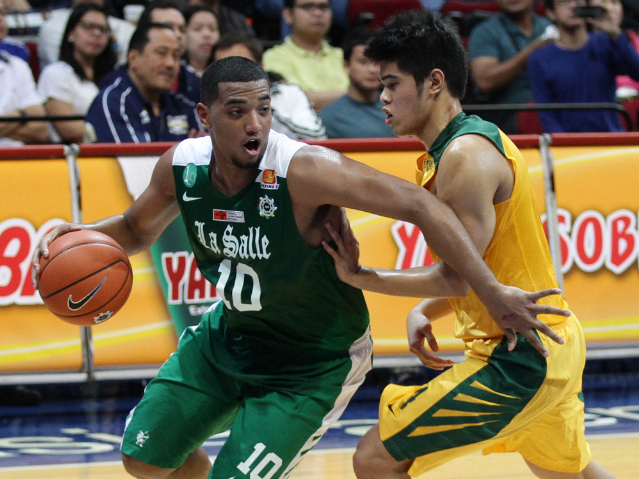
Jason Perkins (L) leads the charge for the hulking DLSU front court. KC Cruz
Big Archers
La Salle is the king of the UAAP hill in terms of size. Between Norbert “The Bear” Torres, Arnold Van Opstal, Jason Perkins and Jeron Teng, La Salle has tons of size to throw around. And that’s one reason why the Archers are the second-best offensive rebounding team (rebounding almost 35.5 percent of their misses) and the best defensive rebounding team (rebounding almost 30.4 percent of their misses).
Due to this inherent size, La Salle’s defense is such a hard nut to crack – between the bodies you need to bump against and the limbs you have to shoot over, La Salle offers a lot of resistance inside. This is a big reason why teams make just 43.9 percent of their shots from the paint when playing against them. The amount of torture you have to go through just to get a look – not even a clean look – is unbearable.
Not just that, Coach Juno Sauler has done a marvelous job of orchestrating a defense designed to leverage La Salle’s size. They are one of a few teams I know of that zones off on a ball screen more than they hedge. This results in a lot of midrange jumpers because the intimidation factor that comes with La Salle’s size, coupled with their overloading defense, forces opponents to make tough decisions. Does the player take the semi-open midrange shot after coming off a screen, or pass the ball to the weakside corner/shoulder for a barely-open three-pointer, due to his defender sagging off all the way to the paint (a big reason why La Salle had one of the highest percentage of shots allowed from three-point range)? That didn’t matter as much since La Salle’s players are either long-limbed (but slow) or quick (Padilla, Vosotros, Montalbo, Torres). La Salle also allows their opponents to shoot just 23.3 percent from downtown (second-lowest in the league).
Combine all of this and what you get is a team that leverages its size to force a lot of misses from the efficient spots on the floor (allowing an effective field goal percentage of just 40.6 percent) and makes sure you’re stuck to just one shot (being the top defensive rebounding team).
Their one key “weakness” is their inability to force turnovers, but that’s primarily because they would rather discourage the pass instead of invite them and gamble for steals. This strategy has worked well for La Salle because it turns the game into a sort of crowded 1-on-1 match between the ball-handler and defender.
La Salle’s defense is what propelled them to the Finals – limiting the potent FEU offensive attack to just 81.6 points per 100 possessions in their series-clinching win. In fact, teams were only able to score above the league average three times against La Salle. That’s a big feat of consistency on defense. Overall, teams scored just 87.3 points per 100 possessions against the La Salle defense.
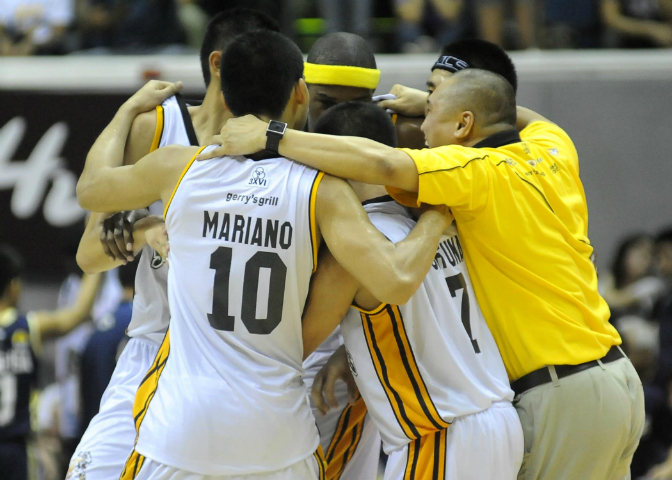
The Growling Tigers leaned on their "heart" to make it to the Finals a season ago, and then again this year. KC Cruz
The Tiger’s heart
When people talk about heart, they usually leave out a lot of important details that matter more to the game than most people realize.
“Heart is giving 110 percent every time you get on the court”.
“Heart is about passion and your will to win”.
Now don’t get me wrong, all of those things matter. But underneath that shiny exterior lies ideas that are far more important and relevant to winning the game.
In fact, when people talk about the “heart” of the Tigers, they usually talk about their energy and their eagerness to mix it up when need be. UST is one of the most, if not, the most, physical teams in the UAAP. They will bump you and they’ll slap across your arms. They’ll do whatever it takes to win – sacrificing their bodies for rebounds, running hard on leak-outs, basically laying down the full brunt of their claws on you.
They’re among the better teams in the league at rebounding their own misses, grabbing almost 34.8 percent. Couple this with the fact that they miss a lot of shots (probably because they’re always leaning and trying to get contact) and you’ll see why the Tigers are the kings of heart.
UST is never afraid to mix it up and they attack the paint relentlessly and without regard for their own safety. They shot 48.7 percent of their attempts near the paint, the third-highest mark in the league, and they get to the line 24.9 times per game, the most of any team. They draw the highest number of fouls in the league too, 21.4 per game. All those numbers point to a team willing to bang in a crowded paint and pit bodies against bodies.
Most importantly, UST’s swarming and frantic defense allows them to discourage not only shots from the inside, but make you miss should you get there. This is possible because they have an assortment of players who are not afraid to mix it up, long-limbed and vertically gifted guys like Kevin Ferrer, Karim Abdul and Ed Daquioag.
Much like La Salle, UST is a defensive-minded team fueled not by a rigid system (unlike La Salle) but rather by spontaneity and energy. Same story, different journey – UST is the second best defensive team in the league, allowing just 85.8 points per 100 possessions.
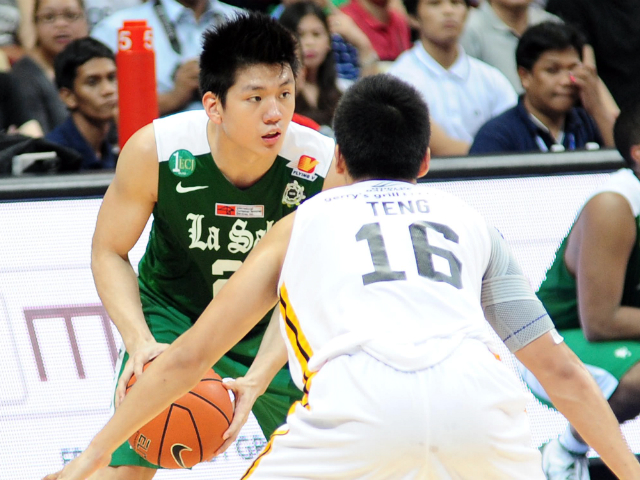
The brothers Teng face off with the stakes at their apex. KC Cruz
Keys to the Finals
1. Rebounding
Both of these teams will fight and battle for every rebound out there, whether it’s from their own misses or from their opponent’s. La Salle has the edge because they focus more on corralling defensive rebounds than attacking the break (unlike UST).
2. Dirty and grimy
I’m not talking about the play, although it could get chippy in there. I’m talking about the game. A “dirty” game is normally associated with misses. With how defensive-minded both these teams are, you can expect there to be a lot of misses from both sides, as they try to force the other team to shoot over the top. One team does it better than the other (UST), but by and large, they’re practically the same fruit from the same tree.
3. Referee issues
With the added physicality (both from the nature of the teams and from the heightened stakes), all eyes will be on the officiating. People will talk about “letting the players decide the game” but that really isn’t the best course of action, I think. Instead, people should be clamoring for consistency. If refs are to call it tight, then call it tight from start to end, If they're to call it loose, then call it loose. A slap across the arm that’s called a foul in the first quarter should not be a non-call in the fourth just because it’s the fourth. A foul is a foul. Plain and simple.
The difference between La Salle and UST is marginal, unlike the difference between UST and NU (a total and complete upset). That’s an issue for another time, but one thing is certain – this is going to be a good, physical series that will not lack for drama and attention. Between the rebounding and the foul-calling and the missed shots, people will not lack for topics to discuss. - AMD, GMA News
Nico Baguio holds a Masters Degree in Mathematics from the Ateneo de Manila University. He's currently a writer for SBNation's The Bird Writes and runs a website that focuses on using advanced statistics on the local hoops scene, HumbleBola. You can email him at contact@humblebola.com and also follow him on Twitter.

