

 GMA Brandtalk
 Tracking
 Archives

ADVERTISEMENT
Filtered By: Scitech
SciTech
'Computerized Titanic' ship older than Christ yields new surprises
+
Make this your preferred source to get more updates from this publisher on Google.
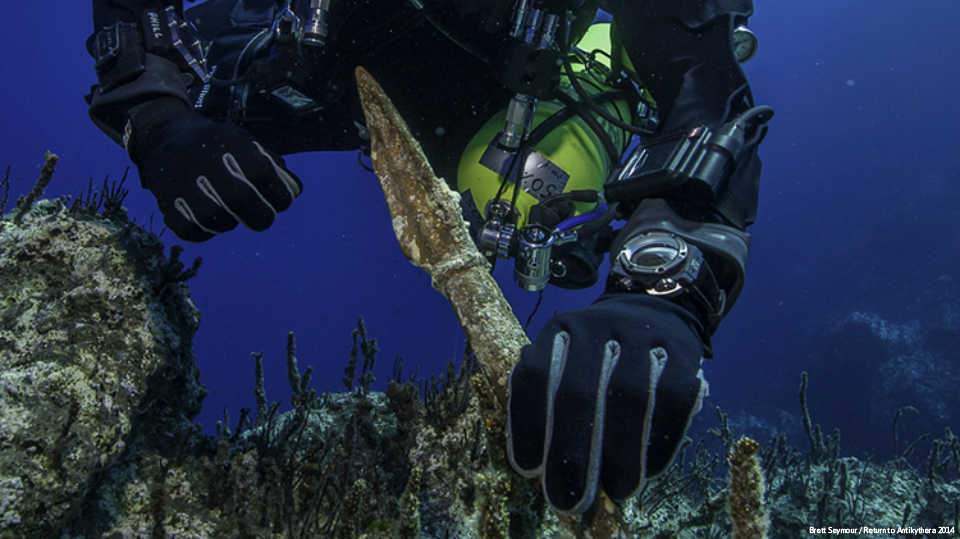
Return to Antikythera project chief diver Philip Short inspects the bronze spear recovered from the Antikythera Shipwreck.
A massive 2,000-year-old shipwreck, famous for having yielded the remains of a complex mechanical computer, is revealing more of its secrets to scientific explorers.
The new discoveries suggest that the ship could be the largest known shipwreck of its kind, "the Titanic of the Ancient World."
Known as the "Antikythera Shipwreck", the ancient vessel was believed to be a luxury cargo ship on its way to Rome from the Greek island of Delos, packed with artworks for the homes of the rich.
It went down in the first century BC near the island of Antikythera in the southern Aegean Sea, taking with it statues, gold jewellery, glass vases, coins and other precious ancient artefacts.
It went down in the first century BC near the island of Antikythera in the southern Aegean Sea, taking with it statues, gold jewellery, glass vases, coins and other precious ancient artefacts.
The wreck was discovered by Greek sponge divers in 1900, who retrieved a wealth of antiquities under difficult conditions.
Ancient computer
However, the wreck is most famous for the "Antikythera mechanism", an ancient Greek astronomical analogue computer from the second century BC, referred to as the world's oldest computer that performed multiplication, subtraction, division and tracked the movements of the sun and the moon.
Famous oceanographer Jacques Cousteau led a second expedition to the wreck in 1976, but its deep remote location, of some 55 meters deep, has made it difficult to reach.

A replica of the Antikythera mechanism on display at the Exhibition of Ancient Greek Technology in Athens, 2005. Its mechanism consists of at least 29 gears of various sizes.
Renewed interest
It is believed that much more lies amidst the wreck on the seabed.
Now, 38 years later, an international team of archaeologists undertook the third expedition, organized by the Woods Hole Oceanographic Institution and the Greek Department of Underwater Antiquities.
Archaeologists Brendan Foley of the Woods Hole Oceanographic Institution and Theotokis Theodoulou of Greece's Hellenic Ephorate of Underwater Antiquities led the international team of scientists studying the wreck.
Dubbed "The Return to Antikythera Project," the first expedition season ran from September 15 to October 7.
Dubbed "The Return to Antikythera Project," the first expedition season ran from September 15 to October 7.
The researchers created high-resolution, 3D maps from stereo images taken by cameras onboard an autonomous underwater vehicle (AUV).
A high-tech robotic diving suit was also used, allowing divers to go deeper than otherwise possible.
Real-life Iron Man
"It's basically a wearable submarine," said diving specialist Phil Short of the $1.5-million suit.
He added the pressure inside the suit "is no different from being in a submarine or in fresh air."
"We can go straight to the bottom, spend 5 hours there and come straight back to the surface with no decompression," he said.
The mission, which was wrought with rough weather since it began on September 15, has now ended, but will continue again in the future, as it is believed more treasure is to be found at the site.
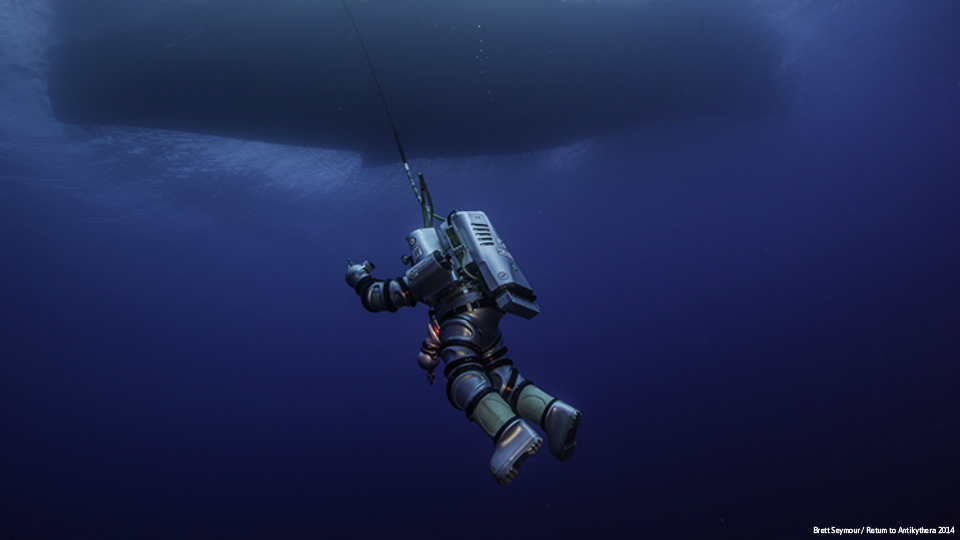
WHOI diving safety officer Edward O'Brien "spacewalks" in the Exosuit, suspended from the Hellenic Navy vessel THETIS.
'Titanic of the ancient world'
Divers were able to recover numerous ship components, including several meter-long lead anchors, hull planks, and bronze rigging—possible proof that much of the ship may still be intact.
The extent of the wreck, coupled with the sizes of the discovered components, suggests that the Antikythera ship was bigger than initially thought. Experts believe it may have been as much as 50 meters long.
"The evidence shows this is the largest ancient shipwreck ever discovered. It's the Titanic of the ancient world," Foley said.
Other discoveries
The Greek Ministry of Culture has released video and photographs of the mission, where underwater archaeologists recovered a two metre solid bronze warriors spear, believed to be part of a large statue. They also found a nearly intact table vase and part of a bed.
The Greek culture ministry also said that, based on the information collected, another shipwreck may be located in the same area.
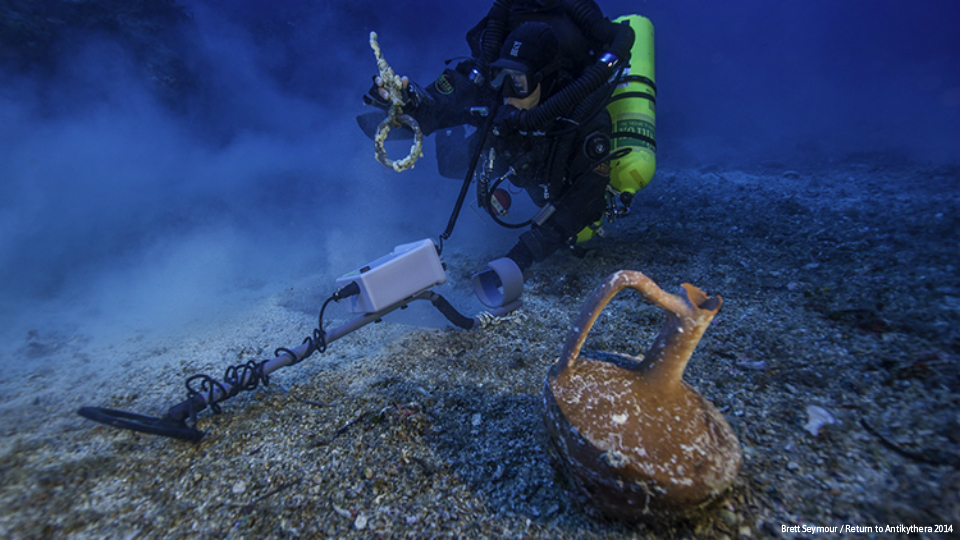
Greek technical diver Alexandros Sotiriou discovers an intact "lagynos" ceramic table jug and a bronze rigging ring on the Antikythera Shipwreck.
— with reports from Reuters and the Woods Hole Oceanographic Institution, GMA News

