

 GMA Brandtalk
 Tracking
 Archives

ADVERTISEMENT
Filtered By: Cbb
Community Bulletin Board
Call for papers, posters for the 3rd National Communication Research Conference
+
Make this your preferred source to get more updates from this publisher on Google.
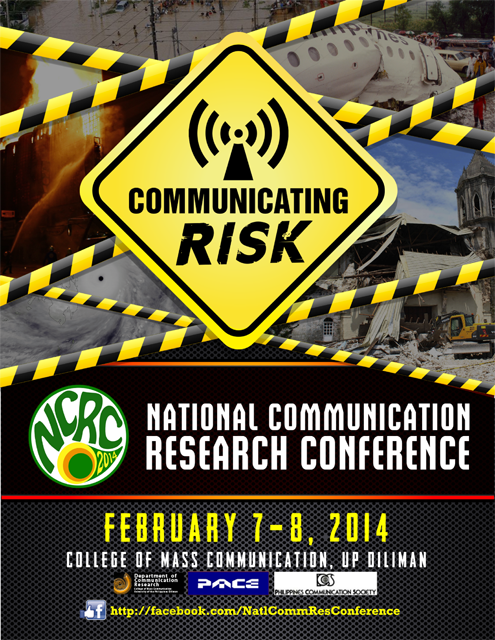
The official poster.
In 2007, the Communication Research Department of the University of the Philippines Diliman launched the 1st Communication Research Student Conference (CRSC) as a venue for students of communication and media to disseminate and share their studies with their peers, mentors, and other scholars within and beyond the UP. The Conference consisted of 20 paper presentations, which represented the best theses and studies done the previous year by undergraduate and graduate students. Over 300 students and faculty members from different colleges and universities in Metro Manila and parts of Luzon attended the Conference.
Designed to be a continuing activity, the 2nd and 3rd CRSCs were held in 2008 and 2010, which showcased 30 papers each, authored by students from various schools in Metro Manila. Attendance grew to around 600 participants for each conference.
With the overwhelming success of, and high participation in, the three student conferences, the Communication Research Department was inspired to go beyond showcasing papers of Metro Manila students. In 2012, it introduced three major changes in the CRSC: it invited students and scholars from all over the country to participate in the conference, added a post-conference workshop for communication and media teachers, and tapped the Philippines Communication Society (PCS) and Philippine Association of Communication Educators (PACE) as conference co-sponsors. With the expanded scope of the Conference to benefit not only students but also teachers of communication and media, the CRSC was renamed as the NATIONAL COMMUNICATION RESEARCH CONFERENCE (NCRC).
The 1st NCRC was held on 13-14 January 2012 with the theme “Creatively Rediscovering Communication and Media”. The 2nd NCRC took place on 14-15 February 2013; its theme was “Communication Research in a Glocalized World”.
The 3rd NCRC will be held on 7 and 8 February 2014 at the College of Mass Communication, University of the Philippines Diliman. The theme of the 2014 NCRC is “Communicating Risk”. Just like the first two NCRCs, the forthcoming NCRC will feature paper presentations and a post-conference workshop for teachers. However, there will also be two new events in the Conference: a poster presentation of best practices in disaster management, and a lecture on disaster reporting.
2.0 Objectives
The general aim of the NCRC is to promote awareness about the importance of communication
research.
In particular, it seeks to benefit the students by providing them with a venue for:
- Developing their research writing and presentation skills;
- Sharing their research activities and findings with other communication and media students, teachers, and practitioners nationwide; and
- Networking with their peers and with professionals from all over the country.
- Provide them with updates on the status, teaching and conduct of communication research in the Philippines; and
- Identify areas of collaboration among faculty members from the different regions.
3.0 Conference Format
Conference Proper
The first day of the Conference will have an opening program, one plenary session, and panel
presentations in parallel sessions. For the opening program and plenary session, the speakers will be well-known practitioners in the field of risk communication. The parallel sessions will consist of papers that have passed the screening process but were not shortlisted for competition. Presenters will be allotted 15 minutes each for their presentation, and a 15-minute open forum will follow after all the session papers have been presented.
On the second day of the Conference, the morning session will be devoted to the presentation of the students’ papers shortlisted for competition. There are no breakup sessions, so that the judging panel would be able to evaluate all papers en banc. Each presenter will be given 20 minutes for the presentation, and a 5-minute Q&A will follow each presentation. Only eight papers will be selected for the competition; the top 3 of these eight papers will be given awards.
In the afternoon, the one-hour lecture on disaster reporting will first be held, to be followed by the announcement and awarding of the research competition winners and the formal closing of the Conference.
Poster Presentations
The poster presentations will be formally launched in the afternoon of Day 1 of the Conference, and will remain on exhibit until the closing of the Conference. During the launch, the poster presenters will be given 3 minutes each to talk about their poster presentation. For the remainder of the exhibit, the presenters will be asked to designate a representative who will be on hand to answer questions from the exhibit visitors.
Post-conference Workshop
The post-conference workshop will be held in the afternoon of the second day, after the formal closing of the Conference. The topic for this year’s NCRC post-conference workshop is “Research Ethics”.
4.0 Submission of Abstracts, Full Papers, and Posters
Research Papers (for Presentation and for Competition)
Only students’ papers (sole authorship or co-authored with other students) are eligible for submission. There should be no more than five co-authors of a research paper, and all authors must be bonafide students at the time the research was/is being undertaken. For completed researches, only those undertaken not earlier than AY 2012-2013 will be considered. Submissions based on researches completed before AY 2012-2013 will not accepted by the Conference organizers.
Participation is open to all students in ALL degree programs, so long as the submission falls within the conference theme. Students, in this case, include not only those currently enrolled but also those who have graduated, so long as their last enrollment in their university/college was in AY 2012-2013 or later.
An extended abstract must be submitted on or before 10 January 2014 to natlcommresconference.2014@gmail.com, cc to vaumali.commres@gmail.com.
Submission must reflect the conference theme “Communicating Risk” and may be any topic related to the different types of natural (earthquakes, typhoons, climate change, etc.) and man-made (pollution, armed conflict, industrial hazards, etc.) disasters, and on any aspect of disaster prevention, mitigation, response and rehabilitation as long as the focus of the paper is on the role of communication in the phenomenon under investigation.
The extended abstract not exceeding 4 pages (letter size paper, standard margins, Times New Roman 12) must include information on the following: 1) the research problem and objectives, 2) study framework, 3) methodology, 4) key findings if available or key arguments/relationships to be tested/verified if the study is ongoing, and 5) conclusions, if also applicable.
Aside from the extended abstract, proponents must also submit a 150-word write-up about the author/s. Information about the proponents’ institutional affiliation and contact details (phone number, email address) should be included in the write-up.
Production theses will also be accepted.
Posters
Initiatives on disaster management – for example, a disaster relief operation, a community-based project on disaster prevention, a collaborative program with a government and/or private agency – spearheaded by the college/university itself, one of its offices or academic units, or one of its student/employee organizations – will be featured in the poster presentations. The initiative need not be focused on communication and must have been conducted not earlier than AY 2012-2013.
A 500-word abstract must be submitted containing the following information: the nature and objectives of the project/initiative, the participating groups/institutions (including the intended beneficiaries), the main activities undertaken, the duration of the project, and its key outcomes.
The submission must include the name, affiliation, and position of the person to whom correspondence regarding the poster presentation should be addressed. Please indicate in your email subject whether submission is for paper or poster presentation.
Selection of Papers and Posters
A Screening Committee consisting of faculty members of the UP-CMC Communication Research Department, and representatives from PCS and PACE will screen the abstract submissions for both paper and poster presentations. They will also select the eight papers to be included in the research paper competition.
All proponents will be informed on 15 January 2014, Wednesday, about the result of the screening. Those who have been shortlisted for the research paper competition should submit their full paper by Friday, 24 January 2014. Guidelines for the paper and poster presentations will be sent to the accepted proponents, also on 15 January.
5.0 Conference Fees
The Conference registration fee is PhP300 for students (undergraduate and graduate) and PhP300 for professionals and teachers. For paper and poster presenters, the registration is free. If the proponent of a paper or poster presentation is a group, up to five members of the group can avail of the free registration. The remaining members will pay the regular fee. For teachers, the registration fee will be waived for every ten students s/he will be bringing to the conference.
The registration fee covers the conference kit, AM and PM snacks on Day 1, and AM snacks on Day 2.
Participants are requested to pre-register.
6.0 Further Information
Inquiries should be directed to the UP-CMC Department of Communication Research via email or by calling (02) 920-6866. Details about NCRC 2014 will be posted on the Conference website. Like and share the Conference Facebook page.
Press release and photo from National Communication Research Conference

