

 GMA Brandtalk
 Tracking
 Archives

As jobs change, AMCP pushes new ways to recognize learning and skills
MANILA, Philippines — Philippine higher education needs to rethink how it recognizes learning and skills as artificial intelligence, technology, and changing industry requirements reshape the workplace, according to Dr. Howell Ho, president of the Association of Micro-Credential Council Philippines (AMCP).
Dr. Ho said micro-credentials can complement traditional college degrees by giving learners a way to acquire and demonstrate specific competencies throughout their careers.
“The question is not whether the college degree is still relevant. The question is whether a degree should be the only way we recognize what a person has learned and can do throughout a career.”
Dr. Ho, who also serves as Vice President for Sustainable Partnerships and Lifelong Learning at Trinity University of Asia, said the issue is becoming more important as workers face the need to continuously update their skills.
A student may spend several years earning a degree, but the skills required in a particular industry can change significantly during that person's working life. Employers, meanwhile, increasingly need ways to identify current competencies, while universities face growing pressure to provide learning opportunities beyond traditional degree programs.
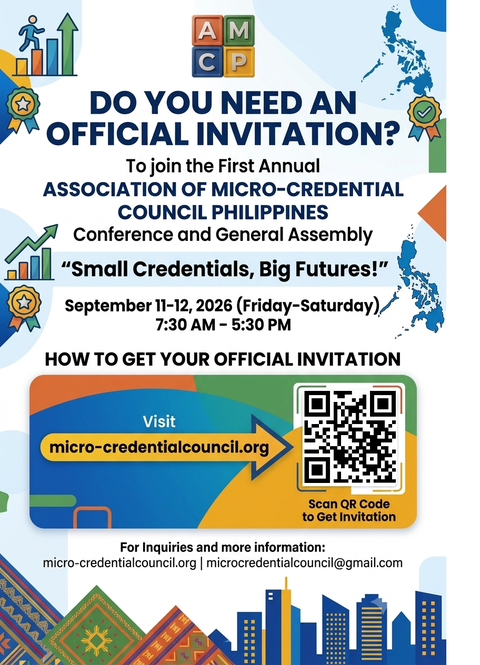
This is the context behind the First Annual Conference and Assembly of the Association of Micro-Credential Council Philippines, which will be held on September 11–12, 2026, at the SMX Convention Center, Mall of Asia, with the theme “Small Credentials, Big Futures.”
The two-day conference will bring together leaders from higher education, government and industry to discuss the role of micro-credentials in lifelong learning, skills development and employment.
Beyond another certificate
Micro-credentials are focused learning experiences designed to recognize specific knowledge or competencies.
For AMCP, however, the discussion goes beyond offering shorter courses or issuing additional certificates.
Questions of recognition, assessment and credibility also need to be addressed: Who should issue a micro-credential? How can competency be demonstrated? Will employers recognize it? And how can micro-credentials work alongside traditional degrees?
These issues affect not only higher education institutions but also students, professionals and employers.
“We are not talking about degrees versus micro-credentials. We are talking about building a learning ecosystem where degrees, professional learning, industry training, micro-credentials, and prior learning can all contribute to a person's lifelong development.”
Changing the way we learn
Dr. Ho said the discussion also needs to consider how education itself must evolve as lifelong learning becomes more important.
“Learning can no longer be something we think of as ending when a person receives a diploma. People will move across jobs, industries, and careers. They will need to learn, relearn, and demonstrate new competencies throughout their working lives.”
This will be among the issues discussed during the conference's opening session, “Micro-Credentials, Macro-Leadership: Governing the Future of Work.”
Commission on Higher Education Commissioner Dr. Michelle Aguilar Ong will discuss “The New Currency of the Labor Market and the Future of Philippine Education,” while Mapúa University President Dr. Dodjie Maestrecampo will examine “Re-engineering Degrees in the University of the Future.”
UP Open University Chancellor Dr. Joane Serrano will discuss the shift toward career pathways and open, borderless learning.
The conference will also examine new approaches to lifelong learning and competency development, the assessment and validation of skills, and the connection between micro-credentials and employment.
The issue of trust
For Dr. Ho, one of the biggest challenges facing micro-credentials is establishing confidence in what a credential represents.
“A credential is only as valuable as the evidence behind it. If we want employers and learners to trust micro-credentials, we have to be serious about assessment, standards, and quality.”
The second day of the conference will therefore focus on assessment, including authentic assessment of skills, assessment modalities, rubric design, bias-free scoring, standardized assessment, and the recognition and validation of prior learning.
The conference will also examine how micro-credentials can address actual industry requirements and improve the connection between learning and employment.
Part of a bigger education conversation
For Dr. Ho, the discussion about micro-credentials is ultimately part of a broader conversation about the future of Philippine education.
“Whether you are a student preparing for your first job, a professional building a new career, an employer looking for talent, or an education leader preparing for the future, the way we recognize learning and skills will increasingly matter.”
The conference is particularly relevant to college and university administrators, academic leaders, faculty members, government representatives, industry and HR leaders, training and learning professionals, and others interested in the future of skills, credentials, and lifelong learning.
The First Annual Conference and Assembly of the Association of Micro-Credential Council Philippines, with the theme “Small Credentials, Big Futures,” will be held on September 11–12, 2026, at the SMX Convention Center, Mall of Asia.
Registration and conference information are available at www.micro-credentialcouncil.org.
“The question is no longer whether Filipinos will need to keep learning. The question is how we make that learning count.”

