We use cookies to ensure you get the best browsing experience. By continued use, you agree to our privacy policy and accept our use of such cookies. For further information, click FIND OUT MORE.
Make this your preferred source to get more updates from this publisher on Google.
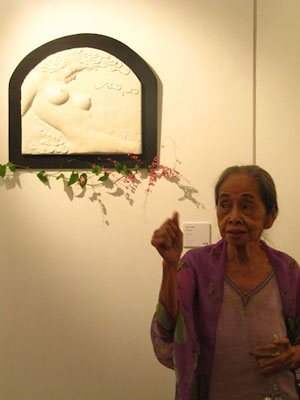
There’s a calm austerity, an ironic cold serenity that you seem to step on and walk through, palpable and real like sinuous white cloth, in a room filled with Agnes Arellano’s new work. And as you stand in front of each sculpture hanging on the wall, you are wrapped in layers of history and knowing, of body and womanhood, of self and tradition unlike any other. In that tiny room filled with seven works, you can only take it all in: breathe in the scent of incense, adjust to the stark white of the room, the beautiful cast marble sculptures attached to dark wood. There’s a moment of uncertainty in the fact of these sculptures being tacked on these walls, in these women’s bodies in cold white marble, a line crossed between what’s expected and the defamiliarized, the one-dimensional come alive, the three dimensional tied down. As a tribute to her great-uncle Lolo Juan, the work in Apaga La Luz (porque me molesta) – Turn off the light because it bothers me – crosses the line between family and the public, the familiar and the new, and is necessarily a reconfiguration, if not a re-imagination, of the histories that tie these things together. Juan Arellano, a known architect of classical structures such as the Post Office and other Commonwealth buildings, painted little known – or seen – impressionist images of women in various poses, from the early 1900s to the 1950s. These images are reproduced in Apaga La Luz, literally in the pages of its curatorial notes where the spectator might be seeing the oil paintings for the first time, but also creatively in the set of works inspired by it, that take from it, that live because of it. In 2011, great-granddaughter Agnes re-renders these images she grew up knowing, she had in her blood, long before she even thought it relevant. But it can only be more than that now, given the shift from one medium to another, the decision to render it in sculpture as tacked-on-the-wall painting. Even more so the fact of woman and womanhood, of the erotic and sensual – a necessary sexiness if you will – that happens on both the levels of sculpting the woman’s body, and choosing the stark white marble as medium: it ain’t as cold as you imagine.
Poet and playwright par excellence Virginia Moreno makes a rare appearance and tells stories at the exhibit
Especially since Juan’s original work renders women in positions that seem to be formally posed on the one hand, some wonderfully imagined on the other. Where in “Salome" the woman holds the head of John the Baptist close to her right breast, seemingly replacing the breast with head, both man and woman looking up in possible ecstasy, feeding of off each other’s presence, the power seamlessly divided between the two. In a painting from 1913/1927, with remnants of blood on the plate, on Salome’s breast, this could only be powerful; in stark white marble in 2011, the power lies in a portrayal almost delirious. The same change in the basic image might be said of “Untitled," which in the original portrayed the monstrosity and violence of woman straddling animal, but which in the 2011 version becomes almost a quiet rendering of man as beast as man, where the woman is not object but subject and powerful in her posture. While less about power, there is surprising whimsy and seeming strength in the women’s poses here, especially as rendered in cast marble where, viewed from different angles, the woman looks more alive, more concrete, more woman than she does in the original oil paintings. In the movement from one medium to the next, it is detail that becomes palpable, as it is erasure. Where in “Zapatos" the woman’s pose happens from the high-heeled shoes to the tips of her fingers resting innocently but in check against the seat. Where in “Apaga la LuH, Porque Me MoleHta" the absence of the couch and color in the original meant a loss of depth, yet the sculpture itself is a re-imagination of depth not as something that’s within a painting, but is outside of it, towards spectator, where breasts and body and extremities are protrusions powerful and beautiful because matter of fact.
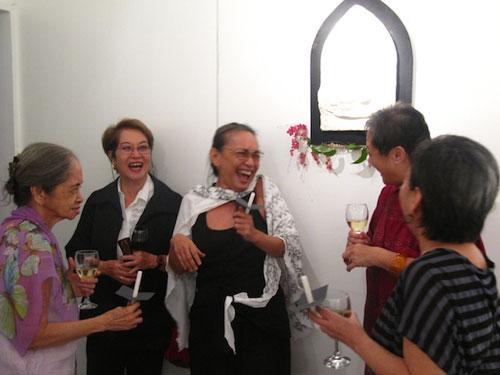
Virginia Moreno, Deanna Ongpin Recto, Adelaida Lim and Angela Stuart-Santiago share laughter and history with artist Agnes Arellano (center)
In “Tempesta" and “Venus" the women’s postures are of bliss, a ravishing if you will, that changes intensities as spectator moves from one standpoint to another. “Tempesta" is woman on fire, in the sky, with the winds, in water, body turned against spectator and towards the elements, the curve of her back, the tendrils of hair part of the seeming euphoria. “Venus" pulls down the towel wrapped around her waist, full frontal powerful, but from the angle of the arm raised towards the head, the curves of the breasts, the face looking away, quiet individual sensuality. But it’s in “Smoking Juanita Angel" that the reconfiguration of an original into sculpture tacked on a wall becomes brilliant in the fact of details chosen, of rendering what is crucial to the fleeting moment of smoking a cigarette, on the bed, hand on crotch, post-coital like no other. The daring shouldn’t be lost on anyone, the trail of cigarette smoke, the pillow turned angel wing a paean to the transience we refuse to speak of, where our bodies remain ours, no matter whose bed it lies on, where the body is only about ours for as long as that cigarette lasts. In the span of time that one lives in this room filled with these women’s bodies, it becomes clear that while Apaga La Luz might be Arellano’s homage to an ancestor, it is also more than anything a tribute to being woman, to owning the body, to exalting its form, to rendering it differently from one medium to the next, from a gaze that’s male to female, which allows it to resonate and bear energy and dynamism that can only be a gift to the current notions of woman and womanhood. And in this room, on an otherwise regular Saturday night, the woman artist and her friends wrap themselves in a sisterhood that has with it histories well-remembered, lives well-lived, the past in the presence of the stark white marble bodies of women, in the voices and laughter of women alive and well, of their time and the present. - YA, GMA NewsApaga La Luz is ongoing at the Now Gallery along Pasong Tamo Extension, Makati City from Sept. 10 to Sept. 30, 2011.


 GMA Brandtalk
 Tracking
 Archives