

 GMA Brandtalk
 Tracking
 Archives

Lighting the shadows: Maguindanao after the massacre
My first glimpse of “Under the Lord's Shadow", Jes Aznar's new photo exhibit at the Kanto art space, was at the occasional Bedroom Lab lectures organized by Tengal Drilon. He presented a slide show with a haunting musical score, and it depicted photographs from the province of Maguindanao. Not far from his mind and indeed from ours were the events of November 23, 2009. This day is now observed as the International Day to End Impunity. Last night, Aznar's exhibit opened to culminate a day of action against impunity. Representatives from the National Union of Journalists of the Philippines were present, having come from a protest action at Mendiola Bridge. They spoke of the events of two years ago and what the exhibit was meant to awaken—a sense of the beauty of that particular place and a willingness to explore the causes of the crisis that led to the massacre. 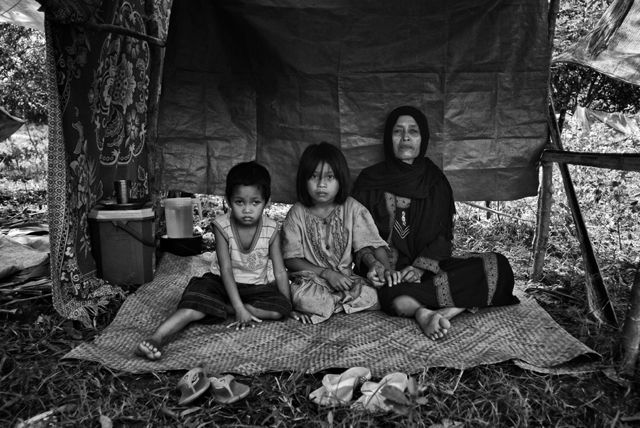 Aznar has covered the country's highs and lows as a photojournalist for, among others, the New York Times and this news portal. His 2008 trip to Maguindanao was, however, an eye-opener that changed his life. For him, this place represents a microcosm of the country. "[The province] is like the Philippines, with its problems magnified ten times over," he says. “It is one of the poorest provinces, with large economic disparities between the social/political elites and those outside their circle. One poignant shot which I still recall from the Bedroom Lab presentation involved children waiting to take whatever corn was left after a husking machine went through dozens of cobs. And then there was, in contrast, shots of the very clean and well-lit place that was the Autonomous Region of Muslim Mindanao governor's residence." The photos show scenes of everyday life or what has become of it in parts of Maguindanao. There are scenes from evacuation shelters where people flee to during clan wars and other times of tumult. Two shots show Muslims at prayer. But the scenes are a stark contrast: women praying in a ramshackle space, and local leaders at a function in a place that looks far from makeshift. Poignant tale The exhibit does not flinch from showing the signs of violence. There are armed men in some shots, and in one shot, a body is being carried away on a stretcher. It could be the only shot, I surmise, from the aftermath of that tragic day in 2009.
 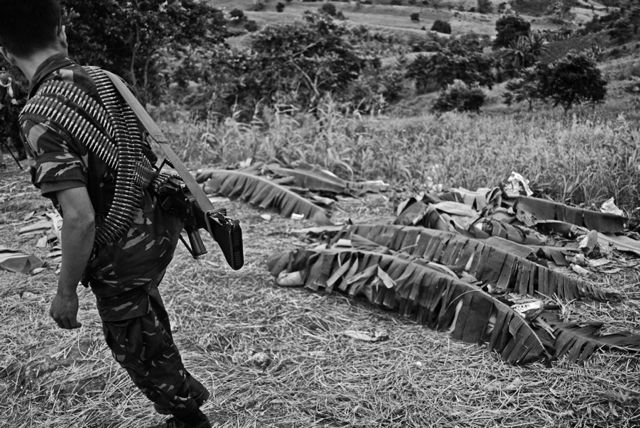 And from last year, a scene from the general elections showed a crowd mobbing a polling station in the town of Shariff Aguak. While talking to a reporter from a local Japanese paper, Aznar explained that the polls were rigged to begin with but it was a wonder that people clamored to vote. Aznar told me later that "our inequalities show that we aren't really a democracy yet." It is a poignant tale, a tragedy that could lead to periodic bouts of national hubris. The poignancy lies in the medium; all the pictures are in black-and-white, and in many ways it adds a gravitas to this show that color would not have. Last year, during the days of Jake Versoza's Manila Collective venture, I was made aware of the contrasts in seeing Nana Buxani's own work in an artist's talk she gave that year. It then did not surprise me that this choice was made: Buxani's work deals largely with questions of social inequality and its effects, and Aznar's work, set in one of the poorest yet beautiful parts of the land, tells an almost similar story. The challenge posed by this exhibit is whether or not the sorry state of things could change. I asked Aznar though whether things had indeed changed in the time he had been there, especially after November 2009. "Nothing has changed," he said. And to paraphrase a slogan used by a vice-presidential candidate last year, it may be that "kung ganito ang Maguindanao, ganoon din ang buong bayan." That may be why last night the hope lay in those who could tell the story and shake people out of their cynicism and indifference. At least that is what filmmaker Gym Libiran, one of Kanto's partners, said. These are sentiments, though, with which I would not disagree. After all, Hamlet's last wish was to have Horatio, his dearest friend, tell the world the truth. The tragedy needs to be retold. This time, we use words when needed. –KG, GMA News

