Ah, the Chinese New Year is upon us. Whether one is of Chinese descent or not, it is so easy to get swept up in celebrating what is also known traditionally as the Spring Festival. Tikoy, hopia, mooncake? Pinoy, Tsinoy? Kung hei fat choi! That means, Wishing you prosperity and wealth. We splurge on getting charms and trinkets and loud firecrackers to drive evil spirits away, attract good luck, good health, and the blessings of long life.

Lion dances and dragon dances are believed to bring good luck.Photo by Sophia Cuevas
The Chinese in the Philippines figure in practically the entire history of the country. Others say even beyond. The first Chinese probably arrived in the archipelago as traders. Porcelain from the Ming Dynasty (1368-1644) unearthed in construction sites are living proof of the civilized interaction between the pre-Hispanic Filipinos and the Chinese. Today, Filipino-Chinese communities and Sino-cultural enclaves, or “Chinatowns,” bear witness to how trade, commerce and culture flourished and evolved through the centuries. In Cebu, Davao and Manila there is a Chinatown. The presence of the Chinese in our history is more than enough reason for Malacañang to declare the Chinese New Year as national holiday, practically the first in the calendar year after Jan. 1. Not to mention that President Benigno C. Aquino III is of Chinese descent, and his middle initial stands for Cojuangco. His great-great grandfather, Co Yu Huan of Hong Chian town in China’s Tongon province arrived in the Philippines in 1861, converted to Catholicism and was baptized as Jose Cojuangco. [See:
Cory Aquino's family tree.]
Dancing dragon, smokeless firecrackers Manila’s Binondo District is, of course, the Chinatown of the Philippines, which the Spaniards established in 1594 as an enclave for the Chinese who have converted, in lieu of the old Parian where the non-converts resided. Binondo is said to be the world’s oldest Chinatown. More than six centuries later, there is a relatively new product in town —electronic firecracker — that, according to a sales lady in Binondo, is getting a lot of attention. Made in China, of course. These electronic firecrackers are smokeless, and thus eco-friendly, and are bound to bring in lots of luck as the device can fire “infinite rounds” as long as they are plugged into the electric outlet. They are produced by a company based in Hunan, China,
the Liuyan Victory Celebration Product & Equipment Manufacturing Co. Ltd. The shopkeepers in Binondo are all smiles as customers inquire about the electronic firecrackers and lucky charms — how much, and then haggle for the best deal. Once a good luck charm is bought and sold, the shopkeeper reveals the secret: harnessing positive energy by uttering certain Catholic prayers, according to the niece of a hardware store owner whose shop is located near the Arch of Friendship marking the southern entrance to Chinatown after Jones Bridge which spans the Pasig River. The dragon dance, a venerable tradition, also comes as a form of entertainment — and this is the Year of the Dragon. According to
chinesezodiac.com, “the Dragon, occupying the 5th position in the Chinese Zodiac, is the mightiest of the signs.
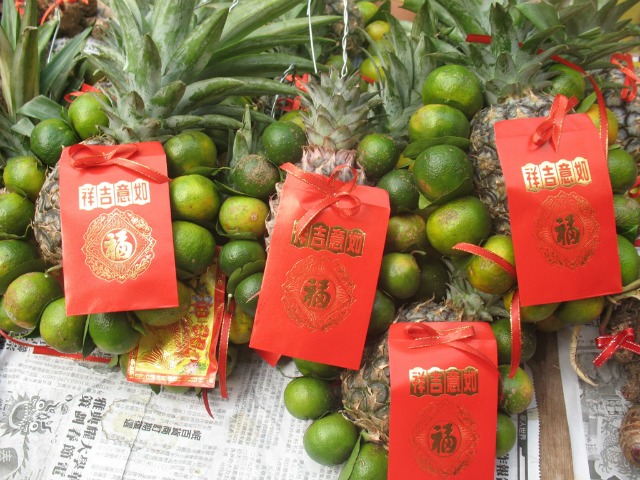
Round fruits and ang pao (red envelopes with money) are traditional gifts on Chinese New Year.Photo by Sophia Cuevas
“Dragons symbolize such character traits as dominance and ambition. Dragons prefer to live by their own rules and if left on their own, are usually successful. They’re driven, unafraid of challenges, and willing to take risks. They’re passionate in all they do and they do things in grand fashion. Unfortunately, this passion and enthusiasm can leave Dragons feeling exhausted and, interestingly, unfulfilled,” it said. Three days before Jan. 23, when the Chinese New Year starts this year based on the lunar cycle, dragon dance groups like the Strong Dragons led by Ramon Sy start performing on the streets of Binondo and visit certain shops. The Chinese believe that dancing dragons are harbingers of good luck. To spice up the belief and the experience, shop owners command the dragons to perform tricks in reaching for the
ang pao or the money to be given at the end of each performance. The
ang pao — literally meaning “to cover in red paper,” and so a red envelope — filled with money is a traditional way of ushering in the New Year, instead of buying things and wrapping them, says Rachel Chua, elementary math and art teacher at Binondo’s UNO High School. It also symbolizes a blessing, more than a gift, she adds.
Appeasing the gods The Chinese household appeases the gods in general by offering fish, pork and noodles, usually prepared by the mother, and burn joss sticks.
Tikoy or
nián gāo is the centerpiece of the Chinese household in celebrating the Spring Festival. It is basically a rice cake made out of glutinous rice flour.
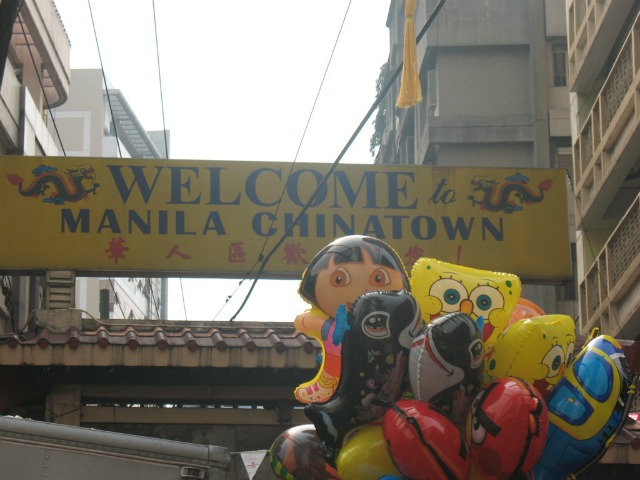
Binondo in Manila, established in 1594, is said to be the world's oldest Chinatown.Photo by Sophia Cuevas
Legend has is that a Kitchen God observes the family for a year and goes back to heaven on the eve of the New Year to report how the family has behaved and what punishment or reward it deserves. Bad behavior portends bad luck for the year to come, and a good family gets good luck. To keep the Kitchen Gods busy and make it difficult for them to speak, they are given the sticky rice cake. It is particularly at this time of the year when the Chinese seek deep communion with their gods by talking to their temple monk, who is supposed to be spiritually linked to the gods and saints and other good spirits. Chua says that problems are supposed to be solved by the seeker through hints and clues spoken by the gods through a Buddhist monk. Alas, temples are full these days with long queues guaranteeing many hours’ worth of waiting for one’s turn to speak to the holy one. For those who have neither the patience nor the will to wait in line, there is the
puah-puei. Chua describes the
puah-puei as a pair of half-moon wooden chips, colored red, each having a flat and a rounded side. After praying to the gods, and asking for a favor posed as a question — “Will I be totally rich this year?” for instance — a devotee rolls the chips on the floor. Same sides up means no. One flat and one rounded side up means yes. A definitive answer is the result of three consecutive throws with the same results.
A fun celebration What is most interesting about celebrating Chinese New Year in Binondo is how the community organizes events to keep the traditions alive. The Chinese have decided to hold true to their cultural traditions and beliefs while giving the event a decidedly Filipino twist by making it fun and engaging even for the non-Chinese participants. Filipino-Chinese ties also thrive as tourists from China, Taiwan, and Hong Kong flock in droves for the holidays. According to Tourism Undersecretary Benito Bengzon Jr., the number of Chinese tourists in the country is consistently high around this time of the year. He says that the Philippine edge over other destinations is how Filipinos are hospitable and friendly, not to mention fun. A fourth generation Chinese in her early 20’s echoes Bengzon’s view, noting that their ancestors decided to stay because Filipinos made them feel at home. Business is brisk at the Tsinoy Food and Merchandising, a snack store on Benavidez Street, and practically all Chinese shops in Binondo. The gods must be happy.
— KG, GMA News 

 GMA Brandtalk
 Tracking
 Archives


