

 GMA Brandtalk
 Tracking
 Archives

Filipino and Spanish dancers re-imagine 'Giselle' and 'Sleeping Beauty'
Three decades ago, Spanish choreographer David Campos was asked to help Filipina ballerina Irene Sabas with her suitcase. Sabas had just arrived as a new member of the Royal Ballet of Flanders in Germany. Little did they know that this would be the beginning of a great love story - theirs, as well as of their own countries. Together, they returned to Campos' hometown in Barcelona and founded Ballet David Campos in 1987. Today, the company dancers include Elline Damian, Aileen Gallinera, Eduardo Espejo and Karina Campos, who will interpret the principal roles in "Giselle" and "The Sleeping Beauty."  These Spain-based Filipino artists are among 17 dancers from the company who will perform in Manila this month. The innovative show combines the classic and contemporary, as well as Spanish and Filipino talent. "Let's take this fantastic idea of classic repertoire and let's do something more," said Campos during a press conference introducing the productions on Thursday. Re-imagined versions Despite their modest budget, Campos explains that they enhance the performances with new ideas, new talents, and new technology. Thus, the productions feature a re-imagined take on the two ballets: Giselle's plot is modified to fit the present day, and The Sleeping Beauty updated with special stage effects. In the original version for instance, ‘Giselle’ is a young peasant girl who is seduced and betrayed by a nobleman. She dies early, but her ghost protects her lover from the vengeance of a group of evil female spirits called Wilis, women scorned before their wedding day and doomed to take their revenge for eternity. In Campos’ version of the 1841 ballet, Giselle is raped and killed, and the story of man’s frivolity, superiority, and power over women, as well as sexism and violence is told through a journey between revenge and terror.
 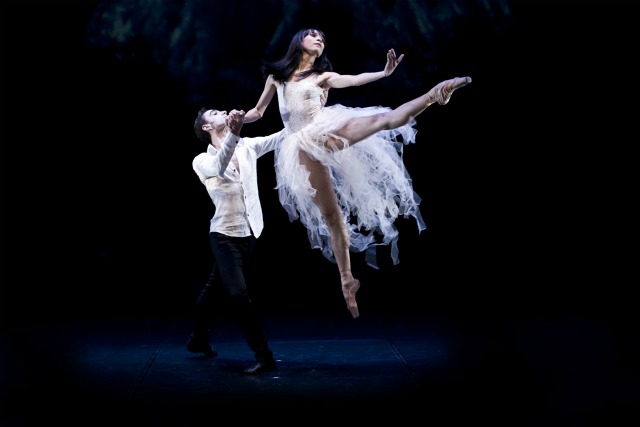 Meanwhile, in Sleeping Beauty, Campos aims to turn the thousand-year-old fairytale into a unique experience through a special set design that takes an almost cinematographic approach. “I always thought that the often heavy set staging always used for this ballet repertoire could be reviewed, revised and updated for this mysterious part of the story, because sleeping and dreaming as it is, can be much freer in interpretation. Therefore this is the result of what I wish to present now for my Sleeping Beauty -- seen from another perspective, where reality and fiction can merge to show you a story within a story," Campos explained. He adds that new generations have trouble appreciating the classics, but with the re-imagined versions, they will understand the stories better. “Everybody has a different concept. It depends on your culture, your age and your experience. But you will understand,” he says. Damian, who plays Aurora in ‘The Sleeping Beauty,’ says that she still does the classical parts, which she believes is essential. “Around that, the other parts are modernized. The original is three hours. Now, in this age of the Internet and everything fast, we have to adjust also because if we do a three-hour ballet, the teenagers will go to sleep. And we still kept certain passages from the classical also to show respect to the original choreographers,” she says. Shared heritage Associate Artistic Director Sabas explains that this is an opportunity to show the world that Filipinos are not only good workers, but talented artists as well. “The Filipino has a very good image abroad, they are respected as workers. They’re very honest, not complaining, persevering. But of course, they're not just waiters, not just domestic helpers. There's a very big part of the Filipino that's still not known in the world. “It was something very important for me to be able to project this image, the artistic part of the Filipinos," she says. “We are doubly proud of this manifestation that not only involves the expertise of the best that Spain has to offer, but the Philippines also has its counterpart by way of these excellent artists,” says Raul Sunico, president of the Cultural Center of the Philippines, where the show will run from March 22 to 25. “This is an art in which both our countries excel, which unites music and dance. I hope that this first performance in Manila will start a tradition for the coming years,” says Spanish Ambassador to the Philippines, H.E Jorge Domecq. Instituto Cervantes director Eduardo Calvo describes the ballet as an expression in movement of Instituto Cervantes in Manila. “And I say this because I deeply respect those who remember with nostalgia our common past, but I must say that the purpose of Instituto Cervantes is to build on today and tomorrow together with the Filipino people. David Campos fully shares this purpose with Filipino and Spanish artists who unite to show, day by day, this harmony through the universal language of dance,” he says. – YA, GMA News The Sleeping Beauty will be shown on March 22 to 23 at 8 PM. Giselle will be performed on March 24 at 8 PM and on March 25 at 6 PM. Tickets are available at the Cultural Center of the Philippines (Tel. 832-3704) and on the TicketWorld website (Tel. 891-9999). Photos courtesy of Instituto Cervantes

