We use cookies to ensure you get the best browsing experience. By continued use, you agree to our privacy policy and accept our use of such cookies. For further information, click FIND OUT MORE.
Make this your preferred source to get more updates from this publisher on Google.
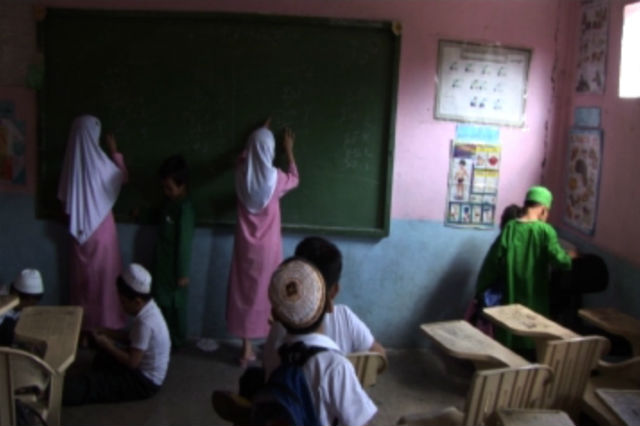
When Raymund Cruz joined a documentary workshop in 2010, his first intention was to examine Muslim culture. It was a world unfamiliar to him, Cruz said, and he wanted to "personally dissect a society that was dubbed by the world as 'dangerous terrorists.'" "In my opinion, any artist enters into a project having a certain “selfish-ness.” This is necessary because you invest at least days, months or years to commit to a vague achievement for yourself," Cruz told GMA News Online. In the process of gathering around 20 hours of footage, Cruz realized that his initially selfish intention had evolved into something more. "The crew would [discuss] the documentary during commutes to Quiapo. And we agreed that the work should educate not only ourselves, but possibly the people who were misinterpreting the Muslims. I think that people are judged for being different," Cruz said. Cruz and his cinematographer and production manager Jemil Bautista spent several weekends filming at a small madrassa (Arabic for school) tucked in a corner of the Golden Mosque compound in Quiapo. The result is "The Golden School," a 24-minute documentary composed mainly of video footage following teachers and students during a regular day at the school: the flag ceremony with the Philippine national anthem sung in Arabic, Qu'ran reading, recess time.
"The Golden School" follows teachers and students during a regular day at a madrassa in Quiapo.
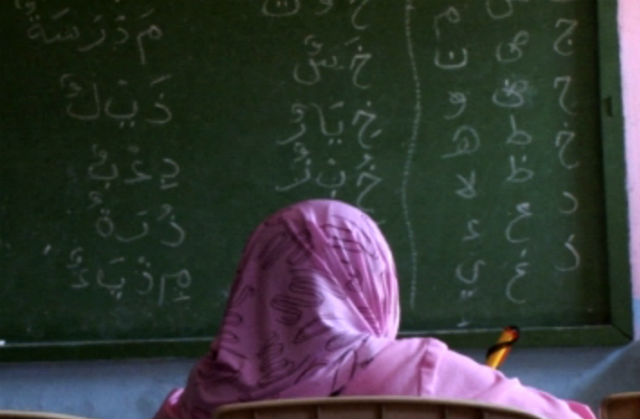
Bautista shared that documentary filmmaking differs from his usual work shooting for news programs. "Iba talaga, kasi dito, immersion, matagal. Pabalik-balik kayo," he said at the film's screening at Fully Booked in Taguig on July 21. Cruz shared that although they conducted a few interviews, he and editor Waise Azimi decided not to include these during the editing process. "Suddenly, after two days of wrestling with Final Cut Pro, the voice of the documentary came out. The subject transformed from people to place; we decided that the madrassa was the lead character to the film," he said. Cruz also gave credit to his mentors, Christoph Hübner and Gabriele Voss, who handled the editing phase of "Reinvigorating the Filipino Documentary," the workshop Cruz joined. The one-year workshop was mounted by the Goethe Institut, National Commission for Culture and the Arts, Independent Filmmakers Cooperative and De La Salle - College of Saint Benilde. "My original cut was a mess. They looked at it, snapped my senses, and said 'simplicity is already complexity.' So I disregarded 90 percent of my eight-month-old footage and directed my focus on everything about the madrassa," Cruz recalled. In "The Golden School," student life is familiar and strange at the same time. The kids run around while the teacher tries to get them to fall in line. They face front, right, left and back — and there's that one sleepy-looking kid who just can't get it right. The classrooms are crowded, and everything is old. On the blackboard, new lessons are written over ghosts of previous ones. The chairs creak, and the nails are rusty. But the children are cheerful, and although it sometimes seems they have forgotten the camera, there are moments when they smile and wave, unable to contain their excitement.
On the blackboard, new lessons are written over ghosts of previous ones.
The film is subtitled, but it is still not easy to understand everything that is being said. Cruz said a Muslim preacher named Amrola agreed to work on the subtitles for the film, in which Tagalog, Maranao, and Arabic are spoken. Cruz explained that Amrola saw fit to leave certain parts of dialogue without translation. When the crew would ask him what those parts meant, he would give them a short interpretation of a long uttered speech, Cruz recalled. "What we learned from the documentary was that Muslims are very protective about their peers. If there is anything that would [show] disrespect to their society and culture, they would passionately argue with it... I respected why he did it, and didn’t want to agitate his protection towards his culture," Cruz said. After producing "The Golden School," Cruz said he was able to achieve his initial intention of understanding Muslim culture, but only to a certain extent. Beyond this, working on the film "embedded in him the idea of love for religion, culture and society." Cruz also said that a big part of the documentary is trying to bring attention to its subject, the madrassa, which severely lacks funds. "It’s hard to be poignant in such a fast-paced metropolis. What these kids made me realize was that we should love the simplest of things. Be thankful for these minute details, no more bickering about what we don’t have," he said.- BM, GMA NewsFor more information about "The Golden School," email the producer, Jenny Logico-Cruz (jenny.logico@gmail) or Raymund Cruz (raycruz22@gmail.com). The Golden School photos courtesy of Raymund Cruz


 GMA Brandtalk
 Tracking
 Archives