

 GMA Brandtalk
 Tracking
 Archives

Despite neglect, thespians show grit in 4th National Theater Festival
A two-foot-high brown rock sculpture sits quietly on the front lawn of the Cultural Center of the Philippines (CCP), its brass plate caked with layers of mud and dust after many years of exposure in the heat and rain. Chiseled by National Artist Napoleon Abueva, the rock sculpture was dedicated and a canister was buried beneath it, between the two poles holding the flags of the Philippines and the CCP, at the end of the First National Theater Festival (NTF) in 1992. The canister contained printouts of commitments by the Philippine theater community to nurture traditional art forms and to animate local theater, especially children’s theater. During the Second NTF in February 1996, the sculpture and the canister were not disturbed. At the Third NTF in November 2004, the canister was unearthed to review the progress of the pledges. From the center of the CCP front lawn, the rock memorial was also moved to the right side, next to the pedestrian path where a jogger could easily miss the 20-year-old marker beside the thick shrub. Poetically, the rock carving stands as a symbol to the plight of 100-percent Filipino theater talents performing in 100-percent Filipino production companies catering to 100-percent Filipino spectators: ignored, if not neglected, yet proudly performing before tissue-thin audiences, their professional fees often comparable to daily minimum wages. 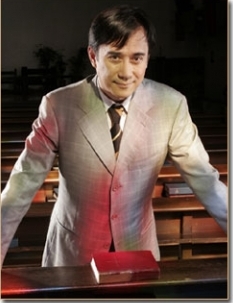 The Philippine theater community, on a nationwide scale, doggedly fulfills its mission to its Filipino audience despite the absence of substantial government and private sector support, local stalwarts say. “The government has no clear agenda for the culture and the arts,” Audie Gemora (left), president of the Trumpets and Philstage, said in an interview. Nanding Josef (below), festival director of the Fourth NTF which runs from Nov. 8 to 18 at the CCP, said the “age-old and perennial problem” is the lack of recognition both from the national government and the corporate world, as well as the public at large, of “the indispensability of art in peoples’ lives.” Josef, who is also the artistic director of CCP’s Tanghalang Pilipino, says “the biggest challenge is to convince the entire nation to support the arts, and to make the arts as indispensable as economic programs, health programs, and investments in technology.”
 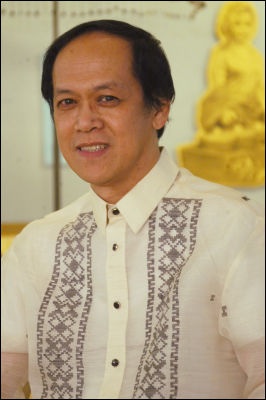 He adds, “Arts and creativity are the counterpoints to money and everything that's material. A country without a comprehensive program for the arts towards national development will never achieve greatness.” World-class Philippine theater There’s also the cruel competition posed by Filipino impresarios peddling international productions such as musicals and concerts, which further chip away local interest in Philippine theater productions. Gemora says among the problems besieging the local theater community are the colonial mentality of Filipinos that is manifested in their strong support for imported shows, lack of corporate sponsorship for local theater productions, and inadequate performance venues.
  Prof. Ricky Abad, artistic director of Tanghalang Ateneo, said the Filipino general public has yet to recognize the wealth of Philippine theater and talent of Filipino artists. “But there’s got to be more than watching shows. There’s got to be support from media, among others, to guide the public in conveying the excitement of Philippine theater. And if one can manage it, showing how Philippine theater can be worth watching more than Phantom of the Opera or Ms. Saigon,” said Abad (right), who teaches sociology at the Ateneo de Manila University. “And I can tell you from experience, at least from a college- and university-based perspective, our theater is at par or even better compared to those performed in other colleges and universities around the world. We can compete at the international scene,” Abad added. 18 different shows Twenty years after it was first launched, the NTF continues to provide a forum for theater artists and managers, scholars, and theater-goers to build stronger networks and formulate strategies for Philippine theater to have an impact locally and globally, said Dominique Torres, the 2012 NTF manager and moderator. “The NTF this year features 18 different shows by 16 theater companies and two individuals, where each work reflects the realities of our lives,” said Torres. Gemora’s Trumpets is showcasing “Mind’s Eye,” the story of an 88-year-old drama teacher and an angry 16-year-old paralytic embarking on an imaginary trip to Italy, where they explore new truths and face the pain of their realities. Jaime del Mundo directs “Mind’s Eye.” Tanghalang Ateneo features “Sintang Dalisay,” which situates Shakespeare’s “Romeo and Juliet” in an imaginary Muslim village. Abad directs the play that pulsates with the rhythms of traditional dance, martial arts, and the kulintang (brass gong). Tanghalang Pilipino has two plays showing in the NTF, “Stageshow” and “Walang Kukurap.” Written by Mario O’Hara, “Stageshow” is a forceful tribute to the bygone art form of “bodabil” directed by Chris Millado, who is CCP vice president and artistic director. On the other hand, “Walang Kukurap” is a fast-paced murderous tale of small town politics based on testimonies of whistle-blowers and anonymous syndicate insiders directed by Tuxqs Rutaquio. Theatre from the regions Torres describes the selected plays as “all anecdotes, brief glimpses into aspects of our existence. Perhaps the most telling of these are those told by the thespians from the regions.” The Integrated Performing Arts Guild of the Mindanao State University-Iligan Institute of Technology presents “Uwahig,” written and directed by Steven Patrick Fernandez. The musical is based on the Mindanawon Indarapatra epic and the Bukidnon water legend, and speaks of the degradation brought about by war and the abuse of environment into mythic realms. From General Santos, the Mindanao State University’s Sining Kabpapagariya presents “Dula Ta,” a touching play on the conflicts of war as seen through the eyes of children. The Xavier Stage, from the Xavier University in Cagayan de Oro, presents “Isa Pang Kawing.” The play dwells on the betrayal of trust based on motivations arising from tradition, politics, gender and abuse of power. Visayas is represented by “Duha Ka Alimpo Sa Habagat….Bohol 1700” from the Bohol Antequera and Maribojoc Cultural Collective in cooperation with Teatro Bol-anon. Directed by Lutgardo Labad, the play is a musical take on the early history of Bohol. There’s also “Circulo” from the Kanlaon Theater Guild of Colegio San Agustin-Bacolod, which tells the story of four breakdancers: fire, liar, sinner, and hate, and their struggles to keep dance at the center of their lives. The lone Luzon entry is Barasoain Kalinangan Ensemble’s “Kakarong,” a new sarswela on the Kakarong Republic, considered the first and truly organized revolutionary government established in the country to overthrow the Spaniards. Torres said all the regional performances will be done in their respective languages, with English supertitles. – YA, GMA News For more information, please call the NTF Secretariat at 832-2314 or visit the CCP website. Performances at the CCP Main Ramp are free. Discounts of 50 percent for students and 20 percent for senior citizens, PWDs, government employees, and military personnel apply. Photos courtesy of the 4th National Theatre Festival

