

 GMA Brandtalk
 Tracking
 Archives

ADVERTISEMENT
Filtered By: Lifestyle
Lifestyle
The state of art and criticism
+
Make this your preferred source to get more updates from this publisher on Google.
There are things beyond our control, but also discussions that make us uncomfortable because we cannot know now what it’s about.
“Art as Criticism, Criticism as Art” is one of a series of talks organized by the Cultural Center of the Philippines (CCP) in relation to their 2012 Thirteen Artists Awards (TAA). From the outset though, it seemed that this wasn’t quite about the three featured artists, as it was about the elephant in the room: a controversy about one 2012 TAA awardee’s work from six years ago, one that few in that room had actually seen. We were expected to imagine it.
Before it became an exercise in … imagining, what we had were Renan Ortiz and Kiri Dalena, both 2012 awardees, and Mideo Cruz, 2003 awardee, talking about their body of work and its engagement with nation. The stretch in itself from mere engagement to criticism was one barely discussed, and it is unclear whether we were supposed to already presume one to be the other and vice versa. As such, at its simplest, what these artists did was talk about their more important art projects. At its most complex, they were talking about their particular artmaking processes.
One would’ve thought to ask a question to push the artists to elaborate on the subject at hand, but that seems presumptuous: I tend to think that my expectations might be too high, or what I think should happen might not have been in the brief.
Of the three, it was Cruz who at least talked about how his art projects were bound by notions of excess and consumption, given neoliberalism. This was the closest one got to a discussion about art as criticism. Soon enough though, the question of CCP’s 2011 closure of the exhibit “Kulo” was raised, and all three artists went back to invoking the possibilities of engagement.
But something else was up, and while people seemed to expect it, no one had any answers.
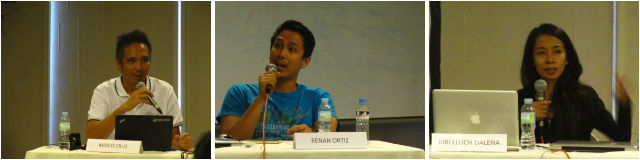
Thirteen Artists Awardees Mideo Cruz, Renan Ortiz and Kiri Lluch Dalena discuss “Art as Criticism, Criticism as Art." Photos by Katrina Stuart Santiago
Beyond discussion: a set of questions
The moment Alwin Reamillo went up to the microphone, it was clear that the topic would go in the direction of his ongoing protest against Constantino Zicarelli’s inclusion in the 2012 CCP 13 Artists Awards. And as he asked the three artists in front to comment on it via a question about artist responsibility, the discussion then became about child abuse, which was no surprise.
“Criticism is Hard Work” was the 2007 collaboration between Zicarelli and Angelo Suarez, one staged at the CCP as part of Tupada Action and Media Art 4th International Action Art Event. It asked street kids to go do some wrestling in a boxing ring set-up in one of the CCP’s spaces, as the two artists “allegedly” encouraged them to fight (see Jaime Oscar M. Salazar’s “Awards and Abuses” at the Contemporary Art Philippines Magazine).
I say allegedly, because I was not there, and I cannot judge a performance I didn’t see. Allegedly, because if there’s one thing we know about performance art, it’s that we have to be there. That would of course bring us to the point of admitting that the experience of one performance will not be the same for everyone.
This is not to say that the abuse of the child is ever acceptable. It is to point out that we are only hearing one voice about this performance. And no, I don’t want to hear Suarez and Zicarelli explaining their work; I want to know what the rest of that audience thought in 2007. Because when the discussion begins and ends with one person, certainly some things have been silenced here.
What for example, of the story that those kids were actually wrestling out in the streets, and then invited by the two artists to do it in CCP? Certainly that layers the discussion with notions of transfer and removal, with subject becoming object, with the gaze within CCP being totally different from that out on the streets. Where were these kids’ parents then? Did they know the kids were engaging in this performance in CCP, and were doing it for fun on the streets? What if the parents of these kids allowed them to do this?
What if these kids thought of the performance itself as nothing but a level-up of their street game? What if stopping the performance and turning off the lights aggravated the situation in that ring? How do we measure aggravation, or lack thereof?
How do we talk about something we didn’t see?
The abusers among us
We ask more questions. Certainly these are questions worth asking, if only so we might add to the discourse about using people – children included – in performance art. And while we’re at it, might other artistic and creative pursuits be held up to the light, too? If only to establish how performance art is different from them all in its use of the other.
Because this is what’s at the core of this discussion but it’s what we don’t want to discuss. As with “Kulo” and particularly Cruz’s “Poleteismo,” the noisier it got, the less it became about art and creativity. Unlike “Kulo” though, where the discussion was at least going on multiple tangents, this one has just been unquestioningly on Reamillo’s side. The reasons are clear enough: the side that screams child abuse is the correct one to be on.
And yet we only hear the voice of these children through Reamillo, and as told to Salazar at this point. We only know of what these kids thought then, what they think now, through one filter. It would be easy to go to Vito Cruz and find these kids, of course, to see if they have answers different from what’s being said, but that seems like the most irresponsible thing to do: who’s to say that this is all not a form of abuse, forcing these kids to relive what happened six years ago? Who’s to say in fact that imbuing the narrative with our notions of justice and apologies, our insistence on what is right, is not abusive in itself?
There is also this: isn’t the publication of those photos of minors fighting, their faces bright and clear for all of us to see – in the pages of a magazine and on Reamillo’s Facebook account and the magazine’s site – isn’t that abusing these children all over again, six years hence?
Sacrificial lambs
This conversation that surrounds “Criticism Is Hard Work” needs to be made more complex, especially since artmaking and creativity are up against a universal such as child abuse. It is also art that’s going to be sacrificed here, if we are all in agreement with Reamillo’s demand of a public apology from Suarez and Zicarelli. At the “Art as Criticism, Criticism as Art” forum though, Reamillo asserted that he needs a particular kind of public apology, because the one Zicarelli wrote to the CCP didn’t admit to anything and only spoke of regret.
There is also the threat of suing the two artists for child abuse, a charge being thrown around with nary a discussion, a threat that is scary in its mere articulation.
Imagine the repercussions of both, the apology and a legal case, on artmaking and creativity in this country. Imagine the kind of precedent it will set. Coming from “Poleteismo” and its aftermath, what kind of repercussions will this have on art given a public that is turning more and more conservative? The possibilities are scary. It is something Reamillo must take responsibility for.
Meanwhile, it is the 2012 TAA awardees that have been subjected to questions about responsibility and who have been scrutinized like anything; before this whole thing blew up, they were also being told to decline the award. The latter was in a piece by Patrick Flores published in the middle of last year; the former is in how Salazar ends his essay:
But perhaps worst of all is how Zicarelli and his co-awardees, supposedly progressive artists among them, are seemingly undisturbed by the prospect that, in accepting the TAA under the prevailing conditions, they have consented to reinforce and perpetuate not the artistic “disruptiveness” for which they have been roundly praised, but the artless dearth of critical, self-reflexive discourse within which the CCP perversely seeks to perform its fraught mandate. Dare one harbor hope for the future of an art-world tainted with such complicity?
Well I ask: why is the charge of complicity only being thrown in the direction of this batch of awardees? Aren’t all TAA awardees – since time immemorial – complicit, too?
In fact, if the awardees from previous years return their awards, give them back to the institution that they now find questionable, that would mean so much more than any of the 2012 awardees declining the award. Because how wonderful would it be to find that the artists we look up to, our mentors and teachers and idols, can take a stand against CCP’s unraveling? Imagine what that would do for morale, to find that the older generations of TAA awardees have it in themselves to deny CCP the right to cite them as their artists, as their awardees. Imagine how that would affect the evaluation of CCP as a cultural institution at this point. Imagine how it would tell the younger generations of artists that at some point, they might do it, too.
An apology from Suarez and Zicarelli, or a case of child abuse filed against them will not change anything within the structure that allowed for that performance to take place. If at all, it will further validate the idea that we don’t need to see the art, to judge it (shades of “Poleteismo” here, yes?). Too, there is this: we can bully our artists into apologies based solely on the moral high ground we take against them and not through a critical exchange among equals.
And when you’ve got more people refusing to engage with this dynamic, when the loudest voice can dictate how we might view things, if not silence our questions, then there is not much to be learned here, really. There is also very little creative thinking. —KG, GMA News

