

 GMA Brandtalk
 Tracking
 Archives

ADVERTISEMENT
Filtered By: Lifestyle
Lifestyle
Japanese ukiyo-e or ‘pictures of the modern world’ at Museo Pambata
+
Make this your preferred source to get more updates from this publisher on Google.
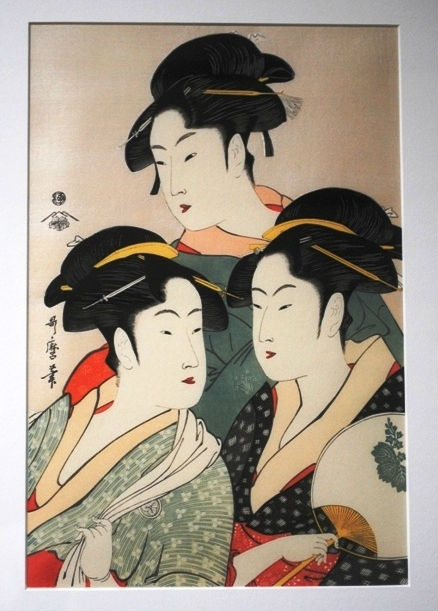
Utamaro's "Three Favorite Beauties"
An exhibition of ukiyo-e (traditional Japanese woodcut prints) from the collection of the Japan Foundation, Manila opens on July 17, Wednesday at the Museo Pambata featuring 26 reproductions of works by ukiyo-e artists in the 18th and 19th century.
Among the artists showcased in the “Ukiyo-e: Art and Tradition” are Sharaku, Hiroshige, Harunobu, Hokusai, Eisen, Kiyonaga, Utamaro, and Eishi. Ukiyo-e is also often referred to as “pictures of the modern world.”
The 26 traditional Japanese woodcut prints in exhibit have been reproduced by the Adachi Institute of Woodcut Prints, located in Tokyo’s Shinjuku Ward, using the same skills, techniques, and materials used by the woodcut printmakers of the 18th and 19th century.
Sharaku’s “Otani Oniji as the Servant Edobei,” Utamaro’s “Three Favorite Beauties,” Eishi’s “The Geisha Itsutomi” from the series “Selected Geisha of the Gay Quarter,” Hokusai’s “Red Fuji” from the series “Thirty-Six Views of Mt. Fuji” are four of the most famous ukiyo-e in this exhibition.
“The Japan Foundation, Manila has a small collection of ukiyo-e reproductions not only of works by Sharaku, but also by other ukiyo-e artists. So, we decided to organize another ukiyo-e exhibition,” said Shuji Takatori, director of the Japan Foundation, Manila.
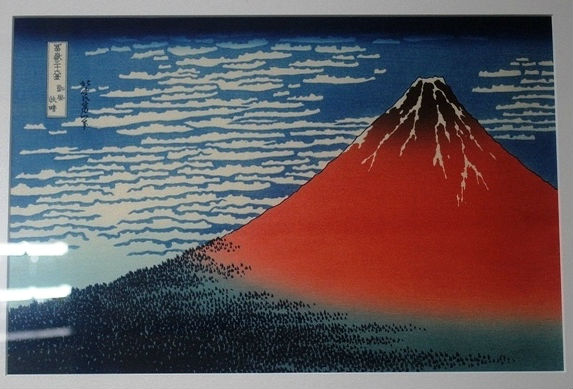
Hokusai's "Red Fuji"
“This is not a large-scale ukiyo-e exhibition. However, we think that it is enough and worthwhile to introduce typical ukiyo-e genres from landscape to birds and flowers, to portraits and beautiful women to the Filipino audience,” Takatori said in an interview.
“We organized the Sharaku Exhibition last year which showed the faithful reproductions of the Sharaku woodblock prints and the unique interpretations of participating contemporary designers and artists. The Sharaku Exhibition generated greater awareness and appreciation of the traditional Japanese art of ukiyo-e among Filipinos,” Takatori said.
Toshusai Sharaku, who is believed to have started out as a Noh actor under the employ of the lord of Awa province and an ukiyo-e artist only for two years, 1794 and 1795, created works depicting portraits of actors appearing on stage in the three kabuki theaters during Edo period: Kawarazaki-za, Kiri-za, and Miyako-za.
Sharaku’s “depictions have extraordinary power and the sense of reality and presence is very strong,” said the Adachi Institute of Woodcut Prints.
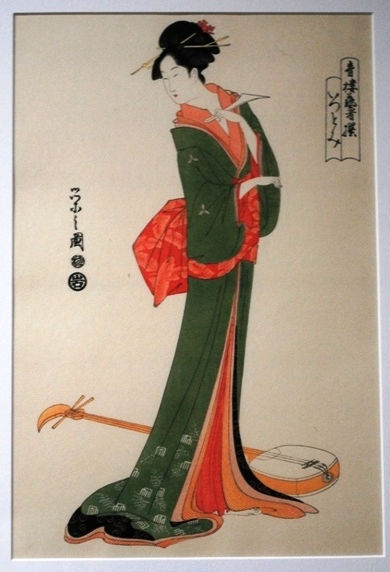
Eishi's "The Geisha Itsutomi"
It is estimated that Sharaku’s ukiyo-e works number 140, with his last works coinciding with the kabuki performances on February 1795.
“Ukiyo-e: Art and Tradition” is part of the Japan Foundation, Manila’s participation in the Philippine-Japan Friendship Month and in the 40th year of the ASEAN-Japan Friendship and Cooperation. Co-organized with the Museo Pambata, the Philippine Association of Printmakers (PAP), and the Embassy of Japan in Manila, the exhibit runs until Aug. 4 at the Karapatan Hall of Museo Pambata.
A children’s printmaking workshop by PAP is scheduled on Aug. 3, from 9 a.m., at the Museo Pambata as part of the educational component of the ukiyo-e exhibit, said Sheila Rose de la Paz, Japan Foundation, Manila’s program officer for arts and culture.
De la Paz said the ukiyo-e exhibit will be on view at the Baguio Museum from Aug. 10, with Japanese artist Haruka Furusaka holding a woodcut printing workshop in cooperation with the Cordillera Green Network.
Delicate work of art
Traditional woodcut printmaking is a “composite art form” in which the individual and specialist skills of an artist, a wood carver, and a printmaker are combined to create a delicate and beautiful work of art known as ukiyo-e, the Adachi Institute said.
The world of woodcut printmaking is one of “grace and warmth” that is not found in any other form of printing and it is through the skillful hands of master craftsmen of the Heisei era that this traditional art form has been inherited by contemporary craftsmen, the institute said.
“The creation of traditional woodcut prints is based on a delicate division of labor among three craftsmen—an artist, a wood carver and a printmaker. If one of these craftsmen outshines or underperforms the others then a high-quality print will not be created,” Adachi said.
These are artisans who master their own area in “an unobtrusive yet dignified manner,” and it is when their supreme skills are harmonized that woodcut print, far superior to that which could be produced by any one individual, is created, the institute said.
Ukiyo-e “is an extremely rare artistic technique in which several people work together to complete a vivid picture of individualistic hues and it is surely fair to say that this is a fine art that Japan can take justifiable pride in,” the Adachi Institute said. —KG, GMA News
For details and inquiries, send email to email@jfmo.org.ph or visit www.jfmo.org.ph. Museo Pambata is at Roxas Blvd. corner South Drive, Manila. Admission hours are from 8 a.m. to 5 p.m., Tuesday to Saturdays and 1 p.m. to 5 p.m. on Sundays. Visit www.museopambata.org for more details.
Photos courtesy of Japan Foundation, Manila
Photos courtesy of Japan Foundation, Manila

