

 GMA Brandtalk
 Tracking
 Archives

ADVERTISEMENT
Filtered By: Lifestyle
Lifestyle
Medium precedes message in 'Art + Video Tech' at the Met
+
Make this your preferred source to get more updates from this publisher on Google.
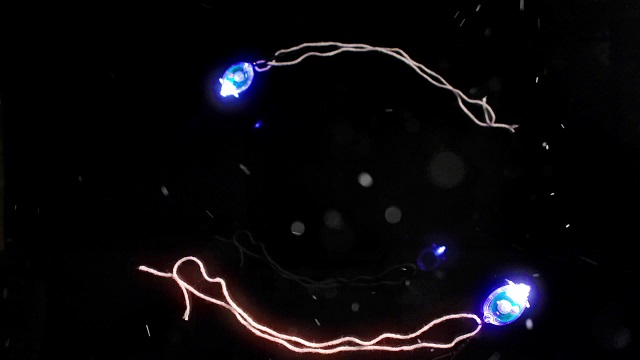
Juan Alcazaren's Balong Malalim. Images courtesy of the Metropolitan Museum
Digital art is not a genre one often associates with the Metropolitan Museum of Manila; its inextricable ties with the Bangko Sentral ng Pilipinas suggest stability, value, and national identity as its core strengths.
But, needs must. In an age where malls precede museums as an articulation of contemporary culture, and access to technologies of production and distribution have made aspiring multi-hyphenate creatives out of everyone, museums must find a way to stay relevant to new audiences.
In Art + Video Tech: Exploring New Technologies for Contemporary Art, the Met Museum Manila undertakes this very challenge, partnering with Samsung Philippines and SM Supermalls for a show that highlights the necessary interweavings of art, commerce, and technology.
From atop and afar, the exhibit looks exactly like any commercial display of home theater systems: wide screens flashing videos that call attention to the TV's selling points—high resolution, interactivity, and other such features that maximize user experience. Only upon closer inspection does one notice the exhibition notes discreetly placed beside each television: title, artist, running time, year of initial exhibition, and a brief artistic statement. All quite standard as far as labels go, but the lack of media descriptors is quite telling. The exhibit is, in fact, a mixed bag of genres that utilize digital technology—films, documentaries, animation, conceptual art—but what the exhibit cards seem to say is, "This is video, that is all you need to know."
Anchoring the exhibit on technology is a crafty way to hook a viewer, especially one who may not have any affinity towards contemporary art. "I may know nothing about art, but I am familiar with the medium in which this art object is presented, I have access to the programs and gadgets that were used to create this piece, and therefore, I can contribute constructively to a conversation about this work." Such thoughts may cross the minds of the viewers, and enable them to engage the work without feeling intimidated by it.

But, needs must. In an age where malls precede museums as an articulation of contemporary culture, and access to technologies of production and distribution have made aspiring multi-hyphenate creatives out of everyone, museums must find a way to stay relevant to new audiences.
In Art + Video Tech: Exploring New Technologies for Contemporary Art, the Met Museum Manila undertakes this very challenge, partnering with Samsung Philippines and SM Supermalls for a show that highlights the necessary interweavings of art, commerce, and technology.
From atop and afar, the exhibit looks exactly like any commercial display of home theater systems: wide screens flashing videos that call attention to the TV's selling points—high resolution, interactivity, and other such features that maximize user experience. Only upon closer inspection does one notice the exhibition notes discreetly placed beside each television: title, artist, running time, year of initial exhibition, and a brief artistic statement. All quite standard as far as labels go, but the lack of media descriptors is quite telling. The exhibit is, in fact, a mixed bag of genres that utilize digital technology—films, documentaries, animation, conceptual art—but what the exhibit cards seem to say is, "This is video, that is all you need to know."
Anchoring the exhibit on technology is a crafty way to hook a viewer, especially one who may not have any affinity towards contemporary art. "I may know nothing about art, but I am familiar with the medium in which this art object is presented, I have access to the programs and gadgets that were used to create this piece, and therefore, I can contribute constructively to a conversation about this work." Such thoughts may cross the minds of the viewers, and enable them to engage the work without feeling intimidated by it.
Ivan Despi and Pauline Vicencio, Amniotic
On the other hand, clustering different genres under one catch-all category may lead to uneven comparisons of the works. Granted, a work must stand by its own merits, but surely there are different conventions for gauging works that clearly prioritize narrative (such as the excerpt from Peque Gallaga's "Oro, Plata, Mata", and Julian Santiago's animated feature, "Mystery of the 24th") from those that are more conceptual in nature (like the running men of Victor Balanon's video diptych, Chase after Kentridge/Chase after Muybridge, or the Inception-esque gallery-within-a-gallery experience of Tatong Recheta Torres's Excerpt from Second Life, a virtual art exhibit created within the Second Life platform), or very technique-oriented (Juan Alcazaren's Balong Malalim).
When technology is established as the identifying characteristic of a collection, one is inclined to assess how the tech informs the artwork. And there are pieces that clearly revel in the use of technology. Ivan Despi and Pauline Vicencio's Amniotic is an exercise in visual and auditory modeling, an artificially-constructed landscape of a mother's womb. Louie Cordero's Itutok Mo Sa Buwan makes use of animation and editing tools to create a witty pastiche that manifests the accidental absurdity and comedy of Pinoy action movies.
There are, also, instances when technology underserves the artwork, when the TV's high resolution dates the work and exposes generation loss—an avoidable but inevitable concern, given that all exhibited works were commissioned for prior exhibits and were created with a different set of technical specifications in mind. Ambient sounds accompany pieces that are meant to be silent meditations, video installations meant to be projected onto other objects are looped on TV sets, altering the presentation and intent of the work. Issues of transience and replicability arise, but these are for academics and critics; for the average mall goers who dropped by the exhibit out of curiosity, how the artwork speaks to them at that very moment will suffice.
Here then is the conundrum of technology-mediated art: the medium can become the message. Good art can transcend technological limitations, but it may also be constrained by these very boundaries. — BM, GMA News
The Art + Video Tech exhibit will be on display in SM Aura, Bonifacio Global City from Oct. 8 -13.
When technology is established as the identifying characteristic of a collection, one is inclined to assess how the tech informs the artwork. And there are pieces that clearly revel in the use of technology. Ivan Despi and Pauline Vicencio's Amniotic is an exercise in visual and auditory modeling, an artificially-constructed landscape of a mother's womb. Louie Cordero's Itutok Mo Sa Buwan makes use of animation and editing tools to create a witty pastiche that manifests the accidental absurdity and comedy of Pinoy action movies.
There are, also, instances when technology underserves the artwork, when the TV's high resolution dates the work and exposes generation loss—an avoidable but inevitable concern, given that all exhibited works were commissioned for prior exhibits and were created with a different set of technical specifications in mind. Ambient sounds accompany pieces that are meant to be silent meditations, video installations meant to be projected onto other objects are looped on TV sets, altering the presentation and intent of the work. Issues of transience and replicability arise, but these are for academics and critics; for the average mall goers who dropped by the exhibit out of curiosity, how the artwork speaks to them at that very moment will suffice.
Here then is the conundrum of technology-mediated art: the medium can become the message. Good art can transcend technological limitations, but it may also be constrained by these very boundaries. — BM, GMA News
The Art + Video Tech exhibit will be on display in SM Aura, Bonifacio Global City from Oct. 8 -13.

