

 GMA Brandtalk
 Tracking
 Archives

ADVERTISEMENT
Filtered By: Lifestyle
Lifestyle
CCP’s Sunico aims to charm soap opera-loving Filipinos with ‘Rigoletto’
+
Make this your preferred source to get more updates from this publisher on Google.
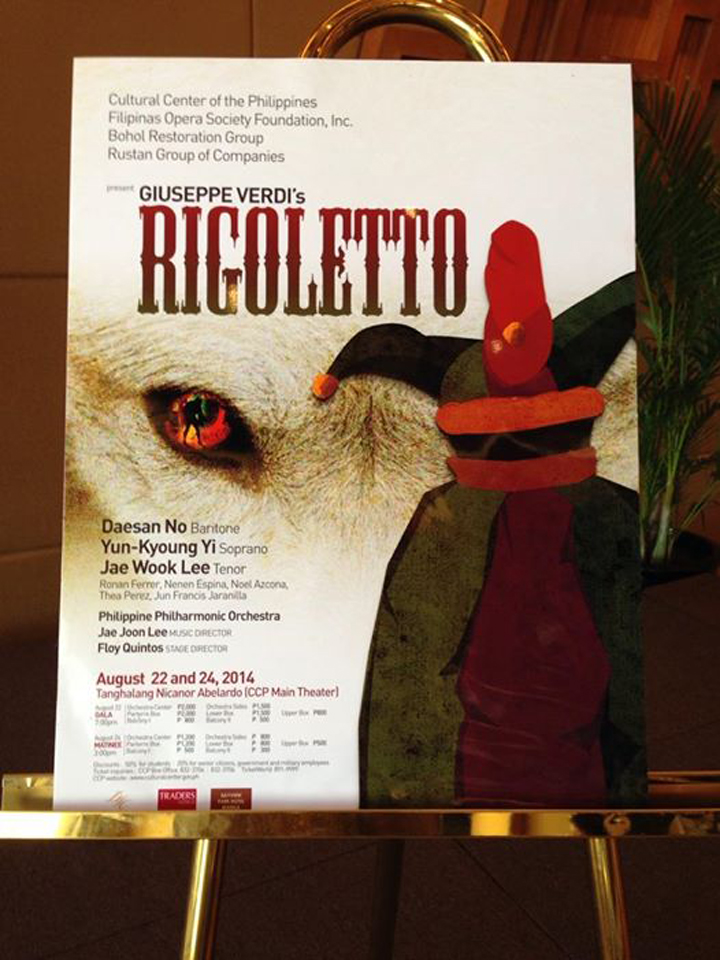
The official poster.
While classical operas are staged using mainly the Italian, French, or German languages, both soap and classical operas have drama, romance, crime, sex, incest, murder, and violence in their narratives.
On top of these explosive ingredients, an opera uses the power and pomp of other art genres such as singing, acting, orchestral playing, dance, lighting, costume design, and beautiful scenography in production design.
Dr. Raul M. Sunico, Cultural Center of the Philippines (CCP) president, said the CCP and the Filipino Opera Society Foundation wants Filipinos to watch local productions of classical operas again as “as close as possible to their original productions as envisioned by the composers themselves.”
“Operas in the Philippines are few and far between. I want to produce a classic opera that is popular and yet not as commonly produced, beautiful as they are, like the 'La Boheme,' 'Madame Butterfly,' 'Carmen,' and 'La Traviata,' Sunico said.
And he may get his wish yet. The CCP and the Filipino Opera Society Foundation are staging Italian composer’s Giuseppe Verdi’s opera, called “Rigoletto” on Aug. 22 at 7 p.m. and Aug. 24 at 3 p.m.—“as authentic” as their budget and time constraints would allow, Sunico said.
He said he requested Floy Quintos, who directed the latest "Rigoletto" production, to hew closely to its original form to provide an opportunity for the local audience to witness how Verdi conceptualized one of his operas.
He said he requested Floy Quintos, who directed the latest "Rigoletto" production, to hew closely to its original form to provide an opportunity for the local audience to witness how Verdi conceptualized one of his operas.
“I want Filipinos to see an opera in the manner that the composer envisioned it to be staged. For our Filipino audience, if we stage an opera in a non-authentic way, the local audience might assume that it was envisioned by the composer that way,” Sunico said.
"Rigoletto," an opera in four acts, is considered by many to be the first of Verdi’s masterpieces. Its tragic story revolves around the licentious Duke of Mantua, his hunchback court jester Rigoletto, and Rigoletto's beautiful daughter Gilda.
The opera's original title, “La Maledizione” (The Curse), refers to the curse placed on both the Duke and Rigoletto by a courtier whose daughter was seduced by the Duke, with Rigoletto's encouragement. The curse comes to fruition when Gilda likewise falls in love with the Duke and eventually sacrifices her life to save him from the assassins hired by her father.
International opera stars
International opera stars
For the full-length staging of "Rigoletto" at the CCP Main Theater, three internationally acclaimed South Korean classical singers are being tapped for the senior roles.
Baritone Daesan No takes the lead role with soprano Yun Kyoung Yi and tenor Jae Wook Lee joining him.
No has performed the role of “Falstaff” in Tanglewood under the baton of Seiji Ozawa, lead role in Rigoletto and Leporello in “Don Giovanni” with the Lyric Opera of San Antonio, Scarpia in Puccini’s “Tosca”, and Escamillo in “Carmen” with the New York City Opera and Opera Grand Rapids. He has performed with the BBC National Orchestra at the Barbican Hall in London, Montreal Symphony, and Mexico Symphony Orchestra at the Palacio de Bellas Artes.
Soprano Yi has been a multi-awarded singer both in South Korea and abroad. In 2002, she won the Grand Prix at the 4th Gotaeguk Voice Competition in Busan as well as the Best Prize at the 20th National Voice Competition sponsored by the Korea Music Association.
Tenor Lee has performed in numerous operas in Italy, Singapore, the Philippines, Ecuador, and South Korea. He had portrayed lead roles in Verdi’s “La Traviata,” “Rigoletto,” and “Nabucco,” Puccini’s “La Boheme,” “Turandot,” “Madame Butterfly,” and “Manon Lescaut,” Donizetti’s “Lucia di Lammermoor” and “L’Elisir d’Amore,” Mozart’s “Doe Zauberflote” and “Cosi fan Tutte,” Strauss’ “Die Fledermaus,” Lehar’s “The Merry Widow,” Bizet’s “Carmen,” Poulenc’s “Dialogues des Carmelites,” and Korean operas “Choon Hyang Jean” and “Guibyang.”
No, Yi, and Lee performed in Manila during the CCP’s highly acclaimed production of Verdi’s “La Traviata” in 2013.
Musical Director Jae Joon Lee, also from South Korea, will conduct the Philippine Philharmonic Orchestra.
Expose and educate
Expose and educate
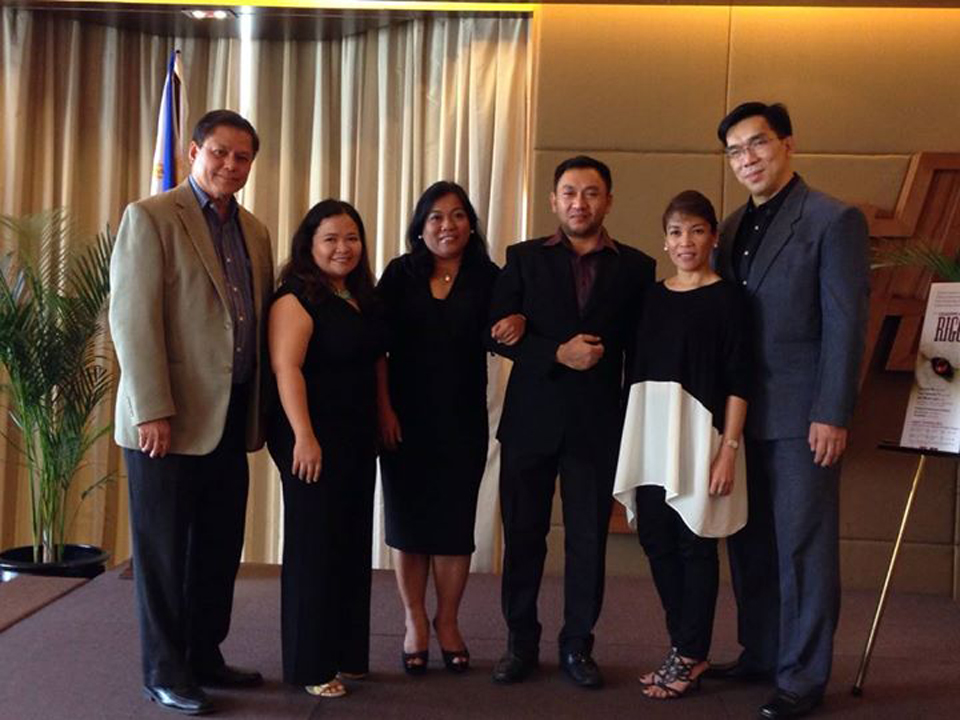
CCP President Raul M. Sunico with the Filipino singers of the "Rigoletto."
Filipino performers sharing the stage with the three noted South Korean classical singers are renowned Filipino classical singers and vocalists tenor Ronan Ferrer, soprano Nenen Espina, soprano Thea Perez, bass Jun Francis Jaranilla, baritone Noel Azcona, and the Coro Tomasino male members.
In a separate interview, tenor Ferrer said one way to lure Filipinos to watch classical operas is to “expose and educate” them.
“We may need to point out the good points of operas and classical music to Filipinos, who are avid watchers of soap operas. We have translations in English that they can read before watching operas,” Ferrer said.
Soprano Espina and bass Jaranilla added that exposing the local audience to operas may lead to “understanding, appreciation, and support for the genre.”
One of the country’s leading and most sought-after tenors, Ferrer has appeared in numerous operatic roles, musicals, and sarswelas, as well as soloist for various orchestras and solo recitals in Japan, Indonesia, and the country’s major performing venues.
Soprano Espina has been featured as soloist in various orchestral performances and had portrayed major roles in the operas of Puccini’s “Madama Butterfly,” Bizet’s “Carmen,” Rossini’s “Il Barbieri di Siviglia,” Mascagni’s “Cavalleria Rusticana,” Mozart’s “Cosi Fan Tutte,” and “Le Nozze di Figaro,” Maramba’s “Lord Takayama Ukon,” Tchaikovsky’s “Eugene Onegin,” and Strauss’ “Die Fledermaus.”
Soprano Perez has appeared in Mozart’s “Abduction from the Seraglio” “Gilas,” a concert showcasing Filipino operas, Tchaikovsky’s “Eugene Onegin,” and Strauss’ “Die Fledermaus.”
Known for his sonorous and expressive singing, Jaranilla is considered as one of the Philippines’ legitimate operatic basses. Though with a big booming voice, he enchants his audience with pure vivacity and passion that exudes and brings life to music itself.
Baritone Azcona has also collaborated with Filipino and international artists and conductors such as Gilopez Kabayao, Corazon Pineda Kabayao, Otoniel Gonzaga, Maestro Oscar Yatco, Julian Quirit, Sir Robert Ryker, and Eleanor Calbes.
Meanwhile, Quintos directed his first opera in Mozart's “Abduction FromThe Seraglio” for the UP Conservatory of Music in 2005. Since then, Quintos has staged Tchaikovsky's “Eugene Onegin,” Strauss’ “Die Fledermaus,” Puccini’s “La Boheme,” Mascagni’s “Cavalleria Rusticana,” and Verdi’s “La Traviata.”
Quintos’ clear and incisive interpretation of classic texts is based on his very simple desire “to re-tell a story in the simplest and most human terms and universal images, for an audience that is, very likely, seeing an opera for the first time.” — VC, GMA News
For inquiries, contact the CCP Box Office at 832-3704. Ticket prices for the Aug. 22 Gala, 7 p.m. are P2,000, P1,500, P800, and P500. Tickets for the Aug. 24, 3 p.m. show are P1,200, P800, P500, and P300. Discounts are 50 percent for students and 20 percent for senior citizens, government, and military employees.

