

 GMA Brandtalk
 Tracking
 Archives

ADVERTISEMENT
Filtered By: Lifestyle
Lifestyle
The art of Gabino Reyes Congson rediscovered in new exhibit
+
Make this your preferred source to get more updates from this publisher on Google.
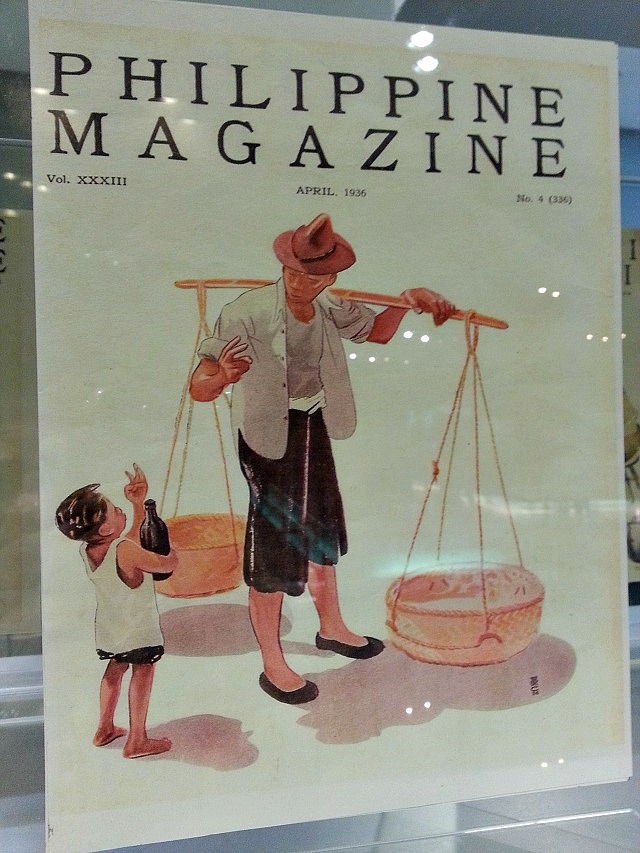
A boy and a vendor in the process of landing sales with each other.
Congson, born in 1910 in Catbalogan, Samar, started working for Meralco in 1930 as a tranvia cleaner. Over the years he moved from job to job within the company, becoming a meter reader, then a clerk. He became a certified public accountant in 1948, after which he became Meralco's chief accountant, then personnel manager, and then assistant vice president. He was later made executive assistant to Eugenio Lopez, Sr. Congson retired in 1973 after 43 years with the company.
His artistic development was concurrent with his professional progress. Even before he began working at Meralco, Congson was already working to improve his skills as an artist by taking a mail correspondence course from the Landon School of Illustrating and Cartooning in Ohio.
In the 1930's, he took the step of writing the American editor of Philippine Magazine, offering his services as an illustrator. His assured work won him the commission, and he provided illustrations for both the pages of the magazine and its cover over the next several years until war broke out.
His career as an illustrator for the magazine was not a long one, but his work endures and deserves to be rediscovered by a new generation of Filipinos.

One boy helps another, arms laden with things, drink from a bottle.
The launch of the Congson exhibit was accompanied by a talk by writer and scholar Felice Prudente Sta. Maria on the 1930's, the decade Congson worked as an illustrator. She also recounted the first time she saw a Congson cover.
"It was in 1973, when I was beginning my writing career. It struck me as so beautiful," she said.
"It was in 1973, when I was beginning my writing career. It struck me as so beautiful," she said.
Congson's subjects were not the rich and famous, or the notable personalities of the time. He chose instead to draw ordinary people going about their everyday business.
Sta. Maria drew a comparison between Congson's work and that of US artist Norman Rockwell, whose now-famous covers for the Saturday Evening Post began appearing in 1916 and for the next five decades thereafter.
"They were showing the everyday; they had seen the charm in it, the beauty in it, and what both Rockwell and Congson were doing was that they were actually making people fall in love with themselves," she said.
"They were showing the everyday; they had seen the charm in it, the beauty in it, and what both Rockwell and Congson were doing was that they were actually making people fall in love with themselves," she said.
"[Congson] made Filipinos fall in love with being Filipino. [He drew] nothing so great, so heroic that maybe not all of us can do. Instead, he drew someone who's trying to be thrifty. Two little boys hiding their puppy from the dogcatcher. A woman who's cash-strapped, but she wants to look like a movie star, so she gets the soot from a pot for her eyebrow coloring. Little children making a parol for Christmas. How can we not love ourselves? That is where Congson stands out."
Timeless work
Another aspect of Congson's work that Sta. Maria hopes will appeal to new eyes is its timelessness. "He dealt with vignettes that are still somewhat common today," she said. "Just change the clothing and you will see the same desire in people today. I like to think that the works of Congson are a visible link between the past, the present and the future, because they captured the everyday in such a way that you can't help but like the illustrations. There are no monsters, there's nothing outer spacey about it...just pure charm, pure enjoyment. I think every generation should have someone like that, because there's too much darkness." — VC, GMA News
Gabino Reyes Congson’s cover illustrations for Philippine Magazine as well as some of his personal memorabilia will be on exhibit at the Ayala Museum until December.

