

 GMA Brandtalk
 Tracking
 Archives

‘Subversive Lives’: Family saga, nation’s trauma
A review of Subversive Lives: A family memoir of the Marcos years by Susan Quimpo and Nathan Gilbert Quimpo
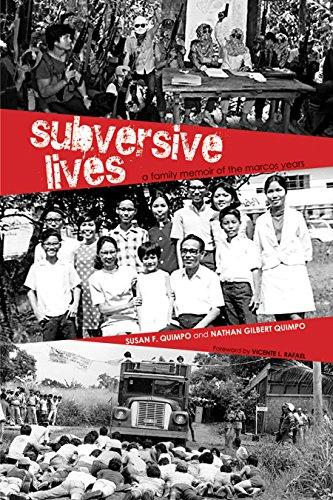
Midway through this sprawling, essential family memoir, Susan—the book's co-author and the youngest of the 10 Quimpo siblings—describes her long, difficult journey to a rural village to learn how her brother Jun, an NPA rebel, had died.
It turned out his killing was an act of treachery, not the glorious death in battle that many a young romantic warrior imagines.
The revelation also marked the end of the dream of the illustrious Quimpo siblings.
In a way, they were typical of the bright middle-class youths of the late 1960s and 70s, who were fired up by a nationalist vision.
But in ways that make this among the most compelling books on the Marcos years, the Quimpos were also no ordinary family.
Read an excerpt from "Subversive Lives" here.
Seven siblings from this family of scholars and writers joined the revolutionary movement in some capacity. One was killed, another is missing and presumed dead, two rose to leadership positions in the Communist Party. Five were political prisoners. It's hard to imagine another family that sacrificed as much for the revolution. What they helped build is one of the world's longest-running insurgencies, now negotiating for peace with the Duterte government.
The memoir presents vivid accounts of the earliest years of the anti-Marcos protests, the Communist Party and the New People's Army. The title refers to then-President Marcos' use of the word "subversive" in the 1970s to describe rebels and dissidents.
The book was published in 2012, but I decided to read it in its entirety recently as it suddenly assumed a fresh and red-hot relevance. Newly elected President Rodrigo Duterte has revived peace talks with the Communist Party and promised a hero's burial for the former dictator Ferdinand Marcos, the figure most credited with driving a generation to rebellion.
Internal strife
Each September is an occasion to roll out fading memories of the Marcos years, usually and understandably focused on the abuses of the dictatorship, especially now with the recycled specter of martial law.
Few memoirs have dared confront the authoritarianism and stubborn dogmatism of the left which, the Quimpos write in their book, hobbled the movement’s ability to adapt to the rapidly changing politics of the 1980s and perhaps scuttled its best chance of victory.
In the 1986 popular uprising that finally drove Marcos into exile, the left had been marginalized of its own doing, yet its leaders showed little remorse.
Nathan describes in detail his side of the Communist Party's internal debates that eventually tore it apart. He argues that the turmoil after Ninoy Aquino’s assassination made the times ripe for a popular insurrection, preceded by broad alliances with non-communist groups, general strikes crippling cities and conditional participation in elections.
But that scenario was rejected by an ideological hard-core led by Joma Sison that was committed to a protracted military struggle in the countryside, leading to the Reaffirm-Reject split in the Party.
Of course, this version was written by dissenters who eventually left or were kicked out of the movement. (Readers still await memoirs by the movement's founders, especially Joma Sison. One wishes that his will be as ruthlessly honest as this one.)
But it is also a journey into the Quimpo siblings' soul-searching and doubt. Was it all worth it? Were they misled or betrayed?
Seven sides of one story
Told in the voices of seven of the surviving Quimpo siblings, each of whom is credited with writing chapters of the book (although cover credits go to Susan and Nathan only), this is a family drama writ large against a flaming backdrop of historical events.
Much of the book recalls granular details in their family life and how each child found their path, attesting to a painstaking exercise in plumbing memory as well as old letters and clippings from decades ago. The siblings' method of tracing where their paths began, split, and intersected is a master class in collective memoir writing.
It begins idyllically with the conventional aspirations of their conservative parents, who had high hopes for their brood of brilliant kids. But one by one, each child joined the stream of youths drawn to utopian ideals, dashing their parents' dreams.
Each Quimpo sibling describes his or her political awakening, at least in part inspired by a sibling or two or three.
The first sibling to become an activist was Jan, who became an adolescent firebrand as a scholar at the prestigious Philippine Science High School. He gave up his future for the revolution. His voice is absent in this book because he disappeared in 1977 and is still considered missing.
Among the other siblings, Ryan's activism was the most poignant because he was disabled.
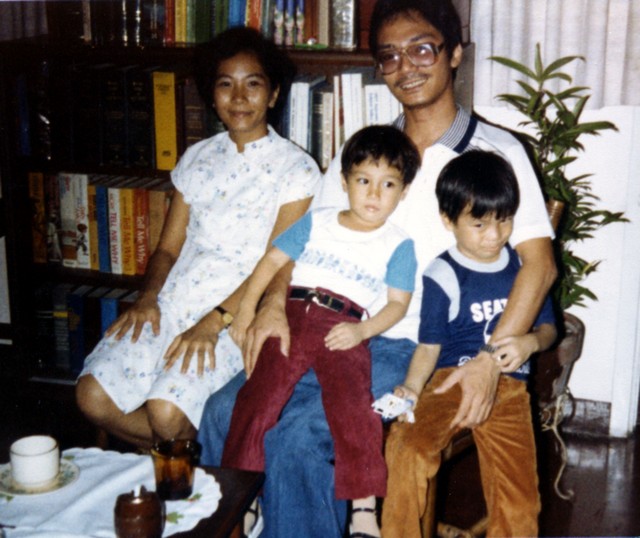
Struck by polio as a baby, Ryan's plight forced the family to migrate from Iloilo to Manila to be nearer the medical care his parents sought for him.
It was a move that would prove momentous, as it exposed the siblings to the movement that would draw them in.
Limping with a leg brace, Ryan impressed his political officers with his commitment and savvy, and to him was eventually entrusted the creation of a solidarity network in France. His perseverance and the danger he courted reflected the depth of political devotion of even teens in those days.
The family story reaches its climax as each sibling comes to terms with the approaching death of their stern father, whom they had defied and disappointed by joining the Left.
Nathan in Mindanao
Defying authority was the instinct of idealistic youths in the 1960s and early 70s, a time of global turmoil when protesters rocked major urban centers around the world.
In the Philippines, protest was fueled by the despised Ferdinand Marcos—virile pre-Martial Law president at the start of the book and dead deposed dictator by the end of it. In between are enough stories of brutality and venality to render absurd any claims of heroism on his behalf.
When Ninoy Aquino was assassinated in 1983, many in the crowds that took to the streets had already been primed by years of conscientization and resistance by the left.
The young brothers, like many activists of the time, assiduously studied political thought on their own the way some precocious teens today master web design.
Nathan Quimpo emerged as one of the Communist Party's leading thinkers and eventual dissenters. His years in Mindanao in the 1970s organizing for the party enabled him to observe the combustibility of protest and conclude that urban insurrection could be the key to the revolution's victory. His superiors didn't buy it.
His passages in Subversive Lives are a vivid account of Davao City's importance in the anti-Marcos struggle, a fact that resonates ironically today.
Among the leading protest organizers of that era was Soling Duterte, the mother of the current president, who wants to honor Marcos with a place in the Libingan ng mga Bayani.
The flawed Left
Through the conflicts in the siblings' lives, the story of the nation's politics unfolds. The book describes how the left kept organizing and fighting from the darkest early days of martial law when the traditional opposition was decimated.
One of the broad lessons from the siblings' wealth of political experience—and Nathan eventually earned a doctorate in political science—is that regardless of a movement's robustness of ideology and correctness of analysis, the character of its leaders matters perhaps even more. They echo Mabini's critique of the leadership of the Revolution of 1896.
Despite the early magnetism of Joma Sison and his teachings, the authors conclude that the party's leadership failed because of its rigidity, intolerance, and even hypocrisy.
It may be sobering for readers to see the current government's recent concessions to the Communist Party in light of this book's withering and well-documented critique of the movement.
But it is also a credit to the movement's resilience that it can still extract concessions from the government, and maintain nationwide networks and widely dispersed guerrilla operations even after the devastating effects of internal strife.
Marcos, of course, was a loser even before Martial Law in their point of view, the primary reason for their youthful rage.
This book is silent on Rodrigo Duterte as it was published in 2012, years before he was even in the national conversation. But the bloodbath and rhetoric of Duterte's first two months have evoked in more than a few martial law survivors a dread of a new form of strongman rule, without the finesse of a legalistic Marcos.
In capturing the perils of the martial law era, this memoir also memorializes the siblings' numerous colleagues who gave up everything—careers, families, even their lives in many cases—for the revolution. Some were valedictorians, seminarians, and among the most charismatic people in their generation: Ed Jopson, Bill Begg, Eman Lacaba, the list goes on. It's hard to imagine such grim and determined youthful commitment in light of the stereotype of callow millennials today.
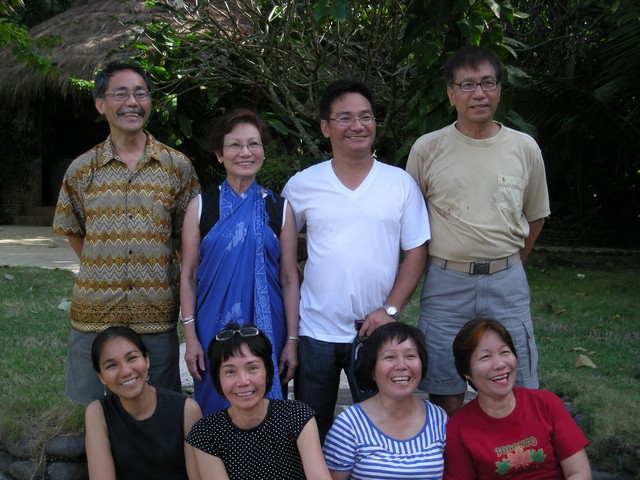
Three decades later, this book makes the reader understand their motivations and the conditions of the time that compelled them to act.
In the end, it’s up to the eldest child, Lys, to ask the tough questions: “Was all this needed? Did it make any sense?... Did the movement really make a difference? Or was it a distraction, however well-intentioned, perhaps on a similar scale, in the waste of human resources, as Marcos’s plundering?”
The siblings' story continues to the present, as Susan Quimpo joins efforts to oppose the Marcos burial and educate the public about martial law at a time when many believe it was some kind of golden age.
Writing this book was part of the same obsession to know and expose the truth that drove Susan to the hills to probe her brother's death years before at the hands of a murderous fellow red fighter.
The fall of the Marcos regime was quickened by the sacrifices of a generation. That is one victory that cannot be denied, despite a revolutionary dream that turned into disillusionment. — BM/KG, GMA News

