

 GMA Brandtalk
 Tracking
 Archives

'Kuwentong Butsero': Not your typical horror stories
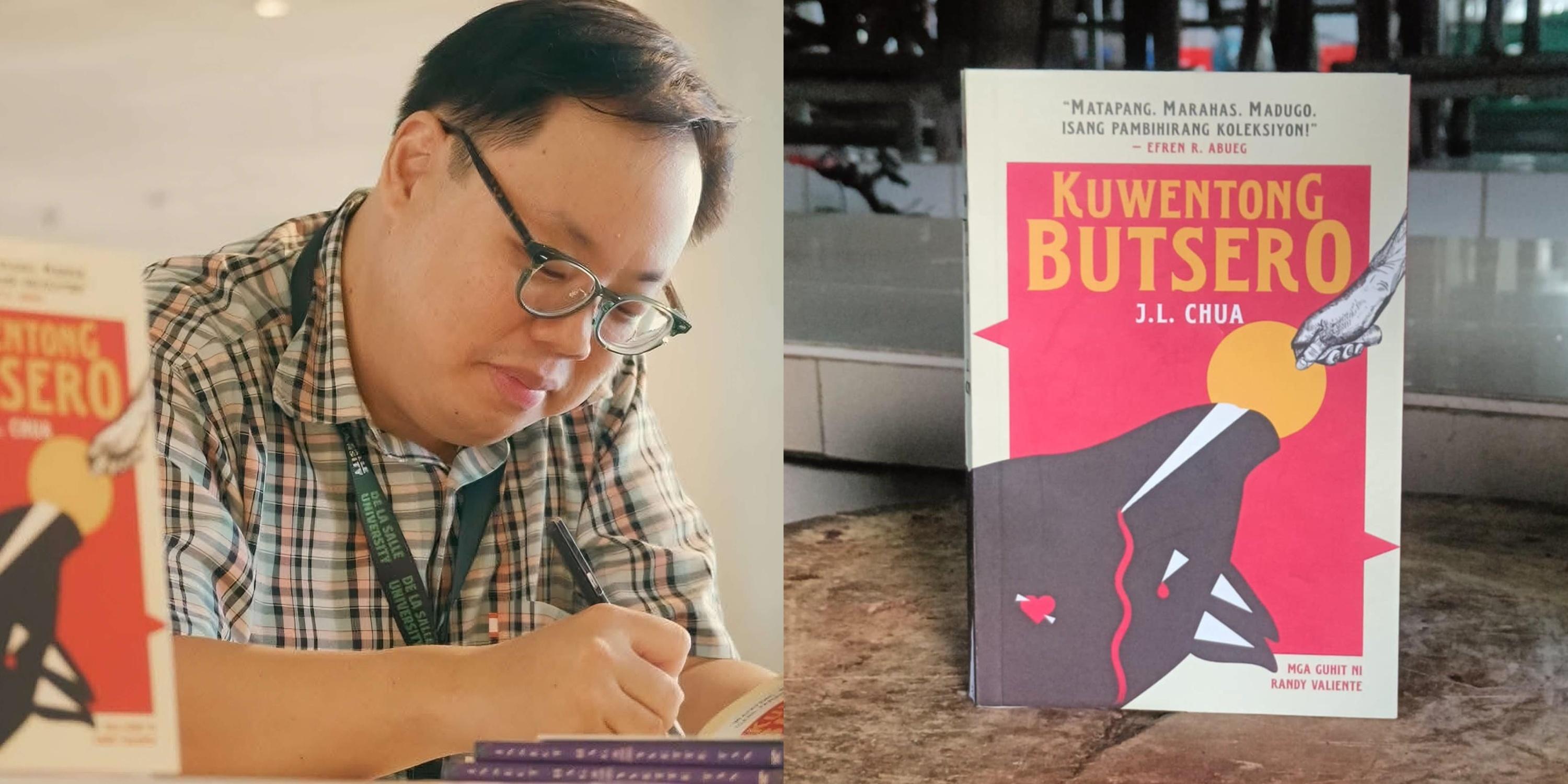
An innocent woman pushed to her death by a judgmental community. An employer murdered by his butcher like a pig for slaughter. Crispy pata possibly made from the human body.
These are just among the stories Johannes L. Chua, or J.L. Chua, wrote in his collection, “Kuwentong Butsero.” The stories are nothing short of graphic, disturbing, and as Chua himself said in the introduction, “Hindi madaling basahin ang librong ito.”
But there is more to the collection than meets the eye.
Although it does fall under the thriller genre, it poses a more important question: “What should we really be afraid of?”
Chua sat down with GMA News Online to talk more about “Kuwentong Butsero,” and the horrors of real life.
Roots in journalism
Chua has a decades-long career in journalism, having worked at the Manila Bulletin for almost 25 years covering the environment, travel, and property beats.
He was also a creative writing, arts appreciation, and creative non-fiction professor at De La Salle University. It is his alma mater, where he earned a bachelor’s degree in economics and a master’s degree in creative writing. In recent years, he has been focusing on writing his books.
It is Chua’s background in journalism that helped him write the stories in “Kuwentong Butsero.”
He creates settings with realistic environments, and the characters are variations of people he knows. According to Chua, his research for the book involved visiting spots and talking to real people, and then later writing about them.
“When I talk to them, ramdam mo ‘yung gaspang ng kanilang palad, nakikita mo ‘yung mga mata nila, ‘yung naririnig mo ‘yung mga voices around them, ganun katindi,” he said. “I was able to use my skills in journalism, in creative writing.”
“Of course, they are fictional, pero may pinaghuhugutan siya na something deeper and something really actual,” Chua said. “The emotions there are really raw and really authentic.”
Studying the animalistic behavior of people
“Kuwentong Butsero” is all about inequalities, which is to say, a kind of horror.
“Look at our society now, lalo na ngayon 'di ba,” Chua said. “Nakakagalit eh ‘no.”
“Minsan nasa sukdulan na ang tao eh. What if you are in that position, that you are abused? That you are in need? Ano kaya magagawa mo? I like to write about those things, ‘yung hangganan ng tao. Saan ba ‘yung hangganan ng tao?" he said.
“’Butsero’ is like that. If you read the characters, in one way or another, baka maka-relate ka eh kasi may nakikita tayong ganon sa mga tao sa paligid natin.”
According to Chua, human nature and attitudes are so wide. With this, he studied the concept of “rubicon," which means when a limitation or point is reached and actions cannot be taken back.
“Ibig sabihin, anong hangganan mo? Ikaw mismo matatakot sa sarili mo,” Chua said.
“It’s very, very nakakatakot, more nakakatakot pa than the horror nung mga spiritual horror—ghosts, tikbalang, kapre, manananggal—because these are real people. ’Yung multo, pwede mo itulog ‘yan eh, pero ‘yung tao, paano na?”
“Kuwentong Butsero” also falls under the transgressive stories genre, which means the characters are confined by societal norms and expectations, and later rebel against these in unusual or maybe even disturbing ways.
It is through these themes that Chua finds his foundation in writing stories, “giving voices to the mga api, studying animalistic behavior of people.”
“'Di ba, 'pag galit tayo sa tao, [sinasabi natin] ‘Ang baboy mo, baboy ka talaga, kababuyan ‘yan, kahayupan ‘yan.’ Ba't natin nasasabi ‘yun? Kasi we equate ‘baboy’ with animalistic behavior,” Chua said.
“As writers, we’re given the chance and the talent to write and give voices to people who have no voices.”
Per Chua, his characters are those shunned by society. "These are people na hindi napapansin eh. I want these characters to use me to write their stories.”
Additionally, “Kuwentong Butsero” looks deeper into what horror actually is.
“Eventually, ‘yung horror pala is our fellow human beings. We infiltrate horror to the planet. We infiltrate horror to our own body. We infiltrate horror to our fellow people, hindi natin kilala,” Chua said.
The three-time Palanca winner added that “’Kuwentong Butsero’ may seem extreme—even nauseating for some people to read—but beneath the surface, the stories unravel deeper truths.”
He cited Scottish writer Alasdair Gray, who wrote in “Poor Things, “We are cruel beasts, born that way, die that way.”
“We may not physically butcher people, but are we not guilty of cruelty in other ways? Underpaying employees, backstabbing friends, spreading lies, indulging in vanity at the expense of others—these, too, are acts of butchery," said Chua.
“’Kuwentong Butsero’ doesn’t just slice the flesh but exposes the soul, unmasking people one page at a time. Yes, I like to believe that this is a crazy book. But aren’t we living in crazy times?”
“Kuwentong Butsero” is available at Fully Booked.
—CDC, GMA Integrated News

