

 GMA Brandtalk
 Tracking
 Archives

'Bagets: The Musical' is a feel-good time capsule for a grown-up audience
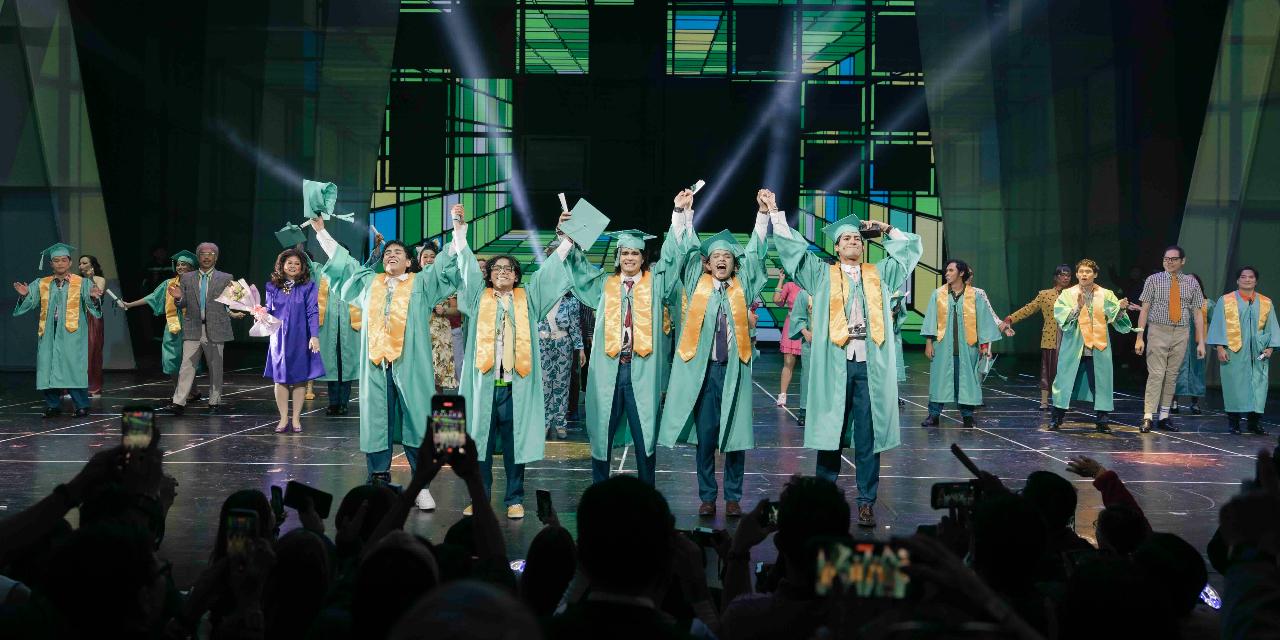
From the moment audiences gathered for the gala night of "Bagets: The Musical" at the Newport Performing Arts Theater, it was clear that the production arrived with built-in goodwill. Bagets is not just a familiar title. For many Filipinos, it is a cultural reference point tied to youth, pop music, and a specific moment in the 1980s.
The stage adaptation leans heavily on that familiarity, relying on recognition and nostalgia as its primary draw. It does not attempt to reintroduce itself. It simply invokes what audiences already know and feel.
At its core, "Bagets: The Musical" follows four high school boys navigating adolescence while dealing with strained family relationships, unmet expectations, and emotional distance at home. They are not framed as exceptional figures but as ordinary teenagers who find comfort in one another’s company. Their moments of fun and rebellion function less as acts of defiance and more as temporary escape.
The musical opens with the cast performing Gary Valenciano’s “Growing Up,” immediately establishing a familiar and upbeat tone. The number sets the pace for the early part of the show, recreating the noise and restlessness of teenage life. Classrooms, barkada dynamics, and youthful confusion are presented with energy that is intentionally busy and at times overwhelming, mirroring the boys’ inner states.
Narratively, the musical keeps its conflicts straightforward. The story does not aim for complexity or surprise, and the predictability feels intentional. "Bagets" has always prioritized atmosphere over intricate plotting, and the stage version remains faithful to that approach.
The mothers as the emotional core
While the story centers on the four boys, much of the emotional weight is carried by the mothers, portrayed by Carla Guevara-Laforteza, Neomi Gonzales, Kakai Bautista, Mayen Bustamante-Cadd, and Ring Antonio. Their performances provide the production with its most grounded moments.
Rather than functioning solely as supporting characters, the mothers are written with distinct emotional arcs, each dealing with fear, frustration, and the limits of their control. Their storylines reflect the pressures of parenting, the effort required to keep families intact, and the uncertainty that comes with trying to do the right thing without clear answers.
This perspective resonates strongly with an audience that grew up watching the original "Bagets" films. The musical implicitly acknowledges the passage of time and the likelihood that many viewers now relate more to the parents than to the teenagers. Through the mothers, the story expands beyond a coming-of-age narrative and touches on responsibility, compromise, and emotional endurance.
Scenes centered on the mothers consistently anchor the production, providing contrast to the heightened energy of the younger cast and giving the musical clearer emotional focus.
Music as familiar ground
Musically, the production relies heavily on a lineup of 1980s hits, including “Telefone,” “Just Got Lucky,” “Build Me Up Buttercup,” “Take On Me,” “Our House,” “Wake Me Up Before You Go-Go,” “State of the Nation,” and “Loving You.”
The arrangements preserve the spirit of the originals while adapting them for a theatrical setting. The familiarity of the music sustains audience engagement and reinforces the show’s nostalgic appeal. In this respect, "Bagets: The Musical" succeeds most clearly as a feel-good experience, designed to be enjoyed rather than closely examined.
Pacing, repetition, and length
With a running time of nearly three hours, including a 15-minute intermission, the musical occasionally struggles with pacing. Much of the narrative is devoted to establishing the boys’ difficult family situations. While this foundation is necessary, the story often revisits the same emotional points.
Scenes repeatedly return to familiar emotional beats: the boys’ frustration at home, their inability to communicate with their parents, and their need to escape through friendship. These themes are made clear early on, yet are restated rather than developed further, which contributes to a sense of drag, particularly in the middle sections of the show. The emotional stakes remain steady but do not always build, making some sequences feel longer than needed.
A tighter structure or more streamlined transitions could have improved momentum while preserving the story’s intent. Still, the repetition can also be read as reflective of adolescence itself, where problems feel cyclical and unresolved. While not always efficient, the pacing aligns with the musical’s portrayal of teenage life as emotionally repetitive and unsettled.
A musical that knows its audience
"Bagets: The Musical" does not attempt to redefine Philippine musical theater. Its strength lies in familiarity and shared cultural memory. It understands its audience and leans into that connection without reservation.
For viewers who grew up with "Bagets," the musical offers a return to a familiar world, now viewed through the lens of adulthood and parenthood. While it is uneven at times and longer than necessary, its intent is clear. The production works best as a communal experience, one built on recognition, nostalgia, and the passage of time.
"Bagets: The Musical" will run from January 30 to March at the Newport Performing Arts Theater in Newport City, Pasay City. Tickets range from P1,000 to P4,000. —JCB, GMA Integrated News

