

 GMA Brandtalk
 Tracking
 Archives

5 must-know facts about Our Lady of Manaoag
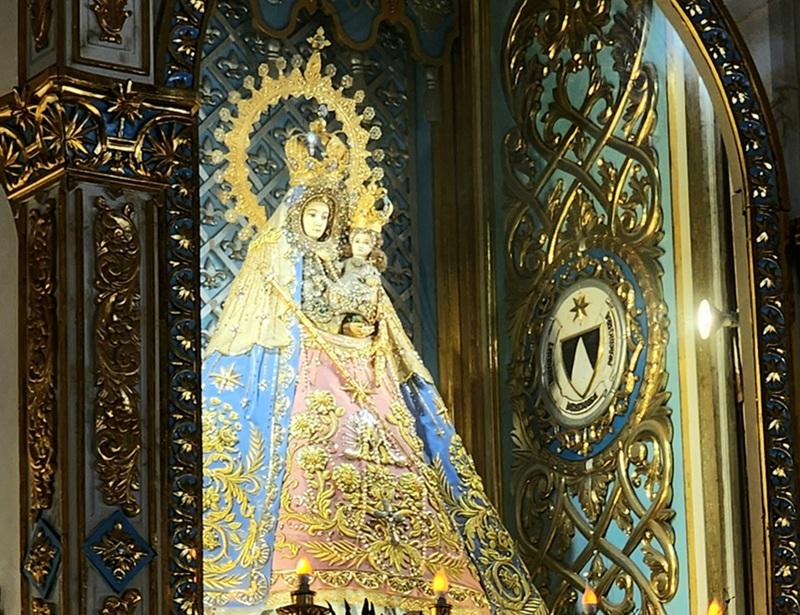
Nestled in the coastal province of Pangasinan is a town called Manaoag that will mark a momentous celebration to honor the Blessed Mother and her call to the children of God during the 100th anniversary of the beloved Marian image's canonical coronation on Wednesday, April 22.
It was in August 1925 that Pope Pius XI granted the petition for the canonical coronation of Our Lady of Manaoag.
There are several activities lined up for the celebration that focuses on the theme "Inan Maria: Crowned in Grace, Calling Us to Jesus."
But who is Our Lady of Manaoag? Here are five things to know about her.
Manaoag means ‘to call’
The Marian image came from the Pangasinense word “mantaog” meaning “to call.” The term is linked to a story that has been traditionally passed on to generations.
The story is about the time the Blessed Mother appeared before a local farmer on top of a hill. She had instructed him to build a church at the site so that the faithful can come to her and ask for her intercession.
The locals call the Marian image "Inay puso mi" or Our mother heart in Pangasinense or "Apo Baket" or Revered Lady in Ilocano.
The Blessed Mother is also known to the present generation as "the Our Lady of Manaoag is the patroness of all Call Centers in the country." The "modern title" is written on one part of the wall of the Museo de Nuestra Señora de Manaoag Museum.
In an interview with GMA News Online, Church historian Fr. Wilhelm Boñon, OP, said that Our Lady of Manaoag caters to all devotees.
In contrast, he said there are saints and shrines that cater to particular causes such as the National Shrine of Saint Jude Thaddeus in Manila, which is associated with board examinees seeking guidance through tough questions, while the Obando Church in Bulacan is known for childless couples praying to have children of their own.
“Dito it caters to everyone (Our Lady of Manaoag caters to everyone). It really calls everyone. Yun yung ano ko (that’s what I believe), the virgin who calls everyone to ask favors from her son, Jesus,” he said.
Made of ivory, wood
The image of Our Lady of Manaoag, which is a depiction of the Blessed Virgin Mary holding the infant Jesus in her arms, is enshrined at the main altar of the Manaoag Minor Basilica.
The head and hands of the Virgin Mary and Child Jesus are made of ivory, while the rest of the statue made of wood. The image is dressed in intricate vestments.
“Originally, ukit po siya. Isang buong image po siya. Made of hardwood, block wood pero later on nilagyan nila ng damit, naging burdado na yung Our Lady of Manaoag,” Fr. Felix Legaspi III, O.P., Manaoag Minor Basilica rector, told the media during a tour last Tuesday.
(Originally, it was just an image carved from hardwood, a dark wood. Over time, the image of Our Lady of Manaoag was adorned with embroidered garments.)
“May sarili siyang dimension kaya mahirap bihisan. If you notice yung gitna, hindi yung mukha ng Blessed Virgin Mary. It's between the Blessed Virgin Mary at saka ni Jesus,” he added.
(It has its own dimensions or measurement, which makes it difficult to dress. If you notice, the center is not the face of the Blessed Virgin Mary, but between the Blessed Virgin Mary and the Child Jesus.)
The Marian image changes its vestments twice a year during its feast days. Each vestment takes at least five months to make and carries its own narrative.
2 feast days
Known as the Pistay Baley (Town Feast) or the Summer Feast of Our Lady of Manaoag, the novena leading up to the feast starts right after the Easter Octave.
The celebration falls on a Wednesday, which aligns with the tradition that the Blessed Mother appeared 20 days after Easter Sunday.
The Dominicans now refer to the Summer fiesta as the "Coronation Feast" of the Manaoag Church, marking the anniversary of the Canonical Coronation in 1926.
Celebrated every first Sunday of October, the second feast is the Patronal Feast of Our Lady of Manaoag, or commonly called the October Rosary Feast.
This occasion is closely linked to the feast of Our Lady of the Rosary, which was established by Pope Pius V, a Dominican pope, to commemorate the victory in the 1571 Battle of Lepanto in the Gulf of Patras.
Devotion to Our Lady of Manaoag in October is also linked to Pope Leo XIII’s 1884 encyclical Superiore anno, which dedicated the month to Our Lady of the Most Holy Rosary.
Under the Dominican pastoral care
Christianity in Manaoag town (formerly called Sta. Monica) was introduced in 1600 by the Order of Saint Augustine (Augustinians) as a visita or mission station.
In 1605, the mission was turned over to the Order of Preachers (Dominicans) represented by Fr. Juan de San Jacinto OP, who decided to establish a new chapel on a hill where the present church is located in accordance with the Marian apparition reported between 1605 and 1610.
In the account of historian and Spanish Dominican priest Fr. Mariano Rodriguez, the Marian image may have originated from Mexico while historian Prof. Regalado Trota Jose said the image is Oriental and Filipino features suggest it is a 17th-century Filipino ivory image.
In August 1925, Pope Pius XI granted the petition of Fr. Rodriguez for the canonical coronation of Our Lady of Manaoag.
The Marian image was crowned on April 21, 1926 by the apostolic delegate to the Philippines Msgr. Guillermo Piani in behalf of Pope Pius XI.
No Church recognition but with people's recognition
The people of Manaoag speak of their devotion to the Blessed Mother while pilgrims visit the miraculous image in order to pray for healing and blessings.
Each pilgrim carries a different prayer as some ask to pass the board examinations, others seek to recover from a medical condition, while others just ask for a simple a favor from God.
The Catholic Church, however, has yet to recognize the apparition and miracles of Our Lady of Manaoag.
Boñon said recognition of the apparition and miracles are through the people's faith.
“Hindi talaga siya recognized ng Church as miracle na mayroong nagpakita doon, na may apparition. Actually, yung miracle sa Manaoag, hindi siya recognized as an apparition. It's just about the faith of the people yung nag-recognize sa apparition dito sa simbahan,” he added.
(The Church does not officially recognize the miracles and apparitions. In fact, the miracle in Manaoag is not recognized as an apparition; rather, it is the people’s faith that recognized the apparition in this church.)
Documentation
The Basilica rector said one of the challenges in getting the recognition of the Catholic Church is the lack of documentation that would support the claims of healing and blessings.
“Yung mga Filipino, not so much on the documentation. Tapos on our part, it will take a tedious process para ma-recognize,” he told GMA News Online.
(Filipinos are not very focused on documentation. On our part, it would take a tedious process to be officially recognized.)
“We have to have experts para masabi na talaga yung case na yan, it's really divine intervention. So, very tedious yung process,” he added.
(We need to have experts to determine that the case is truly a divine intervention. So, the process is very tedious.)
Legaspi emphasized that what matters most is for the people to experience the miracles of Our Lady of Manaoag.
“Mas importante sa amin, yung faith experience ng tao na sana nakita yung pagpapala ng Diyos, at siya rin ay maging pagpapala si iba (It’s more important for us for the people to experience the blessings of the Lord, and, in turn, they also become blessings to other people),” the basilica rector said.
Invitation to join the centennial celebration
Legaspi is inviting the people to join the centennial celebration.
“Sumali po tayo para ipakita, iparamdam ang ating pagmamahal sa ating mahal na ina na siya ang ating gabay at lakas sa araw-araw na buhay (let us join to show and express our love for our beloved Mother, who is our guide and strength in our daily lives),” he said.
Boñon urged the faithful to adhere to the Blessed Mother’s call to listen to God’s words.
“Listen to God's word, telling you to trust in Him, to believe in Him. So sa mga pumumpunta sa Manaoag, yes, we believe in miracles, but we must also strengthen our faith in God,” he said.
“It's not just about pagpapahid, o pagkuha ng tubig, o pagbili ng mga oils dito sa Manaoag, rosaries, but it's really about your faith in God who provides for everything. So sa lahat ng pupunta, sana pagdating nila sa Manaoag, ma-encounter nila ang Diyos, maramdaman nila ang Diyos, at magpasalamat sila sa Diyos,” he added.
(It’s not just about collecting water or buying oils and rosaries in Manaoag. It is really about your faith in God, who provides for everything. So for everyone who goes there, I hope that when they arrive in Manaoag, they encounter God, feel His presence, and give thanks to Him.) — BAP, GMA News

