

 GMA Brandtalk
 Tracking
 Archives

ADVERTISEMENT
Filtered By: Lifestyle
Lifestyle
When literature offends: authors speak up
+
Make this your preferred source to get more updates from this publisher on Google.
With the fairly recent controversy on Mideo Cruz's Poleteismo, one might expect a discussion on offensive literature to turn into heated debate.
But at last month's Manila International Literary Festival, the session "When Literature Offends" was warm and friendly, and there was more laughter than anything else, perhaps because it was a small, intimate group made up mostly of acquaintances, if not friends.
Danton Remoto moderated the discussion on how far authors can take freedom of expression, with Jose F. Lacaba, Isagani Cruz and Beverly Wico Siy reading excerpts from their most offensive work.
Masturbation in literature
Before reading his short story "Father Solo," Cruz began with a short introduction on masturbation in literature. "Masturbation has long been used by respectable writers," says Cruz, who belongs to the Hall of Fame of the Don Carlos Palanca Memorial Awards in Literature.
"In the last scene of Villa Magdalena, Bienvenido Santos makes a dying old man masturbate under the sheets. In the short story ‘Magnificence’, Estrella Alfon has a man masturbate against the back of a child, then lets the mother wash the semen and burn the stained dress. In William Faulkner's ‘A Rose for Emily’, a woman gets off by straddling the stiff penis of her dead boyfriend."
Cruz notes that these great writers depict masturbation in such an indirect way that most readers miss what is going on. "In fact, Santos is an adopted Christian brother. ‘Magnificence’ is taught in Catholic high schools and ‘A Rose for Emily’ is a favorite of very conservative teachers in college. What I have done is simply to call a spade a spade, or a tool a tool, or a toy a toy, or in short, to foreground masturbation," he says, before reading his short story "Father Solo."
The story begins this way: "As he always did after he read the gospel during noon mass at the school chapel, Father Solo went to the podium and delivered a sermon on masturbation."
Some would no doubt be offended by parts of the story, particularly lines such as "Father Solo knew what he was talking about. Every day since he turned thirteen, he had been masturbating" and "When he was abroad from some mission or other, he could dress as a lay person and enter a sex shop. There he would buy one or two of the gadgets that would help him masturbate."
But as Cruz read his work, no one objected, and after the last line, the room was filled with applause.
Cruz shares that he got the idea for “Father Solo” when he was asked to be a judge in a case involving a priest who only talked about masturbation. "Siyempre iniisip ko bakit ba itong paring ito obsessed na obsessed sa masturbation? Pinaalis namin sa eskuwela. It's a real case, but ‘yung motivation niya, ako nag-imbento nun. Kasi hindi ko maisip bakit siya ganun (Of course, I was thinking, why is this priest very much obsessed with masturbation? We expelled him from the school. It’s a real case, but as for his motivation (in the story), I invented it because I can’t even imagine why he is like that)," says Cruz. 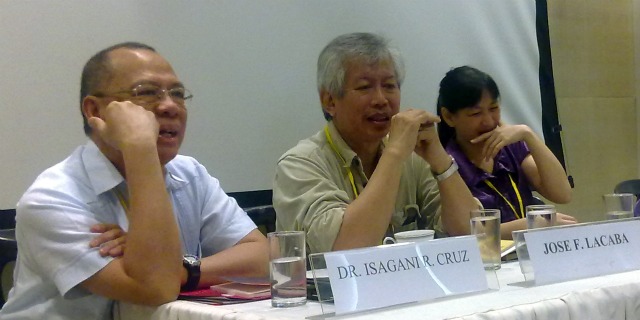 Brutal
Brutal Siy read a chapter from her commissioned work Mingaw, which tells the story of a young married couple and how their sex life is affected after the husband leaves to find work in another country.
"Twenty-two sila pareho. Eighteen pa lang, naging mag-boyfriend. Bago maka-graduate, nabuntis na ang babae. Isang araw nag-decide sila na mag-aabroad ‘yung lalaki. Doon pumasok ang problema. Totoo naman eh, ang pag-abroad ay nakakaapekto sa sex life ng mag-asawa (They were both 22. They were only 18 when they became sweethearts. Before they graduated, the woman got pregnant. One day, the man decided to go abroad. That’s when the problem started. It’s true—going abroad affects the sex life of married couples)," says Siy, who writes poetry, horror stories, essays, and the erotic novel.
"'Napaka-brutal. Brutal pa siya sa iniisip ko' (It’s too brutal. It’s more brutal than what I can imagine)," Siy recalls a comment she read online about Mingaw. "Hindi po ako gumamit ng euphemism—sandata, bulaklak. Talagang straightforward ko na binanggit sa wikang Filipino. First chapter hanggang sa dulo, consistent po ako. By the time na nasa gitna ka, wala na ‘yun sa ‘yo. Hindi ka na masyadong naiilang (I don’t use euphemisms such as weapon, flower. I was straightforward using the Filipino language. From the first to the last chapter, I was consistent. By the time you’re in the middle (of the book), it won’t affect you anymore)," says Siy, explaining that for some, language is the issue.
Siy says that if “Father Solo” had been written in Filipino, it would sound just as "brutal."
"Hindi lang talaga tayo sanay na nasa wikang Filipino ‘yung bahagi ng katawan natin (We’re just not used to naming our body parts in Filipino)," she points out. Siy says that if one is offended, one was probably unprepared.
"Unang una, bakit ka manonood ng horror kung ayaw mong matakot? Unless niloko ka na ito'y comedy tapos pala ay horror...Ibig sabihin hindi ka nag-research doon sa babasahin mo (First of all, why will you watch a horror movie if you don’t want to be scared? Unless you were fooled into believing it’s a comedy then it turned out to be a horror film... That means you didn’t research about what you’re about to read)," says Siy.
With intent to offend
On the other hand, multi-awarded writer Pete Lacaba explains that sometimes, the writer really intends to offend.
"Minsan sinasadya naming maging offensive para pangyugyug, pantusok, pang-inis sa mga ibang mambabasa, mga gusto mong inisin, gusto mong galitin o gisingin (Sometimes we really intend to be offensive to nudge, poke, or irritate some readers, especially those you want to get irritated or mad or woken up)," he says.
Lacaba also notes that a work may be offensive to some but not to others. Lacaba's own poem "Ang mga Kagilagilalas na Pakikipagsapalaran ni Juan de la Cruz" is one example.
"Ang nangyayari kapag ipinu-publish na sa textbook, tinatanggal nila ‘yung isang stanza, ‘yung merong ‘nang dapuan ng libog si Juan dela Cruz,’ (What happens is when they publish it in a textbook, they delete the stanza that has the line ‘when Juan dela Cruz felt lascivious')," says Lacaba, adding that his permission was not sought, either for reprinting or for removing the stanza.
"Kung pang high school, papayag ako pero lalagyan ng ‘excerpts from’—hindi ito ang buong tula [If it were for a high school (textbook), I would agree (to the deletion). But they should write ‘Excerpts from’, not the whole poem]," he says.
In another of Lacaba's poems, "Pasyong Mahal ni San Jose," the line "pagkat Diyos ang gumahasa (because God was the one who raped)" was found to be offensive.
"Ibig sabihin, patama sa mga, kung sa salitang aktibista, sa mga naghaharing uri. Hindi diyos na Diyos kung ‘di mga diyos ng ating lipunan. So merong deliberate na pinapatamaan (It’s an innuendo. In activist language, it’s an innuendo against those who lord it over others. It doesn’t mean god as in God, but gods in our society. So there’s a deliberate intent to hit specific people)," Lacaba explains.
Siy emphasizes that even when certain things are found to be offensive, they are not merely there for the sake of offending.
"Siniguro ko na ‘yung bawat eksena ay importante doon sa kuwento (I made sure that each scene was important to the story)," she says. –KG, GMA News
The Manila International Literary Festival was held from November 16 to 18 in celebration of the National Book Development Board's 15th Philippine Book Development Month.

