

 GMA Brandtalk
 Tracking
 Archives

ADVERTISEMENT
Filtered By: Lifestyle
Lifestyle
How and why we write, from immigrants to monsters
+
Make this your preferred source to get more updates from this publisher on Google.
Write what you know. This is possibly the most frequently given advice on writing, right up there with show, don't tell. So it's not surprising that most things we read are, in fact, based on real life. That is, the lives of the people who wrote them. But how do writers end up writing in the first place?
At the recently held Manila International Literary Festival, Pulitzer Prize winning author Junot Diaz talked about his experiences as a Dominican child growing up in New Jersey.
"I was put in what they call special education in my first two years. They thought if you didn’t speak English that you were mentally handicapped. My first American experience was watching television, and in those months, there was nothing on the news except Vietnam. The joke in my family was that the first word that we learned in English was Vietnam," he says.
Vietnam may have been the first English word Diaz learned, but it was only a matter of time before he developed an uncanny knack for the language. "When you're pushed to the absolute extreme, you discover your talents," says Diaz, whose own talent was being "freakishly good" at English. "I had a ninth grade reading level in first grade. I could read absolutely anything," he says.
"I still remember sitting in the library—we didn't have Internet, we didn't have cable, we didn't have satellite, didn't have Twitter. The way we understood where we were at in the world was by going to the library," he says. The immigrant experience is found in both of Diaz works: Drown, a collection of short stories, and the Pulitzer Prize winning novel The Brief Wondrous Life of Oscar Wao.
Diaz considers himself a reader more than a writer. He says that if there's any secret to his success, it's that he religiously avoids writers, many of whom he notes write for the applause. “The thing about artists is that we are not entertainers...artists are here to do the work no one else does. Our politicians have failed us. Our community leaders have failed us. Our business leaders have failed us. Our religious leaders have failed us. Artists are doing a lot of heavy lifting, because to be an artist means to deliver what people don't want," says Diaz.
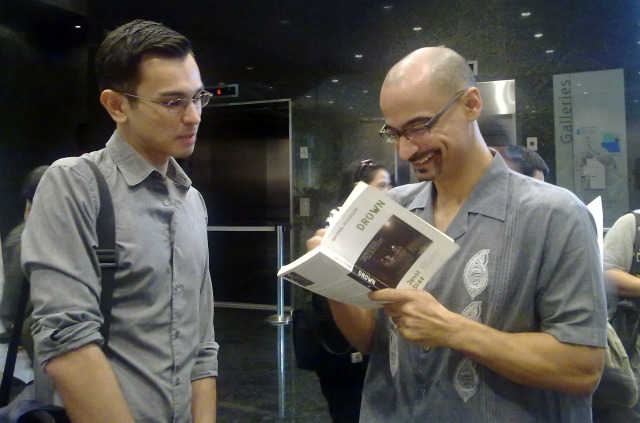
Junot Diaz signs an autograph during the Manila International Literary Festival.
In another session during the festival, multi-awarded writer Jose “Pete” Lacaba says sometimes writing is offensive because it wants to affect the reader. "Minsan sinsasadya naming maging offensive para pangyugyug, pantusok, pang-inis sa mga ibang mambabasa, mga gusto mong inisin, gusto mong galitin o gisingin," he says.
Fantasy and horror in real life
It’s easy to see how an author might take actual experiences and use them in fiction, but even fantasy and horror have their roots in real life. At the session on “Folktales, Myths and Legends”, writers Karl De Mesa, Budjette Tan and Yvette Tan talked about their own strange encounters.
Budjette Tan, who created the bestselling graphic novel Trese with artist Kajo Baldisimo, recounts one of his mother's favorite stories from his childhood. It was the summer of 1973, and they had just moved to a new house in Merville. First it was little things—lights switching on and off, voices in empty rooms. Then it was the driver seeing things as he backed out of the driveway. He would look in the rearview mirror and see a woman, who would tell him "Ingat," then she would disappear. Once his uncles looked up to see a light bulb slowly unscrewing itself until it fell to the ground.
“There's no such thing as ghosts," Tan’s mother used to think. Then one day, while changing his diaper she noticed that half of her son’s face had wrinkled up and he began to look like an old man. "The first thing she does is she slaps me with all her motherly love. That didn't work, so she started to pray the rosary. Only after she prayed did my face return to normal," he said.
Tan grew up hearing the story of his possession over and over again, and as he grew up, he acquired a taste for the strange. He would read about John Constantine, who uses magic to solve cases involving angels and demons, and Batman, whom he thinks is the greatest detective of all time. And then he discovered Gilda Cordero Fernando's The Soul Book, which compiles articles from all over about the skyworld, underworld, and all creatures of myth and folklore in between.
Tan credits Neil Gaiman as a major influence, because he posed the question of where are the old gods now. "Where are the old gods or creatures of Philippine folklore now in Metro Manila?" Tan wondered. "I created Alexandra Trese who becomes my detective, my window into Manila's underworld," says Tan, who imagines the nuno sa punso living in the manhole, the tikbalang drag racing along C-5, and the manananggal setting up an abortion clinic where she gets a steady diet of fetuses.
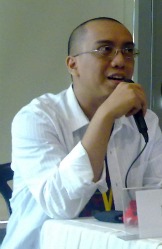
Karl De Mesa talks about his strange encounters.
For horror writer Karl De Mesa, it began with superstitions, like don't sweep at night—because it's dark. "You find out there's a logical explanation for it," says De Mesa. But his experiences were far from logical, including a tikbalang following him when he was a child. His encounters with ghosts and duwendes piled up until his sister got sick. "Shadows would roam around the house. One time they called a manghihilot in and the diagnosis was shadow people wanted me and my sister for their own," he says.
The shadows were banished, but since then, his third eye remained open. After that, he discovered Maximo V. Ramos' The Creatures of Philippine Lower Mythology. "From there I learned about the things I had been encountering," he says.
Later, he encountered a kapre who was living in his room. "Iniwan daw siya sa puno. It's all very suspect," says De Mesa, who brought a psychic in after they kept smelling sulfur.
"His name was Simon and could he live with us and become the guardian of the house. I said 'Why not? Sounds awesome!'" recalls De Mesa. After that, the smell of sulfur was gone. De Mesa's books News of the Shaman and Damaged People — Tales of the Gothic-Punk are works of fiction, but as he shared his childhood stories during the festival, the audience realized that real life is indeed often stranger than fiction.
Waking the Dead author Yvette Tan shares that she has no idea how she got into horror. Growing up in a Filipino-Chinese Christian family meant she wasn't allowed to do anything, but studying in a Catholic all girls school meant she was exposed to the usual stories that run around. "Our school used to be a hospital, or a church, or a cemetery. Then you have stories about nuns without feet," she says.
"I didn't start reading fiction until high school. I'm a late bloomer. But I read a lot of non-fiction. Anything on mythology, secret religions—I read that growing up. I was a strange child," she says. Tan says she didn't start watching horror films until college, but then she got so into it that it became her thesis subject.
"Monsters are a manifestation of society's fears. I try to use monsters that people are familiar with but I try to use it in different ways," says Tan, whose one story features a kapre who stopped smoking because it's unhealthy. He makes friends with a human child who's psychic, and rescues her from a life of abuse. "He becomes more human in that way, he sacrifices himself so that she'll have a better life," says Tan.
She shares that in another of her stories, a foreign guy tries to find a bride online. He picks a woman from a website called Siquijor Brides. "I try to take all these things together and see how it’s going to work now. Since we're a Third World country, we can't afford airfare. So this man gets his bride in pieces, which he has to assemble," she says.
Tan says that what's important in any story is love, and the human element. She also suggests getting inspiration from other authors, but to make sure you don't copy. She notes that monsters can also be found in unlikely places. We have a history of realist fiction, and no one would call our National Artists genre writers. "But when you read them, there's a lot of horror in it, like with Nick Joaquin, or F. Sionil Jose's The God Stealer," says Tan.
She also encourages writers to explore new possibilities. "Do not be afraid to create your own mythology. Monsters can't be scientifically proven, which gives you room to play around. After all, that's how they were created in the first place," says Tan.
She ends with the same basic advice. "Write what you know. And if you get to know that people around you, you can put the faces on the monsters," she says. –KG, GMA News

