We use cookies to ensure you get the best browsing experience. By continued use, you agree to our privacy policy and accept our use of such cookies. For further information, click FIND OUT MORE.
Make this your preferred source to get more updates from this publisher on Google.
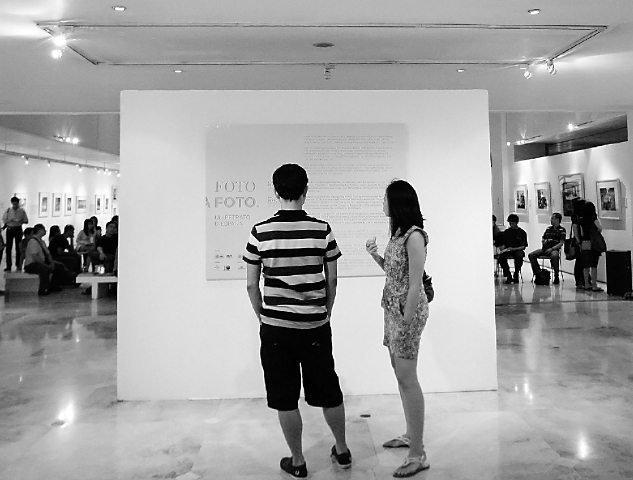
Photography… has become the most prevalent medium in contemporary art, according to Pulitzer-prize winning writer Ferdinand Protzman in his book “Landscape: Photographs of time and place.” Recognizing this trend, the Spanish embassy found it appropriate to bring the works of 15 Spanish photographers to Manila for the 150th birth anniversary of Philippine national hero Jóse Rizal. ”Photo a Photo. A portrait of Spain is a visual journey that depicts the evolution of Spanish cities and their inhabitants from the fifties until the present day, focusing on the two cities where Rizal lived and studied: Madrid and Barcelona,” according to the Embassy of Spain in Manila and The Metropolitan Museum in a joint statement.
Photo a Photo. A portrait of Spain takes viewers on a visual journey to the two cities where Rizal lived and studied: Madrid and Barcelona. Vic Sollorano
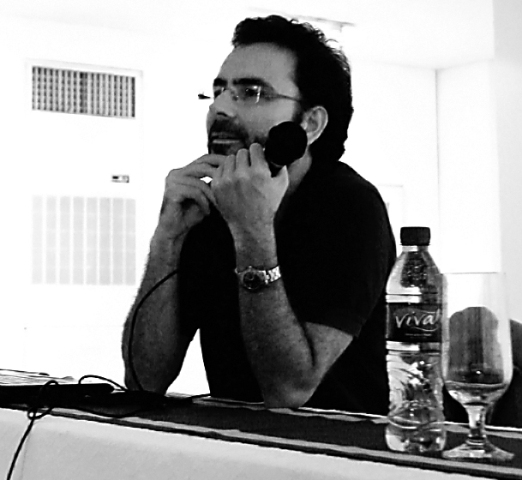
Jose Maria Fons Guardiola, cultural manager of Instituto Cervantes in Manila, told GMA News Online, “photography is an artistic expression and art form just like painting, film or cinema.” One of the highlights of the exhibition was a lecture on photography, Encuentros en la fotografia: Txema Salvans, Basado en hechos reales, at The Metropolitan Museum. Salvans is a documentary photographer who describes his relationship with photography as something akin to, or a matter of, life and death. “If I didn’t take photos, I would die.” In practicing the medium and the art, his urban reportage “surprises the viewer with innovative images taken with the precision of a surgeon from the day-to-day that would have difficulty in interesting us if it weren’t for his gaze,” according to the Foto a Foto catalog.
Documentary photographer Txema Salvans says, “If I didn’t take photos, I would die.” Vic Sollorano
His technique borders on the spontaneous, spur-of-moment snapshots that have nothing to do with commercialism. “I am more concerned with the setting, the landscape… waiting for a character to pop out,” he said in response to a query from GMA News Online during his Dec. 3 lecture. It is in the same light that American photographer Robert Frank approaches photography. “Only in the way he shot his pictures did Frank depart from the reflective, deliberate methods…” writer Fred Ritchin said in The New History of Photography. “When taking pictures, Frank depended on unpremeditated, unmediated instinct to such an extent that he did not even put the camera to his eye,” Ritchin added. The difference between Frank and Salvans is that the Spaniard shoots with a large format camera on a tripod. But the type of equipment is not the point of the medium, Salvans noted. “If you ask me, I can take pictures with a cell phone, or with a bigger camera, or what have you… provided it is the… thing that I want to do.” At the end of the day, Salvans says, there is no single piece of equipment that one needs all the time. “I think you should use the camera you’re comfortable with, that is appropriate for the job or the work you are going to do.”
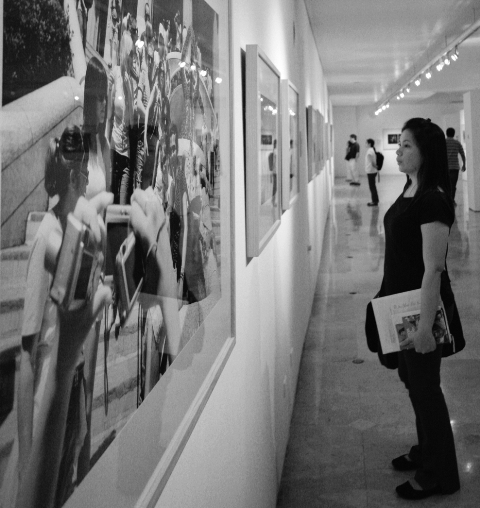
The jumble of digital cameras echoes the jumble of people in Group of Tourists in Gaudi’s Güell Park, Barcelona, 2009 by Txema Salvans. Vic Sollorano
The foreground to his Group of Tourists in Gaudi’s Güell Park, Barcelona, 2009 is a pair of hands holding three compact digital cameras. Now hanging on a wall of The Metropolitan Museum, Group of Tourists in Gaudi’s Güell Park thrives on the skewed perspective so natural to how a camera renders an image — seemingly — in a haphazard way. The background of skewed concrete columns and the equally skewed people reflect the shapes and patterns that give the image its artistic value, while the jumble of cameras echoes the jumble of people that serve as both subject and foreground. The innovative spirit of Group of Tourists in Gaudi’s Güell Park, and thus that of Salvans, speaks of what makes photography and photographs, by the interaction among shapes and patterns within a two-dimensional substrate, magical. It also reflects on the historical perspective of photography. “Photography’s origins placed it in the same sphere as magic and illusion…” Jean Sagne wrote in “The New History of Photography.” “It also encouraged every type of escapism,” according to Sagne. ” From one establishment to the next, photography revealed the path along which clients could move from the secular world they inhabited to the sacred world of representation without even realizing it.” - YA, GMA NewsPhoto a Photo. A portrait of Spain is on display at The Metropolitan Museum’s Tall Galleries until Jan. 7, 2012. The works included are those of Israel Ariño Jóse Manuel Ballester, Jordi Bernardó, Juan Manuel Castro Prieto, Francesc Català-Rocas, Alberto Garcia-Alix, Gonzalo Juanes, Fernando Manso, Ángel Marcos, Ramón Masats, Juan Millás, José Manuel Navia, Txema Salvans, Marta Soul, and Miguel Trillo.


 GMA Brandtalk
 Tracking
 Archives