

 GMA Brandtalk
 Tracking
 Archives

ADVERTISEMENT
Filtered By: Lifestyle
Lifestyle
Art review: Amanda Heng, artist
+
Make this your preferred source to get more updates from this publisher on Google.
There is reason that I sit on certain exhibits, some longer than others, and this is never a question of whether the work is good or bad, as it is about how it resonates with me, usually how painful it was to see. Of course there’s also this: when you see too much art, the tendency is to fail tremendously at dealing with all of them, happening as they do at the same time.
So there are exhibits that pass me by. And then there are those that I find I cannot stay away from, ones that I cannot get out of my head, but remain difficult to write about because of how large they are in my head.
This is the work of Amanda Heng, Singaporean artist, exhibited in a retrospective at the Singapore Art Museum (SAM)@8Q at the end of last year. “Speak To Me, Walk With Me” cut across all three floors of SAM@8Q, brought me to tears in some parts, just forced me into melancholia in others, and in the end proved none of these reactions actually do justice to the breadth and scope of the work that is here.
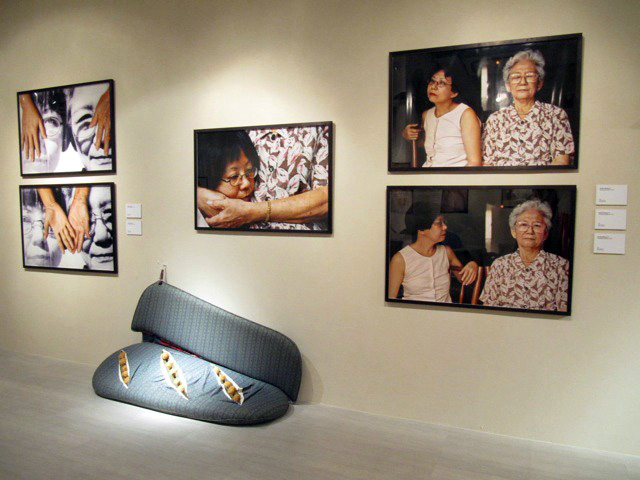
"Another Woman" chronicles intimacy with one's mother, with one's own self.
And yes to the extent that a retrospective is about a reckoning of sorts, one can only speak of scope in terms of the two decades worth of Heng’s work. When I speak of breadth, I mean her work cutting across installations to performances to photography, all conceptual and demanding that spectatorship be about literal (versus figurative) engagement. But too it seems that now when I speak of both breadth and scope I also speak of depth, of the visceral reaction to the work at the moment of seeing it, but more importantly of how it resonates so many months after, distance notwithstanding.
Because you begin with the installations for Singirl, an anti-homage to the Singaporean Girl, the cabin crew imagined in the 1970s by Singapore Airlines, a trademark for nation that can only be a stereotype for the Singaporean woman. That Heng works against this stereotype would seem, uh, stereotypical, except that she brings it to levels that are unexpected. For “Singirl – Objects 1, 2, 3” the batik Singirl outfit is installed as interwoven with the military uniform that is its counterpoint for Singaporean men. For the new series entitled “Singirl Revisits,” Heng appears in the batik costume, with a huge smile on her face, in a series of photographs where she seems mis-/dis-placed in spaces that have been lost to or deemed false by the task and acts of development that the State celebrates. As counterpoint there is a life-size photo installation entitled “Singirl in Lorong Buangkok,” a homage to one of the last kampongs or traditional communities in Singapore.
In the video of her own performance of Singirl, a repetitive act in a public space denies precisely the notion of subservience that is intrinsic to the stereotype that the batik costume carries. Across her Singirl works, the spectator’s engagement is heightened by the absurdity of performing what the costume requires, in spaces where it is unexpected. More than an anti-homage, it seems like a meta-imagination of the 1970s Singirl—a real girl in and by itself, stereotypes and expectations notwithstanding.
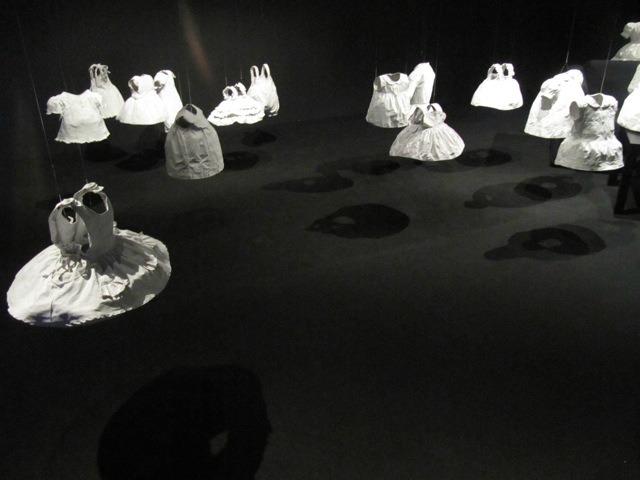
Eerie whimsy in a memorial for female victims of infanticide in "Missing"
The latter two also necessarily echo in work that is about family, and in “Another Woman” the normalcy of both stereotype and expectation, the fact that it happens within the most basic unit of community, is what Heng works with and against. That this happens in relation and in direct contrast to her mother is what allows for this room with disparate objects—from installations of objects found in the home to photographs with her mother on the wall—to ironically become a space of belonging. Female spectatorship renders the bodies and faces and situations here familiar, if not a bond that we share on some level, in some form as women. That the visceral reaction is one that traverses nostalgia to reminiscence, one’s childhood to womanhood, like a rundown of memories extraneous but particularly tied down to these images not mine, was eerily beautiful.
That these happen on the level of the body, naked beyond the literal, is part of Heng’s work’s power: we are unified by skin, bound by embraces, one in the knowledge of love in our hands. That this body is always oppressed by standards that keep it hidden and dressed, that render it useful only when it is in the act of service in the home and the roles we play, is what can only be rendered impotent by photos of nakedness. On videos across the exhibit, Heng is also necessarily performing on and with and against her body, and the oppressions it represents: from standards of beauty (“Yours Truly, My Body”), to being seen as a woman artist (“S/HE”), to tracing her family’s history (“Narrating Bodies”). But also she insists that she is artist period, beyond gender and sexuality, and within nation in the series of “Let’s Walk.”
That what resonates is womanhood though, that what stays is a sense of Heng’s brave portrayals of body and artistry, of art making as performance not just because the artist literally performs, but because her participatory installations are difficult to ignore. More than just being spectator, you become active participant even as you might only be teary-eyed and nostalgic, but even more so as you are enjoined to engage with a room filled with videos, or an installation of tables on which the community that’s made real by the task of cooking and conversation is rendered true (“Let’s Chat”), or in a whole bathroom setup with a videoke machine blaring standard pop tunes as reminder of the contradictions between private and public performance (“Bathroom Karaoke”).
By the time I walked through the room for and of WW2’s dead in “I Remember” involvement could only be default, the performance mine traversing as I did that room with the forgotten. But it would be the smaller room, painted stark black, with bright white papier mâché baby girl dresses that would bring me to tears. A memorial for victims of infanticide against female babies given the preference for male heirs, the eeriness of “Missing” is one that’s surprisingly balanced out by the whimsy of dresses, the happiness they stand for, and the loss of one that was never had.

A life-size photo installation entitled “Singirl in Lorong Buangkok” is a homage to one of the last kampongs or traditional communities in Singapore.
And here really is how Heng’s work resonates. It is memory you have yet to have, forgetting you have yet to do. It is you as woman, as Asian, as creative spirit. But also it is just you as citizen of nation, one that is wont to oppression, that lives off of stereotypes and limitations, that demands so much more even as it deems us so much less than what we actually are. In that sense Heng’s nation is mine, I am her. There is no refusing that. –KG, GMA News
Amanda Heng’s "Speak With Me, Walk With Me" ran at the Singapore Art Museum@8Q in the last quarter of last year to Jan. 1, 2012. Katrina Stuart Santiago writes the essay in its various permutations, from pop culture criticism to art reviews, scholarly papers to creative non-fiction, all always and necessarily bound by Third World Philippines, its tragedies and successes, even more so its silences. She blogs at http://www.radikalchick.com. The views expressed in this article are solely her own.

