

 GMA Brandtalk
 Tracking
 Archives

ADVERTISEMENT
Filtered By: Lifestyle
Lifestyle
Movie review: The ascent of game science in 'Moneyball'
What makes a sport? In baseball it’s the gestalt of patience and swagger, a coiled energy that waits to explode into the craved for home run. Score enough home runs and you beat the other team.
That said, the plot of this movie is simple: a perennially loser team uses statistical science and averages to break down each aspect of the ball game into algorithmic components to win.
Does that sound especially complex? It’s really not. The key word here is “specialization.” Like in an old school assembly line someone cuts the metal to manufacture the gear, someone cleans it, and someone else connects it to a cog, and voila, before long you have a car. Example: this guy is best at throwing curveballs so you need to pit him against someone with a weakness for it, and so on for each iteration. That kind of insight is on the money, get it? That’s what the term “money ball” means.
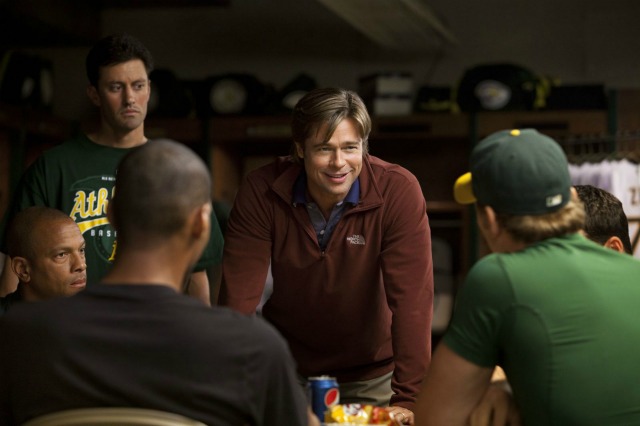
'Moneyball' is about a perennially loser team who uses statistical science and averages to break down each aspect of the ball game into algorithmic components to win.
Based on a true story and in turn based on the similarly-titled 2003 book by Michael Lewis, “Moneyball” is about Billy Beane (Brad Pitt) who was once a young, would-be baseball superstar but washed out early. He choked after being headhunted by a major league team. Stung by his failure to live up to expectations, he instead turned his energies to management.
He’s the current General Manager of the small-market team, the Oakland A’s, and right now the team is in a rut. It’s heading into the 2002 season and Beane faces the renewed loss of their star players again to other big-market teams and their astronomical salaries. How to rebuild his team with a third of the big-market payroll?
Beane recruits Peter Brand (Jonah Hill) after he meets him at a power meeting where managers shop for players to trade. Brand, a number-crunching, Yale-educated economist nerd who’s obsessed with baseball, confesses to being dissatisfied as to how the game is handled by the powers that be.
Sensing a kindred spirit, Beane hires him and together they take on the system by challenging the fundamentals of the game using the oft-dismissed theories of Bill James. He then hires his new players based on said theories.
Having collected a ragtag team that everybody else passed up on (because this player was drinking too much or that player is too old), they start to execute their strategy, armed with computer driven statistical analysis long ignored by the establishment. Against them are arrayed their own team scouts and even the field manager Art Howe (played by Philip Seymour Hoffman).

Beane (Brad Pitt) recruits Peter Brand (Jonah Hill), a number-crunching, Yale-educated economist nerd who’s obsessed with baseball.
Baseball, misfits, and algorithms
There are two very niche things this movie has working against it: that it’s about baseball (an American a sport as you can get, like the UK has cricket) and that it’s about how misfits used statistics and algorithms to beat the essential human ecology of the game. And if you’ve ever seen a baseball game you’ll know it’s an incredibly slow burn sport. For many—and this is especially true of outsiders like me who scratch their heads at all the hoopla—it can be astoundingly, magnificently boring.
The drama of the movie is of such an art house nature that the pacing mimics a ball game going badly. You can feel how much pressure Beane and Brand are under and aptly ache for a payoff, but when it does come, things slack off again before you can even relax. There is a mosaic of ideas being presented here but the understatement of it all leads me only to confusion.
“[Billy Beane] realized that the A’s simply couldn’t fight the way the other guys might fight,” Pitt explained in the production notes. “They had to look for new knowledge, they had to question all the norms and find the inefficiencies in the way things were being done. They began with this seemingly naïve question: what if we were starting this game from scratch today, how would we do it? Where would we place value on the players? Then they went out and actually found these guys who were being overlooked and put together, in a patchwork, a formidable team.”
Still, this is a movie about how to fight for ideas, and screenwriters Steven Zaillian and Aaron Sorkin put that to the surface effectively, except that it all fails to cohere on screen. Don’t get me wrong. Pitt was right in the pocket as the struggling and eccentric Beane, and Hill actually plays well against his character, but there’s only so much actors can do to transmit such complex concepts into drama.

Pitt was right in the pocket as the struggling and eccentric Beane.
I mean, this is the territory between science, coaching and physical athleticism that might as well be viewed as black science by the veterans behind the scenes. I think the adaptation caliber here isn’t in question, but how much the directorial voice (of Bennett Miller) took everything into consideration and said “I want to go this way.”
For a movie of its length, the denouement isn’t quite satisfying after sitting through a sluggish plot, but I’m sure baseball fans will hail it as a benchmark of when the sport learned to capitalize on the benefits of new tech. Did the Oakland A’s finally win using their system? A cursory Google search will tell you: yes, and in spectacular fashion at that, but I’ll leave the other surprises for your theatrical viewing delight.
As a corollary, from that point of view you can see how this movie is really about resistance to change and how mean Beane and Brand fought against it and won a victory to show others that there’s a third option, a way not yet taken.
So go see it if you’re into sports or math, otherwise there’s little else going for it that can be pushed onto the mainstream public. –KG, GMA News
"Moneyball" opens March 7 in all major Metro Manila theaters. All photos courtesy of Columbia Pictures

