

 GMA Brandtalk
 Tracking
 Archives

ADVERTISEMENT
Filtered By: Lifestyle
Lifestyle
Triple axe threat: Pinoy guitarists on heavy music
+
Make this your preferred source to get more updates from this publisher on Google.
Pinoys love rock and roll. As much as we fawn over solo artists, adult contemporary songwriters and biriteras, there’s a huge demographic whose tastes were weaned on the music of Juan De la Cruz Band, Maria Cafra, and The Downbeats. The slew of groups that those progenitors influenced are now ripping up stages with guitar driven music, and those bands are also heir to the sons and daughters of said fans.
As rock made its aggressive expansion into heavy metal, the guitar morphed from an instrument to party to, to a genuine weapon of mass sonic destruction.
Joey Dizon (Intolerant), Mico Ong (Fuseboxx), and Eight Toleran (Franco/Quezo) are three of the leading guitarists of Pinoy heavy music, and their riffs and shreds have taken local audiences to heights of sonic belligerence heretofore unknown, motivating them to the ritual of the circle pit and the synchronic headbang. They’re also really big guitar geeks.
In early 2012, ESP and LTD (the budget series brand) guitars chose them as the first Pinoy endorsers for their instruments of mayhem. Here we talk to them about their love for the instrument.
PAOLO "EIGHT" TOLERAN (FRANCO, QUEZO)
Wiry, heavily tattooed and with long hair set loose when he plays, Eight (or Otso) moves with the quintessential swagger of an old school rock star on stage. He remembers the late 1970s, when he was barely a teen, the times his mother would have relatives over to hang out at their house and play rock records of the day like Led Zeppelin, Jimi Hendrix and Deep Purple in ye good ole LP format.
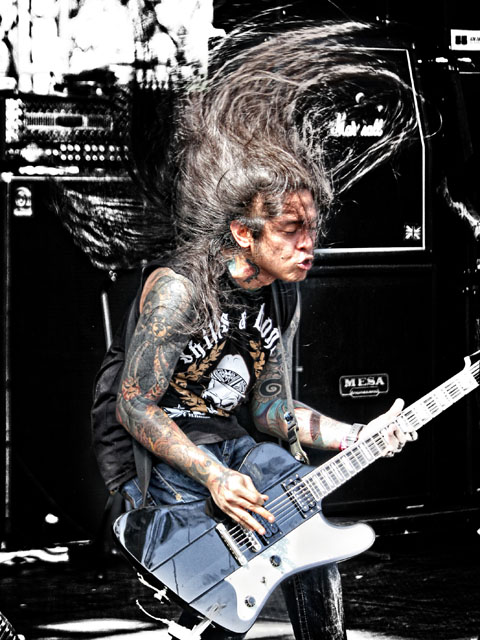
Eight Toleran of Franco and Quezo moves with the quintessential swagger of an old school rock star onstage. Photo by LittleJohn Villamor
Those Jimmy Page and Richie Blackmore riffs must have made a big impression on him. You can still find a lick or two from his idols in the guitar work he does for the alternative roots rock of the incredibly popular Franco, and the nu metal attack of Quezo.
“A short time after that,” he explains with candor, “somehow meth got thrown into the mix and everything around me just went haywire real quick. I guess I was in for the ride as well. It forces you to revert to your own made up 'happy place.’”
And his happy place for him was playing the guitar. It was, he explains, “[a] great distraction from all the crazy stuff that was happening around me at the time.”
Did you learn your instrument the traditional way, with a mentor?
EIGHT: I tried to learn all the technical terms, chords, scales and all, but I guess I just gave up in the middle of it as soon as I figured out I couldn’t control my pinkie finger as well as the rest. As long as all the knobs work and I can tweak the gain up just right, I’m fine.
I notice you have a very low guitar stance, is it harder to play like that?
EIGHT: I’ve always played in a weird angle, with my guitar slung lower than usual. I’ve always had to deal with little things I thought were common since I opted for the cooler stance.
You bought your first expensive, high-end guitar before you bagged your endorsement deal as a pro, right?
EIGHT: I forced my way into that endorsement! [Laughs] Just thinking that a few Pinoys have made it into the ESP roster is enough to make me proud of my heritage. I mean, who gets free guitars besides snooty brats who want to act cool?! I’ve always drooled over ESP [guitars], seeing them in magazines held by young legends at the time. I always figured they were the future.
What’s the secret behind your killer riffs?
EIGHT: I’ve always been more percussive than melodic with my approach. So it all starts with a beat or a groove that’s stuck in my head. Then I just try to chunk a bunch of tones together while keeping a certain groove in mind. I’ve always looked up to a lot of musicians, not just guitar players mainly. Hard work just comes with it when you’re driven. And we all know that it all comes down to who worked the hardest at the end of the day.
JOEY DIZON (INTOLERANT, SKYCHURCH)
When you see him onstage, Joey Dizon is bald, menacing and large as a safe. His physical presence and size interlaces effectively with the heavy, aggressive riffs that he plays in both bands he’s in: the metal and hardcore fused Intolerant, and the straight up groove and technical metal of Skychurch (a group complimented by ex-Metallica bassist Jason Newsted when he was in Manila).
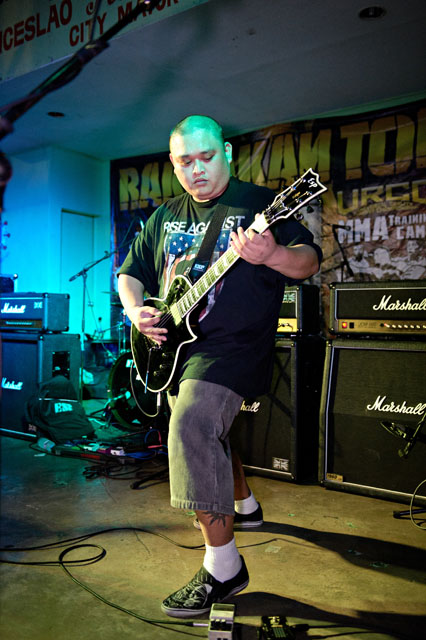
Joey Dizon of Intolerant and SkyChurch thinks guitar players should really be judged by how well they can convey emotions. Photo by Mark Terence Sy
Offstage, Joey is calmly jovial, well-mannered and soft spoken. He thinks that guitar players should really be judged by how well they can convey emotions rather than just pure technical chops.
“As much as shredding is always entertaining for me to watch and blows my mind,” he shrugs, “it’s just one side of guitar playing. So I do like really angst-driven players who aren’t necessarily shredders like Billy Corgan, a lot of punk, hardcore musicians, and players who genuinely have an over-the-top love for the instrument like the late, great Dimebag Darrell.”
Did you have a love affair with your instrument from the start?
JOEY: I guess it started with my love for heavy music. But when I got into Metallica, I immediately lost it and took my guitar playing seriously: everything about the guitar playing and sound and technique was over the top and, to this day, I look up to players like James Hetfield and Kirk Hammett.
How do you get that very chunky, very vicious tone you have on your records and live gigs?
JOEY: After years of trial and error, I prefer plugging in direct to the amp and using the amp’s distortion. I find that there are simpler, more effective ways to achieve aggressive tone: the attack of your right hand, the quality of your guitar’s wood, the pickups. I’m a fan of that big, chunk and not too processed guitar sound, so I really like pushing the volume knob instead of the gain knob. I mean, decades ago they didn’t even have a gain knob on amps: musicians just cranked it hard!
Any specific way you use your choice of weapon?
JOEY: Usually, coming up with riffs starts with a pretty basic urge to just hold the guitar and hear how it sounds; I don’t even rehearse or do warm-ups properly. I just like holding the instrument. I chose the ESP Eclipse FR-II because the versatility of the instrument is perfect. For the past few years, I’ve been playing directly through amps. No detuning, no fancy effects.
Tell us about your writing process.
JOEY: I find that a lot of the riffs that I came up with on our first album [2010’s “Reasons for Unrest”] that made it onto the record were during times when my mind was blank, and when I didn’t consciously try to come up with them. It’s weird.
MICO ONG (FUSEBOXX)
Mico, who does guitar duties for Fuseboxx, plays an incredibly technical genre called prog (progressive) metal alongside classically trained bandmates who make mincemeat out of 16th note bursts. He also looks like a choir boy on an off day and carries with him an aura of total nice guy.
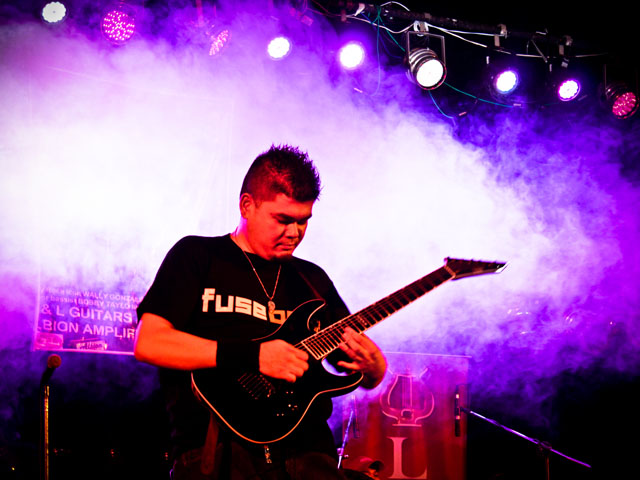
Mico Ong of Fuseboxx initially never wanted to play guitar, but changed his mind after being blown away by "Stairway to Heaven." Photo by Mark Vincent Villa
Timid, tall and on a perennial even keel, Mico explains that he initially never wanted to play guitar, even finding his first foray into formal lessons a stupendous bore. He did eventually learn to love it after being blown away by “Stairway to Heaven.”
“I can't call it a love affair,” says Mico. “It was more of: instruments were either expensive or noisy. I wanted drums or a saxophone. But my mom insisted that I play guitar. She had this beat-up nylon string. I had no idea how to use it.”
Eventually, he got himself some high-caliber mentors and overcame his initial reluctance with the instrument by disciplined self-study. “[But] I don't like the guitar up to now!” he laughs.
You stopped training after being under various guitar teachers. Why?
MICO: I took guitar lessons again in Yamaha in Galleria under the wing of Benj Zialciata, then at RJAM under Jun Mesina. They were awesome teachers! I wish I’d continued and really took things seriously, but me being lazy, I stopped and did things on my own. I went through guitar magazines, tablature, studied by ear, but never really figured out how my guitar idols ticked.
I hear you carry two guitars to gigs?
MICO: I use two guitars because of their versatility: my ESP Horizon NT and my LTD H1007FR. Why these types? I use the H1007FR for the heavier side and the Horizon for all genres. These guitars sing. I could actually call them the yin and yang of guitars.
A lot of guitarists are obsessed with the holy grail of tone.
MICO: I guess my obsession with tone is 50/50. I care about it and don't care about it. I only start to care when I know I go to a venue and the gear is not up to par. In all honesty, we guitar players have a hard time because of the many variables affecting how we sound: venue, amps, attitude. We just complain a lot!
Complaints and guitarists do go hand in hand. But does the presence of good tone affects your songwriting? MICO: In all honesty, we guitar players… we just complain a lot! [Laughs] We don’t like this, we don’t like that, the sound is not working for me, and a lot of excuses. We have lots of excuses and complaints. We may have a tone preference, but we have to always make sure it fits the situation. –KG, GMA News

