

 GMA Brandtalk
 Tracking
 Archives

ADVERTISEMENT
Filtered By: Lifestyle
Lifestyle
Spotlight on Cebu's newest treasure: the Cebu polyhemp fabric
+
Make this your preferred source to get more updates from this publisher on Google.
Fashion has always been used as an alternative vehicle to draw attention, create awareness, or get a message across to an intended audience.
With this idea in mind, the Provincial Government of Cebu, the Mandaue Chamber of Commerce and Industry (MCCI), and the private cause-oriented group ANTHILL (Alternative Nest and Trading/Training Hub for Ingenious/Indigenous Little Livelihood Seekers) chose a fashion show as their opening salvo to introduce Cebu’s newest treasure, a fabric called the Cebu polyhemp, to draw attention to the history and tradition that is intertwined with it. 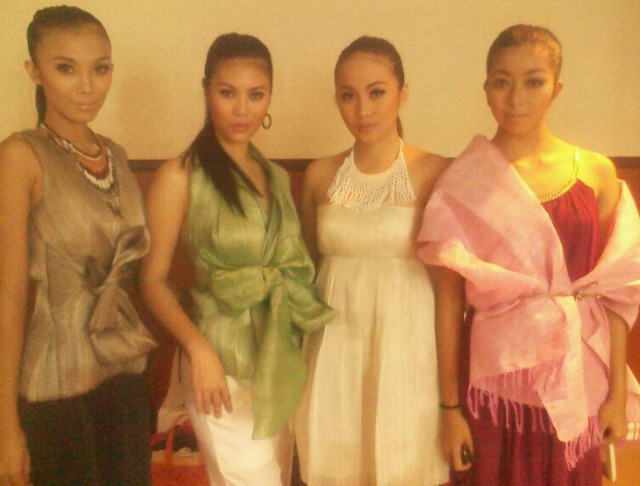
Cebu designer Vania Romoff used the traditional Cebu polyhemp in producing these contemporary women's wear. Photo courtesy of ANTHILL Fabric Gallery
Last August 3, at the One Cebu Expo held at the Cebu International Convention Center, Cebu province’s most prominent personalities gathered for a fashion show that showcased the use of Cebu polyhemp.
ANTHILL chose acclaimed young designer and Cebuano pride, Vania Romoff, to come up with a collection that exhibits a contemporary approach to a traditional material.
Romoff created modern women’s wear using the Cebu polyhemp. The pieces were done in classic patterns but with certain twists like oversized ribbons and unusual folds to make them trendy.
“I am always quick to jump to projects like this. It is my little way of contributing to the cause and giving back to my province,” she told GMA News Online.
The show impressed members of the audience who saw the fabric for the first time. One was overheard saying, “I never thought we had this in Cebu.”
The discovery of the Cebu polyhemp came by accident. Annie Lim, co-founder and CEO of ANTHILL, was in southern Cebu for business and stumbled upon a small community of weavers in Dalaguete and Argao. Her interest piqued, Lim sought the weavers and began her initial stage of research.
“In these rural communities, their livelihood and skills are not getting any support or market access, causing the industry to die,” Lim said. “When this industry dies, the technique, the history, the culture that was passed on by their ancestors dies with it.”
This prompted Lim and her daughter Anya to take on a more proactive role in the preservation, awareness and marketing of the Cebu polyhemp. Being founders of ANTHILL, a fabric gallery featuring textiles sourced from all over Asia and Philippine tribes, it was natural for the mother-daughter tandem to give extra love to a fabric found in their own province.
The provincial government and MCCI were quick to come on board for this common cause.
“There are other polyhemp fabrics in the country. What makes the Cebu polyhemp different is its texture, the way it stands, and most importantly, the signature weave of our elders,” explained Lim.
The Cebu polyhemp was a cottage industry, with its patrons limited only to the community, but now, with their efforts, the textile will be commercially available.
Proceeds will support the Dalaguete and Argao weavers, who are hoping they can sustain the craft and pass it on to their young.
“We aim to create awareness first locally among the Cebuanos then to the rest of the Philippines about the existence of this thriving industry before the rise of industrialization. We hope for market interest and support. We aim to awaken and stimulate the interest of women especially among the younger generation to learn the skill, embrace their culture, identify with the tradition and hopefully pass it on with enthusiasm and deep appreciation,” ANTHILL said in a statement. –KG, GMA News
The Cebu polyhemp is available at www.anthillfabricgallery.com.
Photo courtesy of ANTHILL Fabric Gallery

