

 GMA Brandtalk
 Tracking
 Archives

ADVERTISEMENT
Filtered By: Lifestyle
Lifestyle
Kidlat Tahimik says 'straying on track' led to Fukuoka Prize
For Kidlat Tahimik, his life choices have been as unconventional as his name. With an MBA from the University of Pennsylvania's Wharton School of Business, he could have been Eric de Guia, businessman. Instead, he became Kidlat Tahimik—filmmaker, installation/performance artist, and culture observer.
In his own words, "when Kidlat Tahimik tore up his MBA diploma—to change horses—and instead ride on his artistic strengths. Jumping out of his MBA cocoon occupied by “Wall Street” dreams, Kidlat was reborn—with a new freedom."
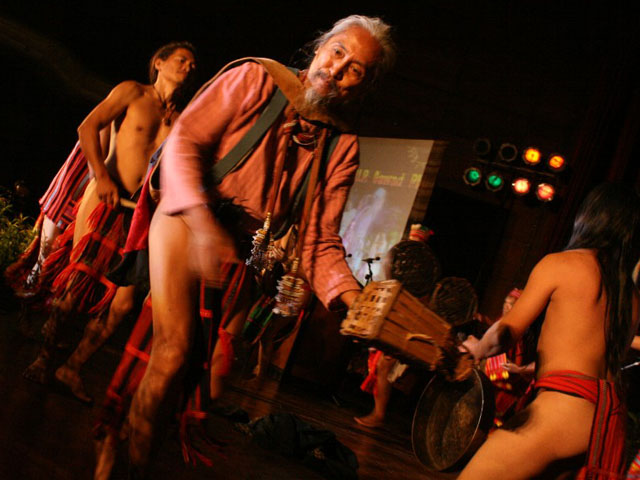
Multi-awarded Kidlat Tahimik shares the essence of the indi-genius perspective, and invites filmakers to use it as a lens. File photo by Roehl Niño Bautista, GMA News
This big life detour is just one of many that the artist credits with having brought him to where he is today. The Fukuoka 2012 Arts and Culture laureate has an impressive curriculum vitae, but the Baguio-born artist says he was nominated for the award because of "cosmic meanderings" that aren't mentioned in his CV.
"I wish to believe that this prestigious award—the Fukuoka Prize—is given to Kidlat Tahimik, because of his parallel engagements in the modern and the ancient worlds—not necessarily because of a 'solid career' in some specialized niche," he said in his acceptance remarks during a press conference at the Cultural Center of the Philippines on August 8, a copy of which was sent to GMA News Online.
According to Kidlat Tahimik, the achievement milestones in his career track were career moves which many could have achieved. He recalled showing his rough edited film “Perfumed Nightmare” to accomplished German independent filmmaker Wener Herzog, who told him, "Ahhh, Kidlat, you are best in your detours."
"Inadvertently my CV does not mention my life detours. And yet I firmly believe I was nominated for this honor—because KT had followed cosmic detours in his life-flow—which steered away from any fixed-track career track. Such cosmic meanderings have brought me to where I am today. In Filipino words— 'sumabay sa ibang daloy.' Took a different flow. Or sometimes even counter-flowed!" he said.
Apart from turning his back on his master's degree in business administration, another detour he mentioned was his choice "to steer clear of the Sex/Violence-for-Profit formulas emulated by Hollywood wannabes... daring to work three decades on one film."
His art was just one of the ways he went against the flow.
"Another U-turn, during his 50th year on this planet, KT detoured from the city of his bourgeois childhood, to stray on track—read my lips: to STRAY ON TRACK—opting to live with Ifugaos in PatPat village to learn their ancient tribal wisdom," the filmmaker said.
Indi-genius
Kidlat Tahimik, who has taught at San Francisco State University, and with the Baguio Arts Guild which he co-founded in 1986, shared his advice to university students and indie filmmaker friends: "make your graduation films with our indi-genius lenses."
"My best friend, an Ifugao woodcarver-philosopher, is endowed with ancient tribal eco-wisdom. In his non-Oxford-English accent, he always mispronounced the word ‘indigenous.’ He talked of the ‘dignity of our indi-genius tribe.’ Often he lamented the pejorative attitude of westernized Filipinos ‘looking down on our indi-genius culture.’ Wow! A cosmic mispronunciation! An Ifugao elder had combined the “genius” of Ifugao civilization with ‘indigenous’ into one word: Indi-genius," he said.
In his acceptance remarks, Kidlat Tahimik acknowledged his mentor and indi-genius brother Lopes Nauyac from PatPat village in Ifugao, and his wife Katrin.
"Lopes Nauyac has validated Kidlat Tahimik’s grand detours with his indi-genius wisdom. May I acknowledge a major force behind my Fukuoka Prize today. As well another influence, my wife Katrin, whose German frame of our indigenous psychology in her PhD studies—mirrored to me what I took for granted," he said.
He said our education system, designed by colonial framers, buries indi-genius values under Western efficiency-is-god values.
"Even six decades ago, as an elementary kid, what I was learning at school was not feeling right—di mapakali ako. It seemed at the expense of a relevant precious knowledge—a learning less-oriented towards competition, but kapwa sharing. It was lacking a holistic orientation toward my kapwa community, to my kapwa family, and why not—to my kapwa trees/animals, to my kapwa rivers/forests?" he said.
He said it was through making “Perfumed Nightmare” that he "began to decode what he was shedding while learning to become an ideal globalized-citizen."
"The Ifugao shaman’s commonsense eco-wisdom made more sense than the Eco101 teacher who quantified board-feet value of trees," he said.
Kidlat Tahimik said the way indi-genius elders trust in the cosmos when solving problems—the "Bathala na!" attitude—resonated with something he knew was in his innermost being. And so, after his film debut in Berlin, he and his wife decided to leave Munich and return to Baguio. Despite economic temptations from winning awards, he said the move would perhaps give their firstborn a chance to absorb indi-genius education.
"The German filmmaker had a parting word for me: 'Ahhh Kidlat, you can never be a good Bavarian director…' Was he disparaging me, a neophyte filmmaker? Years later, those words became clearer: don’t try to imitate your mentor or your idol. Don't waste your time trying to be an 'American Idol' filmmaker. It was a signal to allow my artist’s best—to bloom within my own cultural turf. It was time to fertilize the indi-genius at home," he said.
He explained that the bamboo cameras in his art installation "BambooCams" are metaphors for local artists to tell the local story. "Whether we are filmmakers, painters, writers or,
yes, gatekeepers of the news—we should not let the box-office formula—patok-sa-takilya—drown out our cultural values. There is so much to tap in our indi-genius watertable of ancestral knowledge. Why sacrifice kapwa-culture values on the altar of economic efficiency?" he said.
For Kidlat Tahimik, it is because he asks such questions that he was nominated for the award, despite his CV, which he says is not as vital as curriculum vitae would imply.
He said he is accepting the Fukuoka Prize award for Arts and Culture "as a recognition of the importance of reviving the Indi-Genius of our race" and in behalf of his indigenous mentors, and the culture bearer-artists who were present at the Cultural Center of the Philippines "so we further solidify CCP’s encouragement of indi-genius culture—amongst post-modernist trend.
"Let my Fukuoka Prize award honor the Pinoy artists’ straying on track in both worlds," he said. –KG, GMA News

