A sunlit dining room with sweet pastel shades, a pocket garden in the corner. A sleek living room with sliding doors, mood lights, and water cascading down a glass partition. A cozy lanai with a hammock for lazing in. A Tiffany-blue dining room with mirrored walls. At first glance, you wouldn't notice anything out of the ordinary about the spaces featured in the Dibuhong Umaakay exhibit. As expected of an interior design showcase, everything looks carefully planned, from floor to ceiling, color schemes to wall textures. But there's more to these rooms than meets the eye. As the name suggests, each room is designed to assist those who will inhabit it, whether they have difficulty seeing, hearing, or walking. "What we wanted was something that's very socially relevant. We believe that interior design is not only for people who are 'normal,' but interior design should also be attainable to people with disabilities," Pojie Pambid, 2012 batch adviser of the Philippine School of Interior Design told GMA News Online. Pambid said the theme was significant not only for the advanced class who were tasked to interpret it, but for PSID, which is celebrating its 45th year. "We wanted to actually create something that's very atypical [of] what interior designers are accustomed to doing. So I challenged them actually by giving them something that of course hasn't been done before," he said, explaining that the students came up with spaces for different kinds of assisted living. "Iba-iba eh so that they will be able to really use interior design as a means to make the lives of these people comfortable and safe and at the same time, maganda pa rin. We wanted to create that focus na hindi porke't you have a disablity that you cannot have a nice home," he said. The result is Dibuhong Umaakay, which features 23 spaces divided into four main areas.
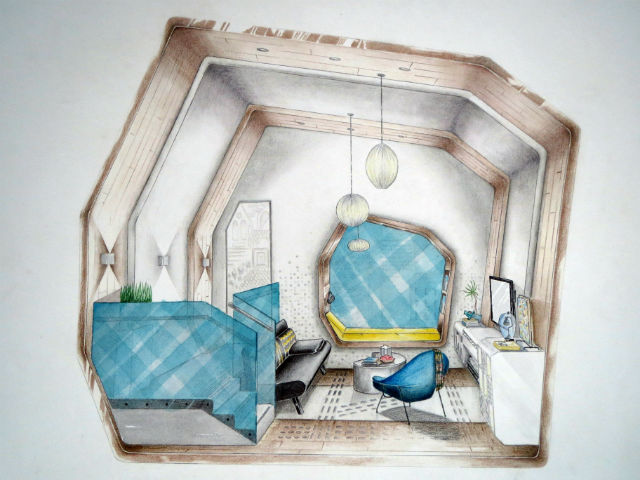
Beyond Sight by Lyka Alarilla, Uzel Alconera, Trency Caga-anan, Coloma Jeditte and Tet Paras
For the visually impaired, "Tanaw" features spaces that focus on texture and sound. In "Beyond Sight," a living room designed for a family with a blind child, the shapes are inspired by tunneling vision. "We wanted to create a seamless organic space for the family," said group member Uzel Alconera. On the walls, Antoine de Saint Exupery's "What is essential is invisible to the eye" is in Braille. The child can also find the way by following the grooves on the floor. In "Midnight Rhapsody," designed for a couple where the husband has low vision, makes use of open spaces to allow maximized mobility. Varying textures also help him locate himself, as well as his things. "Based on our research, blind people use mental mapping, like us. We're so used to our own bedroom that we don't really have to think that much that we won't know where to go. Everything is fixed, the side tables, and the desks, and the accessories are in niches," said group member Alessa Borromea.
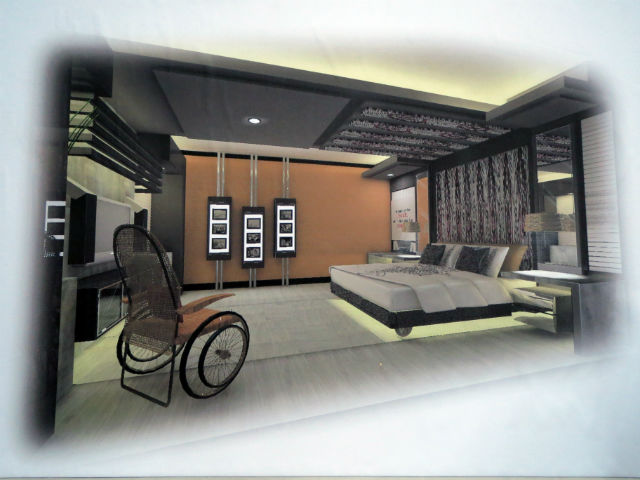
Abot Kamay by Dana Alcaide, Lalaine Almoro, Amanda Brodett and Anita Chan
For the orthopedically challenged, "Tindig" features spaces with handrails, access ramps, and padded furniture — without sacrificing style and ambiance. In "Brave Art," a toilet and bath designed for a paraplegic, a seesaw-inspired bathtub allows him to get in and out by himself. "Once the client transfers to this area and the bathtub is filled with water, this becomes straight. Once water is drained it will incline once again and he will return to his wheelchair," explained group member Kris Ramos. Controls for the bidet, faucet and shower are strategically placed to allow him easy access, and there are grab bars and a horizontal chairlift that the client can also control. In "Abot-Kamay," a bedroom designed for former Pinoy Big Brother housemate Naprey Almario, the theme is inspired by his profession. "He's an IT teacher, so the feel is medyo techie, modern," said Lalaine Almoro. There is ample space for him to maneouver his wheelchair, and a study desk with a drawer that can easily be pulled out. "He's from Davao so we add the tinalak for local element... he likes photography so we made him this picture cabinet, which he can put photos in. Puwede din siyang night light," she said. The doors slide, and the bed can also be pulled away from the wall, so he can change the sheets by himself. For the hearing-impaired, "Dinig" features spaces with alarm systems that light up or vibrate. In "Visu Centric Living Room," designed for a couple where one is deaf, the telephone rings and a light goes on simultaneously, so both can tell when someone is calling. The television is also connected to the Internet, to allow easy video calls. "The layout is a bit different compared to the other layouts because based on our interviews a lot of deaf people prefer to see everything. That's why it's 'Visu Centric,' they're not capable of hearing but they are very visual," said Francesca Tingcungco. She added that their sense of touch is also enhanced, so they incorporated different textures in the design, such as a cowhide rug, and a multi-textured sofa.
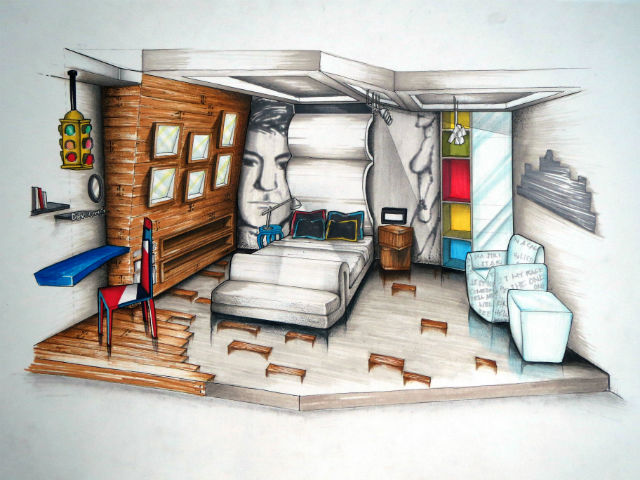
If Walls Could Speak by Charmaine Avena, Asey Ybañez Cantillas, Kc Castillo, Cha Estefano, Julienne Hidalgo and Zarah Lasac
In a cave-inspired design, the floor vibrates when the doorbell rings. In "If Walls Could Speak," a bedroom designed for a deaf artist, the bed is programmed to shake to wake him up instead of an alarm clock. "Pop art yung pinaka theme. So yung stoplights would alert the person, kunwari red, there's someone at the door, yellow, the telephone is ringing, it's color-coded. Instead of just using colored lights, the group decided to incorporate real stoplights so that he will be able to really appreciate the pop art theme of the space," Pambid explained. He added that the design is very tactile, with rough textures allowing the sound to bounce around. "They're very sensitive kasi to echo vibrations. So if you notice, hardwood, and then cement, then concrete so that the sound is contained. And then it creates this acoustic effect," he said. For the elderly, "Galaw" features spaces where lolos and lolas can relax and take care of themselves.
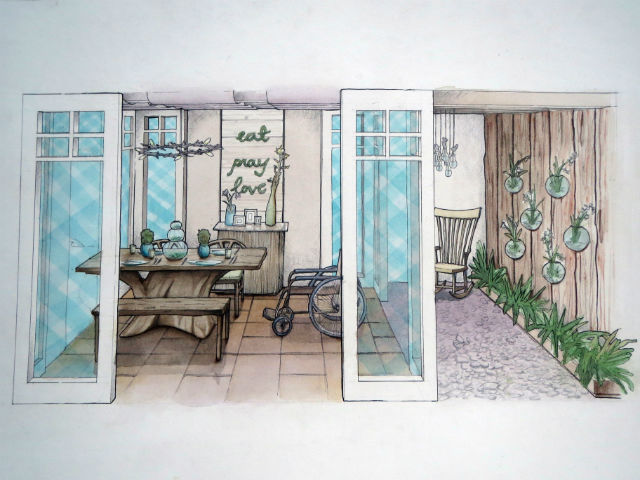
Sweet Escape by Willer Agulan, Sheryl Carlos, Madelaine Hui, Via Pacheco, Kellie Ugaddan and Tina Villegas
In "Sweet Escape," a dining room for an elderly couple on retirement, the group decided to place it in a sun room instead of the normal enclosed walls. "We felt it was important for elderly people to experience enough sunlight and be surrounded by nature. We actually integrated the outdoors indoors," said Tina Villegas, adding that their pocket garden has different medicinal herbs. "We have a lot of DIY projects as well because it's important for them to keep busy," she said, gesturing to the wall decor made of moss, and the chandelier made of branches. In "Diamond in the Rough," a bedroom for an elderly woman, her old gramophone and luggage serve as room accents, and hidden underneath an armchair is a potty. Also hidden on one side of the bed is a handrail, to help her pull herself up when she wakes up. That the students were afraid to tackle the assignment at first, said Pambid, but after researching about the needs of Persons with Disabilities, they were able to meet the challenge. PSID partnered with the National Council for Disability Affairs for the project. "We even had a guest speaker, who happens to be blind, and an architect who happens to be blind, and then he talked about again the advantages of providing good design for people with disabilities," he said. Saying the class was able to adapt and translate what they learned in the designs, Pambid said he was impressed with the research that went into the exhibit."Kasi syempre sabi ko you have to be able to justify. Parang, creatively they're able to translate all these things," he said. Dibuhong Umaakay: an interior design exhibit on assisted living, runs from September 30 to October 31 from 9 a.m. to 5 p.m. at the former Super Sale Club at SM North EDSA.
— BM, GMA News Perspective drawings courtesy of the Philippine School of Interior Design 

 GMA Brandtalk
 Tracking
 Archives


