We use cookies to ensure you get the best browsing experience. By continued use, you agree to our privacy policy and accept our use of such cookies. For further information, click FIND OUT MORE.
Make this your preferred source to get more updates from this publisher on Google.
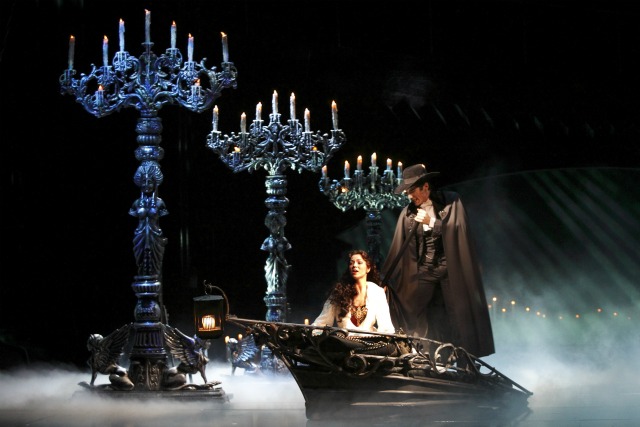
The music of the night: 'Phantom' has enthralled crowds all over the world for nearly 30 years. Press photo
With its timeless, hypnotizing music, a story that keeps an audience on edge, a title character who is perhaps the most fascinating and strangely lovable antihero in musical theater, and a 26-year-strong theater tradition, “The Phantom of the Opera” dazzles audiences, no matter who’s on stage or behind it. That is to say, even a half-baked production of "Phantom" has the potential to astonish, if only for any one of the aforementioned qualities; that is also to say, for a "Phantom" production to be bad it has to be really bad and, conversely, a good production of "Phantom" is always extraordinary. That said, with a beloved classic to perform and so many protective "phans" to appease, there is great pressure for any group attempting to do "Phantom" to at least meet expectations, and in the case of the Really Useful Company’s Manila production of the famous musical, the expectations are as high as they come. Running at the Cultural Center of the Philippines since August 25, so much has been said about the show already, with endless raves from a very satisfied audience flooding Twitter timelines and Facebook feeds every night. The set is genius, these mini-reviews say; the costumes are stunning, the orchestra is flawless. The actors are brilliant, OMG Phantom is amazing, wow, didn’t know the CCP stage could look this good! These are the expectations that the company has to live up to every night, and it exceeds them with a flourish such that those who are fortunate enough to behold the play with their own two eyes understand, in a very real way, why "Phantom" is the longest-running and reportedly most successful musical ever. The set, designed by the late Maria Bjornson, was the first thing that took one’s breath away. Beautiful even with the curtains closed, it wasted no time in recreating the romance of Paris in the early 1900s. And then the curtains were drawn to reveal the prologue: an auction scene at the once-glittering Opera Populaire, with the fallen chandelier smack in the middle of the stage. At the auctioneer’s command, the chandelier was uncovered and illuminated, and the massive gold piece slowly soared to its rightful spot above the stage, beginning the deliberate unfolding of the past right before the audience's very eyes, all done in perfect time to the familiar overture’s crescendos.
Let the spectacle astound you: Breathtaking sets are just part of 'Phantom's' appeal. Press photo
From that moment on, every movement of the set held the audience captive as it revealed itself to be as labyrinthine and inventive as the inner workings of the fictional opera. Every piece of the set functioned to full capacity beyond adding texture and aesthetic value to the production design. For instance, the mirror in Christine’s dressing room served a double purpose, not merely as the glass which separates the young soprano from her angel of music, but also as a Brechtian device to include in the scenes, by way of reflection, the orchestra—conducted then by Stan Tucker—playing flawlessly in the pit. The initial descent into Phantom’s lair made pulses race not only because of the music but also because of the scene's choreography, which made the characters move at a hurried pace. By the time the fog rolls in from the floor and the countless burning candles appear to recreate the opera ghost’s desolate domain, the audience is utterly out of breath. And then of course there was the cast, whose performances made every scene—whether comic, intense, or tender—resonate with delight, fear, frisson, and pathos. Andrea Creighton as the diva Carlotta and Thabiso Masemene as her partner Piangi played their parodical roles with gusto, balancing the darkness of the play with some lighthearted exaggeration. The same can be said for James Borthwick and Jason Ralph, who played the new opera owners, Monsieurs Firmin and Andre, respectively. Rebecca Spencer’s Madame Giry seemed slightly weak when the performance began, but she soon grew into the formidable ballet choreographer that is the Opera Ghost’s messenger—and, come to think of it, only true ally—right in time for the second act where she performs her most important scenes. Cat Lane was sprightly as Meg Giry, and the bounce in her step lent a schoolgirl sort of charm to the character who has come to be known as Christine Daae’s sidekick. Emilie Lynn as Christine hit all the right notes as the conflicted young singer, not only vocally but emotionally. Her only lack, perhaps, was the lukewarm chemistry between her and Anthony Downing’s Raoul, who, barring that, played the role of besotted lover superbly, exuding the dashing hero with each strong stride and powerful solo. Of course, and rightly so, the star of the night was Jonathan Roxmouth, whose portrayal of Phantom managed to evoke compassion as much as fear. Not only was the 25-year-old brilliant, emanating the vibe of an isolated eccentric down to the way he fiddled with his fingers, but he was most importantly a truly talented singer whose voice distilled the Phantom’s ruthlessness to loneliness. During the intermission for one particular show, a woman in the audience who had apparently seen many stagings of Phantom before, remarked that Roxmouth was a talented performer, but she felt that he wasn’t fit for the role—his voice was too gentle, too smooth, not angry enough. But that was exactly what set Roxmouth’s performance apart from the many Phantoms who had come before him. His voice was more lonely than livid, and there was a sad tenderness to it such that the Phantom he brought to life was someone so much easier to fall in love with and root for, thereby heightening his character's—and the play's—conflicting elements of darkness and light, of ugly and beautiful, of good and evil, and highlighting the conflict that arises upon the discovery that all these elements coexist within. In a way, the play mirrors the Phantom himself—dark, tragic, and surviving, thriving, and creeping under your skin by sheer creative genius. — BM, GMA NewsThe Phantom of the Opera is now on its extended run until October 14. For tickets, contact Ticketworld at 891-9999 or log on to www.ticketworld.com.ph.


 GMA Brandtalk
 Tracking
 Archives